

17 Fall Planter Ideas for a Beautiful Seasonal Porch
A couple of good planters can make your porch look ready for fall before you’ve even considered buying a decorative pumpkin.
That’s why I love fall planters. They bring color, height, texture, and actual life to an entrance, and you can make them work whether you have a wide covered porch or barely enough room beside the front door.
You also don’t need to fill every container with bright orange mums. Burgundy foliage, ornamental grasses, kale, evergreen branches, trailing greenery, and earthy neutrals can create an autumn display that feels warm without looking like the seasonal aisle exploded outside.
These fall planter ideas range from classic mums and pumpkins to neutral arrangements and late-season containers. Pick one that suits your porch, your climate, and—rather importantly—the amount of sunlight your plants actually receive.
1. Fill a Terracotta Pot With Burgundy Mums
Let’s start with a combination that almost never disappoints: burgundy mums in aged terracotta.
The deep flowers create beautiful contrast against the warm orange-brown clay, and the whole arrangement feels autumnal without needing extra decoration.
Use one substantial mum rather than several tiny plants if you have a small porch. A single full plant creates more visual impact and keeps the entrance from looking cluttered.
Place the pot beside the front door and add two small cream pumpkins around its base.
That’s enough.
I particularly like burgundy instead of bright yellow here because it feels richer and transitions nicely from early fall into November.
Make sure your planter has adequate drainage, and choose a mum suited to your local conditions.

2. Build a Tall Planter With Ornamental Grass
Tall containers work brilliantly when you want drama without using much floor space.
Start with a compact ornamental grass toward the center or back of a tall planter. Look for a variety appropriate for container growing, your climate, and the mature size you can realistically accommodate.
Then add shorter plants around it.
Burgundy foliage, rust-colored mums, and trailing greenery can create three distinct levels without overcrowding the pot.
I love grasses in autumn because they add movement. A little breeze makes the planter feel much more natural than a rigid arrangement of identical flowers.
Choose a charcoal, warm brown, or dark bronze planter to ground all those softer textures.
And yes, check the mature height before buying. That innocent little nursery pot may secretly dream of becoming landscaping.

3. Mix Ornamental Kale With Mini Pumpkins
Ornamental kale brings big texture without requiring lots of flowers.
Its layered leaves create a sculptural focal point, especially in varieties with green, cream, purple, or dusty rose tones.
Plant one or two kale plants in a medium container, depending on their mature size. Add low greenery around them, then tuck two miniature pumpkins near the front.
Cream pumpkins look particularly good with purple-toned foliage.
This combination works nicely on traditional, farmhouse, and cottage porches, but a clean black planter can make it feel surprisingly modern too.
Just don’t pack the pumpkins tightly against plant crowns or interfere with watering.
Your vegetables—well, decorative relatives of vegetables—still need personal space.

4. Create a Classic Mum and Pumpkin Planter
Sometimes the obvious combination works because it’s genuinely good.
Place a large rust, burgundy, or burnt-orange mum in a substantial planter. Then arrange several pumpkins around the base rather than trying to squeeze them into the soil.
Use different pumpkin sizes and colors for a more relaxed look.
Try one medium orange pumpkin, one smaller cream pumpkin, and a tiny sage-green gourd.
The planter gives you height while the pumpkins create a lower visual layer. Together, they form a complete arrangement with almost no styling gymnastics required.
For a symmetrical front entrance, place one matching planter on either side of the door. For a smaller porch, use just one.
Honestly, one great arrangement often looks better than two cramped ones anyway.

5. Try a Neutral Cream and Sage Fall Planter
Orange isn’t compulsory.
For a softer neutral fall planter, combine cream flowers or foliage, sage-green plants, pale ornamental grass, and one or two white miniature pumpkins.
Choose a warm stone, greige, or terracotta planter rather than bright white. A little warmth prevents the palette from feeling sterile.
Texture becomes especially important when you limit color.
Mix fine grass blades with broad leaves and trailing greenery to create enough variation.
This look works beautifully on porches with brick, dark siding, black doors, or strong wood tones.
I’d also add one subtle brown element, such as dried seed heads, to ground all the pale colors.
The result feels unmistakably autumnal without yelling “PUMPKIN SEASON” from across the street.

6. Make a Rustic Galvanized Fall Planter
A galvanized container can add rustic character without requiring your entire porch to commit to farmhouse decor.
Use a weathered-looking metal planter with proper drainage and fill it with rust mums, olive foliage, and wheat-colored grass.
A few compact dried seed heads can add texture, but secure lightweight materials if wind reaches the porch.
Place a cream pumpkin beside the container to soften the metal.
This arrangement looks particularly good against wood, brick, or warm neutral siding.
I prefer galvanized metal when the rest of the porch stays fairly simple. Combine it with fifteen distressed signs, three milk cans, and a decorative wagon wheel and things can get… enthusiastic.
Let the container provide the rustic note without making it audition for a historical reenactment.

7. Create a Moody Burgundy and Plum Planter
Fall color doesn’t have to mean orange and yellow.
Combine burgundy, plum, dark olive, and chocolate-brown foliage for a moodier porch arrangement.
Use a deep charcoal or black planter to intensify the palette.
Start with a taller burgundy-toned plant or compact grass, add plum foliage through the center, and soften the edges with deep green trailing plants.
A single cream pumpkin nearby can provide enough contrast to stop the display from becoming visually heavy.
This palette looks fantastic against light-colored siding because the dark leaves really stand out.
Warm porch lighting also makes burgundy and plum tones feel richer after sunset.
If you like fall decor that feels cozy rather than cute, this one deserves a spot near the top of your list.

8. Use a Woven Basket-Style Planter
Woven texture instantly makes an entrance feel warmer.
Choose an outdoor-suitable basket-style planter or place a nursery pot inside a weather-resistant decorative basket where conditions allow.
Fill it with a full mum, leafy foliage, or ornamental grass.
Rust and burgundy plants look especially pretty against natural woven brown.
Add a small pumpkin beside the basket rather than inside it so you don’t crowd the plant.
This idea works beautifully on covered porches where the planter gets some protection from heavy rain.
If your entrance receives lots of weather, choose materials specifically made for outdoor exposure. That gorgeous indoor seagrass basket may not share your enthusiasm for October rain.
Pair the planter with a simple coir mat and wood door for an easy, relaxed look.

9. Combine Coral Bells and Ornamental Grass
If you prefer foliage over flowers, try coral bells with a compact grass.
Coral bells come in a range of foliage colors, including burgundy, caramel, plum, and lime, depending on the variety.
Use dark coral bells as the middle layer and place fine ornamental grass behind them for height.
Then add a trailing plant around the edge.
The combination works because every plant contributes a different leaf shape. You get visual interest even without lots of flowers.
Choose varieties that suit your porch’s sunlight and local temperatures.
A warm terracotta or medium-brown planter complements the foliage particularly well.
Add a miniature cream pumpkin if you want a stronger seasonal cue, but the leaves can carry the arrangement on their own.

10. Fill a Black Urn With Fall Foliage
A black urn gives autumn plants a more traditional, polished appearance.
Use one on each side of a larger doorway for symmetry, or place a single urn beside a narrow entrance.
Fill it with deep green foliage, burgundy leaves, compact grass, and rust-colored flowers.
Let one trailing plant spill slightly over the edge to soften the formal shape.
If the urn feels visually heavy, add cream rather than orange accents. A few pale flowers or a white pumpkin at the base can brighten the arrangement.
I especially like black urns against brick and light siding because the contrast makes even simple plants look more intentional.
Just make sure the container remains stable and doesn’t interfere with the walkway.

11. Build a Harvest Planter With Dried Grasses
Want a planter that leans heavily into the harvest look?
Use dried grasses, seed heads, mums, and autumn foliage to create plenty of texture.
Place the tallest dried material toward the back, but don’t make it so tall that it blocks the doorway or window.
Fill the middle with burgundy or burnt-orange mums and add olive foliage near the front.
Then place one or two miniature pumpkins beside the planter.
Secure dried materials against wind and keep them safely away from flames, hot fixtures, and other ignition sources.
This arrangement works particularly well on a covered porch because the dried materials receive more protection from weather.
It feels abundant and seasonal without requiring much color variety.

12. Create a Compact Fall Planter for a Small Porch
Tiny porch? Use height rather than width.
Choose one tall, narrow planter that fits neatly beside the door. Fill it with a compact upright plant, medium-height foliage, and a small trailing element.
A bronze grass, burgundy coral bells, and restrained green vine make a good combination where growing conditions suit them.
Keep the container tight against the wall without interfering with the door.
Then add one pumpkin at the base if you have room.
That’s all you need.
I would avoid surrounding a small planter with six other pots. Suddenly your “space-saving arrangement” requires guests to solve a maze before ringing the doorbell.
One well-designed container can give a tiny porch plenty of autumn character.

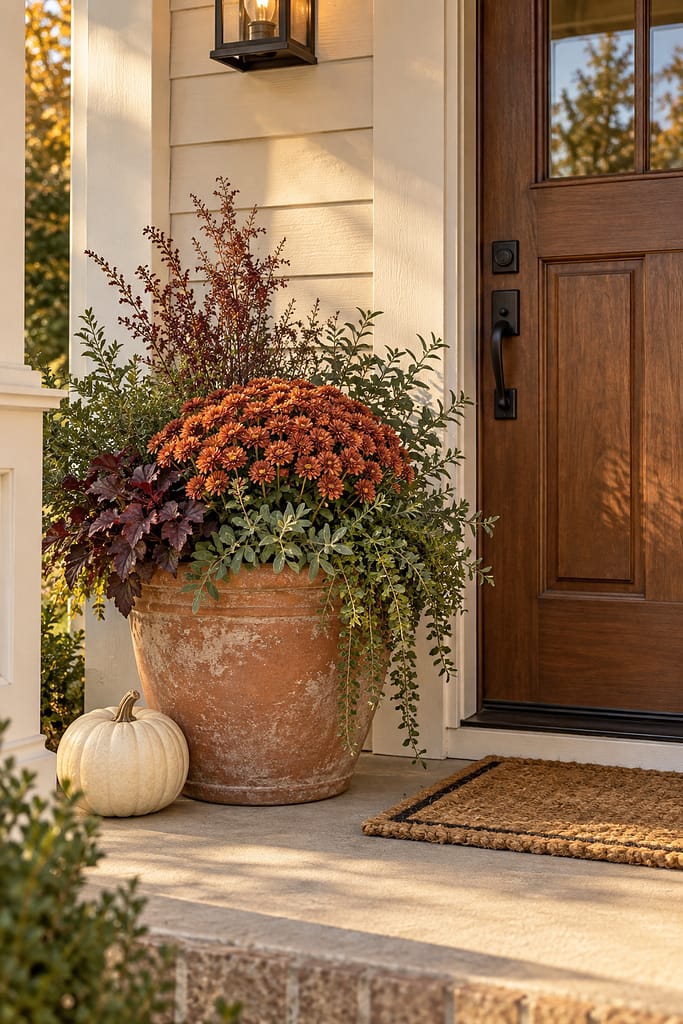
13. Pair Rust Flowers With Olive Greenery
Rust and olive create one of my favorite fall color combinations.
The warm reddish-orange flowers provide seasonal color, while olive greenery keeps the arrangement earthy and balanced.
Use a medium terracotta, brown, or charcoal container.
Place your rust-toned flowering plant through the center and weave different olive-green foliage around it. Add a small amount of warm brown or burgundy for extra depth.
You can keep the planter entirely plant-based or place a cream pumpkin beside it.
This palette works particularly well with natural wood front doors and cream siding.
Unlike bright orange and yellow, rust and olive feel understated enough to complement the house instead of becoming the entire visual story.
And if you already own olive-green plants from summer, you may not need to start from scratch.
14. Make a Cottage-Inspired Mixed Fall Planter
Cottage-style planters look best when they feel a little loose.
Combine soft seasonal flowers, herbs or herb-like foliage, trailing greenery, and fine grasses rather than creating perfectly separated plant sections.
Use burgundy and creamy flowers as the main colors, then layer in olive leaves and a touch of muted rust.
Let a small amount of greenery trail over the edge.
The arrangement should feel full but still allow each plant enough room to grow.
A weathered terracotta or simple stone-look pot works beautifully here.
Place the planter beside a warm wood or muted green front door and add one little pumpkin nearby.
The goal involves “casually charming cottage,” not “I emptied the garden center into this pot during a caffeine incident.”

15. Create a Late-Fall Evergreen Planter
Your fall containers don’t have to disappear when the first flowers fade.
For a late-fall planter, start shifting toward evergreen foliage and stronger structural elements.
Use locally appropriate evergreen branches or living plants as the base, depending on your container and climate.
Add burgundy foliage, warm brown branches, seed heads, and a few pale gourds.
The deep green keeps the arrangement looking fresh while the burgundy and brown maintain the autumn palette.
As winter approaches, you can remove the gourds and adjust the container for the next season if the materials remain suitable.
I love decor that earns a second shift.
A charcoal or black planter makes this transition especially easy because it works with both autumn and winter colors.

16. Style Matching Planters on Both Sides of the Door
If you have enough porch width, matching planters can frame the entrance beautifully.
Choose two identical containers and repeat the same basic plant combination on each side.
You don’t need to make every leaf perfectly symmetrical. Similar colors, heights, and overall volume will create enough balance.
For example, use tall bronze grass, burgundy mums, olive foliage, and a little trailing greenery in each planter.
Then place a couple of pumpkins near one side rather than mirroring every accessory.
That slight asymmetry keeps the porch from looking too formal.
Matching planters work particularly well on traditional homes, double-door entrances, and porches with centered steps.
Measure your available space first. Two giant urns squeezing a standard front door do not create grandeur. They create traffic problems.

17. Build a Layered Statement Fall Planter
For the final idea, combine everything that makes a fall planter visually interesting: height, fullness, trailing texture, and seasonal color.
Start with one tall structural element, such as a compact ornamental grass.
Add medium-height burgundy and rust plants through the center. Layer olive or sage foliage between them, then let one trailing plant soften the edge.
Choose a large but appropriately scaled container.
Place two or three pumpkins beside the planter rather than crowding the soil.
Stick with a controlled palette—burgundy, rust, olive, cream, and warm brown work beautifully together.
This arrangement can become the main seasonal feature on your porch, which means you may not need much other decor.
And that, frankly, saves you from the annual phenomenon where one innocent pumpkin purchase somehow becomes a cart containing $180 worth of autumn.

How to Build a Beautiful Fall Planter
The easiest way to design a fall container arrangement involves thinking in layers.
You want something tall, something full through the middle, and something that softens the edge. Gardeners often use a similar focal-filler-spiller approach for container designs.
A simple fall formula might look like this:
- Tall element: compact ornamental grass, upright foliage, or suitable branches
- Middle layer: mums, coral bells, ornamental kale, pansies, or other locally suitable seasonal plants
- Edge: trailing greenery
- Accent: miniature pumpkins, gourds, or restrained dried materials
You don’t need all four elements in every container.
A small terracotta pot with one beautiful mum can look far better than an overcomplicated arrangement squeezed into the wrong space.
The container size, porch scale, and plants should guide your choices.
Choose Plants for Your Actual Porch Conditions
This part matters more than color coordination.
Before buying plants, figure out how much sunlight your porch actually receives. A covered north-facing entrance creates very different growing conditions from an uncovered porch baking in afternoon sun.
Check each plant’s requirements for light, temperature, moisture, and container space.
Local fall temperatures matter too. A plant that thrives through autumn in one region may struggle much earlier somewhere else.
Don’t choose everything based on one inspirational photo.
I know. Very inconvenient of plants to have biological requirements when we already decided burgundy looked cute.
If you’re uncertain, a local garden center can help you choose seasonal plants suited to your area’s conditions.
Choose the Right Container
Your planter affects the entire look.
Terracotta brings natural warmth and pairs beautifully with olive, burgundy, cream, and rust. Black and charcoal containers create stronger contrast and suit both traditional and modern porches.
Warm brown ceramic works well for earthy arrangements, while outdoor-rated woven textures create a softer cottage feel.
Consider practical factors too.
Your container should provide appropriate drainage for the plants inside. It also needs enough weight and stability to remain secure in its location.
Large containers become extremely heavy once you add growing medium, plants, and water, so position them carefully.
Most importantly, don’t choose a planter so large that it blocks the door, steps, or walkway.
How to Make Fall Planters Look Full Without Overstuffing Them
A lush planter doesn’t require twenty plants.
Different heights and leaf shapes create the illusion of fullness much more effectively than simply packing additional plants into the soil.
Use fine ornamental grass beside broad coral bell or kale leaves. Add medium-size flowers and let a small amount of foliage trail over the edge.
That variety creates layers.
Color repetition also helps. Instead of using seven unrelated flower colors, repeat two or three shades throughout the arrangement.
Give living plants enough room to grow according to their spacing needs.
Remember, the planter needs to look good next week too—not just during its five-minute photoshoot after you finish planting.
Best Fall Planter Colors for a Cozy Porch
Traditional orange works, but you have plenty of other options.
For a warm classic palette, combine rust, cream, olive, and warm brown.
For something richer, try burgundy, plum, dark green, and camel.
A neutral porch might look beautiful with cream, sage, taupe, pale grass, and medium wood tones.
You can also let your home’s exterior guide the palette.
White and cream siding creates a great backdrop for deep burgundy and rust. Brick pairs beautifully with olive, cream, and dark foliage. Gray siding often benefits from warmer terracotta and brown accents.
Keep your palette fairly tight if your porch is small. Too many colors can make a compact entrance feel visually crowded.
Fall Planter Ideas for Small Porches
When floor space gets tight, think vertically.
A tall narrow planter can provide more visual impact than three short, wide pots while occupying less usable porch space.
Keep the arrangement to one side of the front door and preserve a clear path.
You can also use one strong planter as the entire seasonal focal point. Add a wreath to the door and perhaps one pumpkin at the base, and you’re finished.
Small porches rarely need symmetrical containers.
Asymmetrical arrangements often work better because they let you concentrate decorations on one side while keeping the other side completely functional.
The goal involves making the entrance feel welcoming, not testing everyone’s ability to sidestep flowerpots.
Budget-Friendly Fall Planter Ideas
Before buying new plants, look at what’s already growing in your summer containers.
Healthy greenery may work perfectly in a fall arrangement.
Keep useful foliage and replace only tired seasonal flowers. Then introduce one autumn plant, such as a mum or colorful foliage plant, to change the overall palette.
Mini pumpkins can provide another inexpensive seasonal accent without requiring additional planting.
Reusable containers also save money over time.
Choose terracotta, black, charcoal, brown, or natural-looking pots that work throughout the year rather than purchasing highly themed seasonal containers.
You can change the plants and accessories while keeping the expensive part exactly the same.
Caring for Outdoor Fall Planters
Fall weather can change quickly, so check your containers regularly.
Monitor soil moisture instead of watering automatically on a fixed schedule. Temperature, sunlight, rainfall, plant type, and container material all affect how quickly the growing medium dries.
Make sure drainage holes remain clear.
Remove declining flowers and damaged foliage as appropriate for your specific plants. Check pumpkins and gourds for deterioration if they sit near the container.
As temperatures drop, pay attention to the cold tolerance of the plants you’re growing.
Some arrangements may continue looking good well into late fall, while others will need replacing or transitioning sooner.
Let actual plant conditions guide you rather than forcing a display to survive until an arbitrary date.
Keep Porch Planters Safe and Practical
Your fall display still needs to coexist with people.
Keep containers away from the main walking path, stair edges, and door swing. Don’t block handrails or create narrow gaps that make entering the house awkward.
Heavy containers should sit on stable, level surfaces.
Secure lightweight dried branches and decorative materials if the porch receives wind.
Keep dry plant materials away from open flames, hot lighting, heaters, and other ignition sources.
If you use decorative lighting around your planters, choose outdoor-rated products and follow their installation instructions.
A beautiful porch should feel easier to enjoy, not like an autumn-themed obstacle course.
How to Transition Fall Planters Into Late Fall
You don’t necessarily need to rebuild everything when temperatures start dropping.
Remove declining warm-season flowers first.
Keep healthy foliage that still suits your conditions, then introduce more evergreen textures, burgundy leaves, brown branches, grasses, and seed heads as appropriate.
You can leave pumpkins and gourds in place while they’re still in good condition.
As fall ends, remove those seasonal accents and transition the remaining arrangement again if your plants and climate allow it.
This gradual approach saves money and makes your porch look naturally seasonal rather than completely different overnight.
Final Thoughts
A great fall planter doesn’t need dozens of plants or an enormous porch.
Start with one strong focal plant, add contrasting foliage, create a little height, and soften the edge with trailing greenery if your container has room. Then bring in pumpkins, gourds, or dried textures as optional accents.
Choose plants that actually suit your porch conditions, keep the color palette focused, and leave enough room for everything to grow.
Whether you go classic with mums and pumpkins, moody with burgundy and plum, or understated with cream and sage, these fall planter ideas can give your porch plenty of seasonal character.
And if you only have the energy for one terracotta pot and one giant mum? Put them beside the door and call it intentional. Sometimes the simplest fall decorating decisions look the best anyway.