

17 Christmas Tree Ideas 2026 You’ll Want to Copy
There is something mildly dangerous about looking for Christmas tree inspiration.
You start by thinking, “Maybe I’ll buy a new ribbon.”
Twenty minutes later, you’ve apparently committed yourself to replacing every ornament you’ve owned since 2014.
So, before the seasonal shopping spiral begins, let’s focus on Christmas tree ideas 2026 that can actually work in normal homes.
This year’s most useful looks don’t require a 12-foot designer tree sitting in a marble foyer. Think warm neutrals, burgundy, chocolate brown, vintage ornaments, natural textures, bows, metallic accents, and trees that feel collected rather than suspiciously perfect.
Better yet, many of these ideas can be created by adding just one new color or texture to decorations you already own.
Whether you prefer classic red, cozy woodland, moody burgundy, or simple Scandinavian style, these 17 Christmas tree ideas offer plenty of inspiration worth saving for the 2026 holiday season.
1. Decorate With Burgundy and Gold
Burgundy gives traditional Christmas red a deeper, moodier update.
Start with matte and glossy burgundy ornaments in two or three sizes.
Mix in antique-gold baubles rather than extremely bright yellow gold.
Then add narrow burgundy velvet ribbon or several large velvet bows.
Warm white lights bring out the richness of both colors.
If you already own gold ornaments, this is an easy tree to recreate because burgundy can become the only major addition.
Keep the tree skirt neutral—cream, warm beige, or natural woven texture works beautifully.
And resist adding six more colors because you found pretty ornaments at the store.
Burgundy and gold already know what they’re doing.
Let them work.

2. Try a Chocolate Brown Christmas Tree
Brown Christmas decor sounds questionable until you see it done properly.
Then suddenly everything else feels a little loud.
Use chocolate-brown velvet ribbon, bronze ornaments, warm wood decorations, and cream baubles.
Add small touches of antique brass for subtle shine.
The combination looks especially good on a traditional green tree because the colors naturally blend with the foliage.
Warm white lights are essential here.
Cool blue-white lighting can make the palette feel flat.
For texture, add a few pinecones or lightweight wood ornaments.
Keep the base simple with a warm cream tree skirt.
The result is earthy, cozy, and surprisingly sophisticated.
It’s essentially hot chocolate in Christmas-tree form.
Hard to argue with that.

3. Create a Classic Red Christmas Tree
Some Christmas looks don’t need reinventing.
A traditional red tree still works beautifully—especially when you simplify the palette.
Use deep red ornaments, velvet bows, warm white lights, and natural green branches.
Instead of covering every branch, leave a little space between decorations.
Add a few antique-gold ornaments for warmth.
If you like ribbon, use one style rather than several competing patterns.
A deep red velvet ribbon feels classic without becoming overly busy.
Pair the tree with simple kraft-paper-style or cream gift wrapping underneath.
There’s a reason people return to red every Christmas.
It looks festive immediately.
No trend report required.

4. Style a Cream and Gold Neutral Tree
If you love neutral interiors, keep the tree soft too.
Use cream, champagne, warm gold, and natural wood.
Choose ornaments with different finishes so the limited palette doesn’t feel flat.
Mix matte cream balls with slightly reflective champagne ornaments.
Add several cream velvet bows or a narrow ribbon.
Wooden stars and bells can introduce natural texture.
Keep warm white lights visible between the decorations.
The key is contrast through materials rather than colors.
This tree works especially well in beige, greige, or warm-white living rooms.
Just be careful with the amount of beige.
We’re decorating for Christmas.
The tree shouldn’t disappear into the wall and enter witness protection.

5. Add Oversized Velvet Bows
Bows can become the main decoration instead of a finishing touch.
Choose six to ten medium or oversized velvet bows and distribute them vertically around the tree.
Burgundy looks rich.
Chocolate brown feels earthy.
Deep olive gives the tree a natural look.
Classic red is almost impossible to mess up.
Keep the ornaments simpler so the bows remain noticeable.
Use cream, brass, or matching-tone baubles between them.
Make sure bows and decorations are securely attached and kept clear of bulbs or electrical components as appropriate for your lighting setup.
This is also a useful strategy if you don’t own hundreds of ornaments.
Big bows occupy visual space quickly.
Finally, Christmas decor that rewards taking the shortcut.

6. Create a Vintage-Inspired Christmas Tree
A vintage-style tree should feel collected rather than perfectly matched.
Mix glass-look ornaments, small bells, stars, wooden decorations, deep red baubles, and warm metallic accents.
Choose slightly different shapes and finishes.
Add a few simple ribbon bows rather than one large ribbon running through the entire tree.
Warm white lights provide the nostalgic glow.
If you have sentimental ornaments from previous years, this is the perfect style for using them.
Don’t worry if everything isn’t coordinated.
That’s the point.
The tree should look like it accumulated stories over time.
A perfectly matching set of 80 identical ornaments has many qualities.
“Sentimental family heirloom energy” is generally not one of them.

7. Go Moody With Plum and Burgundy
For something darker, combine deep plum, burgundy, charcoal, and antique gold.
Start with burgundy ornaments as the base.
Add plum baubles in smaller quantities.
Use charcoal velvet bows or ribbon for contrast.
Antique-gold ornaments prevent the palette from becoming too dark.
Keep the lights warm and fairly abundant.
This tree looks especially dramatic in the evening.
It also works beautifully with walnut furniture and warm neutral walls.
Avoid introducing bright silver, icy blue, or neon shades.
The appeal comes from the deep, limited palette.
Christmas can be moody.
Nobody said every ornament had to look cheerful enough to host a morning television show.

8. Try an Olive Green and Brass Tree
Yes, green decorations can work on a green tree.
The trick is using different shades and finishes.
Add deep olive velvet bows, muted sage ornaments, antique-brass bells, and cream baubles.
The subtle color changes create a layered natural look.
Warm white lights help separate the ornaments visually from the branches.
Wooden stars or simple pinecones can add more texture.
This palette is ideal if you like organic modern, farmhouse, cottage, or earthy interiors.
It’s Christmas without screaming “CHRISTMAS” from every branch.
More of a confident seasonal whisper.
With bells.

9. Decorate a Scandinavian-Inspired Tree
For a simpler Christmas, let the tree itself remain visible.
Use natural wood ornaments, paper-look stars, cream decorations, small red accents, and warm white lights.
Space ornaments generously.
Skip thick ribbon.
A few small red bows can provide color without dominating the tree.
Use a woven basket-style collar or simple cream tree skirt at the base.
The result feels warm and festive while remaining uncluttered.
This is particularly useful in small living rooms where a heavily decorated tree can visually overwhelm the space.
You paid for a tree.
It’s okay to actually see some of it.
Radical, I know.

10. Create a Cozy Woodland Christmas Tree
Bring the outdoors inside with a woodland-inspired palette.
Use pinecones, wooden ornaments, brown velvet ribbon, mushroom ornaments, forest-green accents, and cream baubles.
Keep everything relatively matte and textural.
Small animal ornaments can work too, but use them sparingly.
One fox is charming.
Fourteen woodland creatures staring out from the branches may suggest the tree has become occupied.
Add warm white lights and a woven tree skirt.
This style works particularly well in rooms with wood furniture, woven baskets, and earthy colors.
It also transitions naturally from fall into Christmas because brown, green, cream, and rust already feel at home together.

11. Style a Candy-Cane Red and White Tree
Red and white can look cheerful without becoming overly childish.
Use deep red baubles, creamy-white ornaments, red velvet bows, and restrained striped accents.
The key word is restrained.
You don’t need stripes on every branch.
A few candy-cane-inspired ornaments scattered through the tree establish the theme.
Keep the lights warm white.
Add a cream tree skirt and simple red-and-cream wrapped gifts underneath.
This style works beautifully in kitchens, family rooms, and homes where you want Christmas to feel playful.
It’s also easy to build using basic ornaments you may already own.
Festive, familiar, and considerably easier than constructing an actual gingerbread village around the base.

12. Try a Dusty Blue and Champagne Tree
If you prefer cooler colors, soften them with warm metallics.
Use dusty blue ornaments, champagne-gold baubles, cream ribbon, and warm white lights.
Avoid bright royal blue or icy silver if you want the tree to feel cozy.
Dusty blue has enough gray in it to work naturally with warm neutral interiors.
Add several wooden or champagne stars.
Keep the tree skirt cream.
This combination feels elegant but still relaxed.
It can also work well if your living room already includes blue-gray textiles.
Use the room’s existing palette instead of forcing traditional red into a space where it doesn’t naturally fit.
Your sofa has been there all year.
It deserves some input.

13. Decorate With Dried Orange and Natural Wood
For a handmade look, use natural-looking decorations.
Combine dried-orange-style ornaments, lightweight wooden stars, pinecones, cinnamon-tone ribbon, and cream baubles.
If using actual dried natural materials, keep them appropriately separated from heat sources and follow safe lighting practices.
LED tree lights are the practical choice.
The orange tones look beautiful against green branches and warm wood furniture.
Use a simple woven tree collar or neutral fabric skirt.
This tree can feel festive without relying heavily on shiny ornaments.
It’s also a great option for anyone who wants Christmas decor to feel connected to nature.
And yes, the tree may make you suddenly crave mulled cider.
Occupational hazard.

14. Create an Antique Gold Christmas Tree
For a warm metallic look, let antique gold and brass dominate.
Mix gold ornaments in several finishes—matte, aged, lightly reflective, and textured.
Add cream velvet bows to soften the metallics.
Several bronze ornaments can provide deeper contrast.
Keep the lights warm white.
Avoid overly bright cool-toned gold if you’re trying to create an aged effect.
A medium-walnut floor or furniture piece nearby will reinforce the warmth.
The finished tree feels festive without needing lots of color.
And because gold reflects light so well, you can achieve plenty of sparkle without coating the tree in glitter.
Your vacuum cleaner has suffered enough.

15. Try a Minimalist Ribbon Christmas Tree
If you don’t want dozens of ornaments, let ribbon carry the design.
Use one beautiful velvet ribbon color—burgundy, chocolate, olive, or classic red.
Arrange it in loose vertical sections rather than tightly wrapping the entire tree.
Then add a limited number of cream and brass ornaments.
Leave plenty of branches visible.
Finish with warm white lights.
This approach is especially useful when decorating a second tree or working with a limited ornament collection.
It feels complete without requiring hours of hanging tiny baubles.
And taking it down in January?
Glorious.
Future-you deserves this level of consideration.

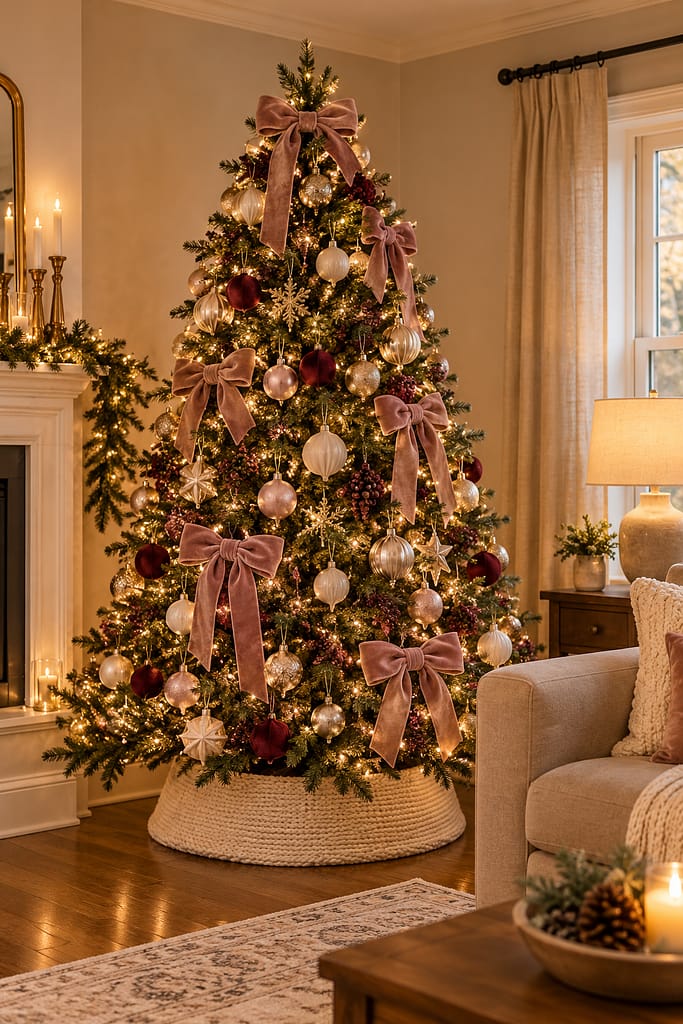
16. Create a Romantic Dusty Rose Christmas Tree
Dusty rose offers a softer alternative to traditional red.
Pair dusty rose velvet bows and ornaments with champagne, cream, and warm brown.
Choose muted pink rather than bright bubblegum shades.
Add champagne-gold baubles for sparkle and cream ornaments for balance.
A few deep burgundy decorations can provide contrast if the palette feels too pale.
Use warm white lights to keep everything cozy.
This look works particularly well in neutral living rooms with beige, taupe, or walnut furniture.
It feels festive but unexpected.
And unlike bright pink, dusty rose isn’t trying to win an argument with the rest of the room.
It knows how to collaborate.
17. Mix Collected Ornaments for a Cozy Family Tree
Not every Christmas tree needs a strict designer theme.
Sometimes the best tree is the one filled with ornaments that actually mean something.
Use family ornaments, handmade pieces, travel souvenirs, children’s decorations, vintage finds, and a few simple filler baubles.
Choose one repeating element to create cohesion.
That could be red velvet bows, warm gold bells, cream ornaments, or wooden stars.
Warm white lights help unify everything visually.
Don’t worry if the ornaments vary in style.
Spread strong colors evenly around the tree so one area doesn’t feel dramatically heavier.
This is the Christmas tree that changes slightly every year as new ornaments join the collection.
No trend can really replace that.
And if one handmade ornament is objectively a little wonky?
Front and center.
Those are usually the good ones.

How to Choose a Christmas Tree Theme for 2026
Start with your living room rather than the Christmas aisle.
What colors are already there?
If your room contains warm wood, camel upholstery, and cream walls, a burgundy, chocolate, olive, or antique-gold tree will probably feel natural.
If your home has cooler blue-gray accents, dusty blue and champagne may fit better.
Then look at the ornaments you already own.
You don’t necessarily need a completely new collection.
Often, one new accent color can transform an existing tree.
Gold ornaments from previous years can become a burgundy-and-gold tree simply by adding burgundy bows and several matching baubles.
Cream ornaments can move into almost any palette.
Shop the storage bins first.
They’ve been waiting all year for this moment.
Pick a Christmas Tree Color Palette
Three main colors are usually enough.
Try combinations such as:
- Burgundy + antique gold + cream
- Chocolate brown + bronze + cream
- Red + warm gold + natural green
- Olive + brass + cream
- Plum + burgundy + antique gold
- Dusty blue + champagne + cream
- Dusty rose + burgundy + champagne
Remember that the green tree itself counts as a color.
So does the room behind it.
Limiting your palette doesn’t mean every ornament must match.
Different textures and finishes keep a small number of colors interesting.
Christmas Tree Ideas for Small Living Rooms
Scale matters more than ornament count.
In a small room with an 8-foot ceiling, a 6-to-7-foot tree often feels much more believable than an enormous tree squeezed against the ceiling.
Measure both height and width before buying.
Slim trees can work beautifully in apartments and narrow living rooms.
Place the tree somewhere it doesn’t block doors, vents, stairs, major walkways, or frequently used furniture.
Then decorate vertically.
Bows and ribbon naturally pull the eye upward, helping a slimmer tree feel substantial.
You don’t need a huge tree for Pinterest-worthy results.
You need one that actually fits the room.
A surprisingly underrated concept.
How to Make a Christmas Tree Look Fuller
Start by shaping the branches before hanging a single ornament.
Yes, it’s tedious.
Yes, it matters.
Separate branch tips and adjust them in different directions to reduce obvious gaps.
Next, distribute lights evenly if your tree isn’t pre-lit.
Add larger ornaments deeper into visible gaps and smaller ornaments toward branch tips.
Ribbon and bows can also disguise sparse areas.
But don’t completely fill every opening.
Some shadow between branches gives the tree dimension.
The goal is lush.
Not “every branch is carrying its maximum legal ornament capacity.”
Mix Ornament Sizes
Using only small ornaments can make a large tree look busy.
Mix large, medium, and small ornaments.
Place some larger baubles slightly deeper into the tree.
Medium ornaments can occupy the majority of branches.
Use smaller ornaments near branch ends and around bows.
This creates visual depth.
You can also cluster two or three smaller ornaments in selected areas instead of hanging everything individually.
Step back frequently while decorating.
The tree needs to look balanced from the sofa, not just from six inches away while you’re wrestling with ornament hooks.
Use Velvet Bows for an Easy 2026 Update
If you want to refresh your tree without replacing ornaments, bows are your friend.
Choose one strong color.
Burgundy creates a rich traditional look.
Chocolate brown feels earthy.
Olive works beautifully with natural decor.
Dusty rose creates something softer.
Place bows throughout the tree rather than only around the top.
Repeat the color through a few ornaments or nearby gift wrapping.
This simple change can make an older ornament collection feel completely different.
And bows store flat.
A seasonal miracle.
Make a Christmas Tree Look Collected, Not Overstyled
Perfect spacing isn’t always better.
Mix old and new ornaments.
Use different finishes.
Allow several meaningful decorations to stand out rather than burying everything under ribbon.
Natural trees aren’t perfectly symmetrical, either.
Let the tree have character.
A slightly irregular branch can become the perfect place for a favorite ornament.
A collected Christmas tree feels like it belongs to the people living in the house.
That’s much harder to achieve when every branch has been decorated according to a spreadsheet.
Though, admittedly, some of us would enjoy that spreadsheet.
Coordinate the Tree With Wrapped Gifts
The presents under the tree become part of the overall look.
You don’t need expensive wrapping paper.
Choose two or three simple papers that relate to your tree palette.
For a burgundy tree, try cream paper with burgundy ribbon.
For a woodland tree, kraft-paper-style wrapping and dark brown ribbon works beautifully.
A neutral tree can use cream, warm white, and subtle gold.
Vary the ribbon rather than using six unrelated wrapping patterns.
Even empty decorative boxes can be used sparingly before actual gifts arrive if you want the tree base to feel finished for photos.
Just remember which ones are empty.
Christmas morning does not need that plot twist.
Choose the Right Tree Skirt or Collar
The tree base can either support your design or become a visual distraction.
Cream fabric skirts work with almost everything.
Woven collars suit Scandinavian, woodland, farmhouse, and natural trees.
A warm brown or velvet skirt can complement a moodier palette.
Make sure the base solution works safely with your specific tree stand and electrical setup.
Don’t pack fabric tightly around plugs, controls, or equipment that requires ventilation or access.
And keep cords arranged according to manufacturer instructions.
Beautiful tree, accessible plug.
We can have both.
Use Warm White Lights for a Cozy Look
For most of these palettes, warm white lights create the most inviting effect.
They complement burgundy, gold, brown, cream, red, olive, and natural wood particularly well.
Very cool white lighting can make warm colors look harsher.
Whatever lights you use, make sure they’re appropriate for the tree and location.
Follow manufacturer instructions regarding connection limits and extension cords.
Inspect older light strings before using them.
Replace damaged electrical decorations rather than trying to hide problems behind branches.
No amount of ribbon can make questionable wiring festive.
Don’t Forget the Back of the Tree
If your tree sits directly against a wall, you don’t need to decorate the hidden back as heavily as the visible sides.
Focus your best ornaments on the areas people actually see.
If the tree can be viewed from multiple rooms, rotate around it as you decorate.
Take a quick photo from the main doorway and sofa.
Photos make uneven ornament distribution surprisingly obvious.
That empty section you somehow didn’t notice for two hours?
Your phone will locate it immediately.
Rude, but useful.
Keep Christmas Tree Decorations Safe
Use a stable tree stand appropriate for your tree.
Place the tree away from fireplaces, heaters, candles, and other heat sources.
Keep walking routes and doorways clear.
If small children or pets are present, consider placing fragile, sharp, or very small ornaments higher on the tree.
Secure decorations rather than balancing them loosely on branches.
For a real tree, follow appropriate care guidance and prevent it from drying excessively.
Use electrical lights and accessories according to their manufacturer instructions.
A beautiful Christmas tree should create cozy memories.
Not an exciting conversation with the insurance company.
How to Refresh Last Year’s Christmas Tree
Before buying anything new, lay out your existing ornaments by color.
You may already have the foundation for a completely different look.
Gold ornaments can move into a burgundy, chocolate, dusty blue, or cream palette.
Red ornaments can become vintage, Scandinavian, or candy-cane-inspired.
Wood ornaments work with woodland, neutral, olive, and dried-orange themes.
Then buy only the missing element.
Maybe that’s burgundy velvet ribbon.
Maybe it’s a dozen cream baubles.
Maybe it’s six oversized bows.
Changing 20% of the decorations can make 100% of the tree feel different.
Much cheaper than emotionally blacking out in the Christmas aisle and returning home with four shopping bags.
Final Thoughts
The most useful Christmas tree ideas 2026 aren’t about replacing everything you already own.
They’re about finding a fresh way to combine it.
Burgundy and gold can update a traditional tree. Chocolate brown and bronze create an earthy look. Olive and brass feel natural, while dusty rose or dusty blue offer softer alternatives.
And if trends aren’t your thing?
Fill the tree with collected family ornaments and call it finished.
The best Christmas tree is still the one that looks right in your actual home—whether that’s a carefully coordinated burgundy tree or a slightly chaotic collection of ornaments gathered over fifteen years.
Pick a palette.
Add warm lights.
Hang the favorite ornaments.
Then stop before you convince yourself the tree urgently needs another 47 baubles.
It probably doesn’t. 🎄