

20 Closet Inspo Ideas for a Beautiful and Organized Space
A beautiful closet is nice.
A beautiful closet where you can actually find your black sweater without excavating three laundry baskets? Much better.
The best closet inspo ideas combine organization with realistic design. You don’t need a celebrity-size dressing room, custom glass cabinets, or an island roughly the size of a compact car.
Most closets need simpler fixes: better use of vertical space, consistent hangers, practical drawers, labeled bins, smarter shoe storage, and fewer things living on the floor.
Whether you’re organizing a small reach-in closet, upgrading a walk-in, or simply trying to make your current setup feel less chaotic, these 20 ideas can help you create a closet that’s both attractive and genuinely useful.
1. Create a Double-Hanging Closet
One of the easiest ways to gain storage is to stop wasting the space underneath short clothes.
Install two hanging rods, one above the other, for shirts, jackets, skirts, and folded-over pants.
Reserve a separate full-height section for dresses, coats, or other longer pieces.
This layout can dramatically increase hanging capacity without making the closet itself any larger.
Add one shelf above the upper rod for bins or less frequently used items.
Keep everyday clothes at comfortable reaching height.
Suddenly, that previously empty three-foot zone below your shirts has a job.
About time.

2. Use Matching Slim Hangers
Sometimes the least exciting changes produce the biggest visual difference.
Replace bulky mixed hangers with matching slim hangers appropriate for your clothes.
The consistent shape immediately makes the closet look calmer.
Slim designs can also free up hanging space, particularly in narrow reach-in closets.
Choose a neutral color such as black, cream, taupe, or natural wood depending on your closet.
But don’t force every garment onto the same hanger type.
Heavy coats may need sturdier hangers, while delicate clothing may benefit from shapes designed specifically for it.
Matching is useful.
Snapped hangers under winter coats are considerably less aesthetic.

3. Add Drawers Under Hanging Clothes
If you have unused floor space beneath shirts or jackets, consider adding a low drawer unit.
A three- or four-drawer dresser-style organizer can hold underwear, socks, workout clothes, pajamas, or folded T-shirts.
Measure carefully before buying anything.
You need enough clearance above the unit for hanging garments.
Secure freestanding storage appropriately where required, especially if there’s any tipping risk.
Keep the top mostly clear.
A small tray for watches or everyday accessories is enough.
The moment the drawer top becomes a dumping ground, the closet begins plotting its return to chaos.

4. Install Floor-to-Ceiling Closet Shelving
Vertical space is valuable, particularly in a small closet.
Use properly supported shelving from lower storage height toward the ceiling for folded clothes, bags, bins, and shoes.
Keep frequently used items between roughly waist and eye level.
Higher shelves are better for seasonal pieces, spare bedding, or rarely used accessories.
Use appropriately installed brackets, cleats, or a manufactured closet system rather than unsupported floating boards.
Store lighter items higher whenever practical.
You shouldn’t need to dodge a suitcase avalanche every time you reach for a sweater.
Beautiful organization should ideally remain attached to the wall.
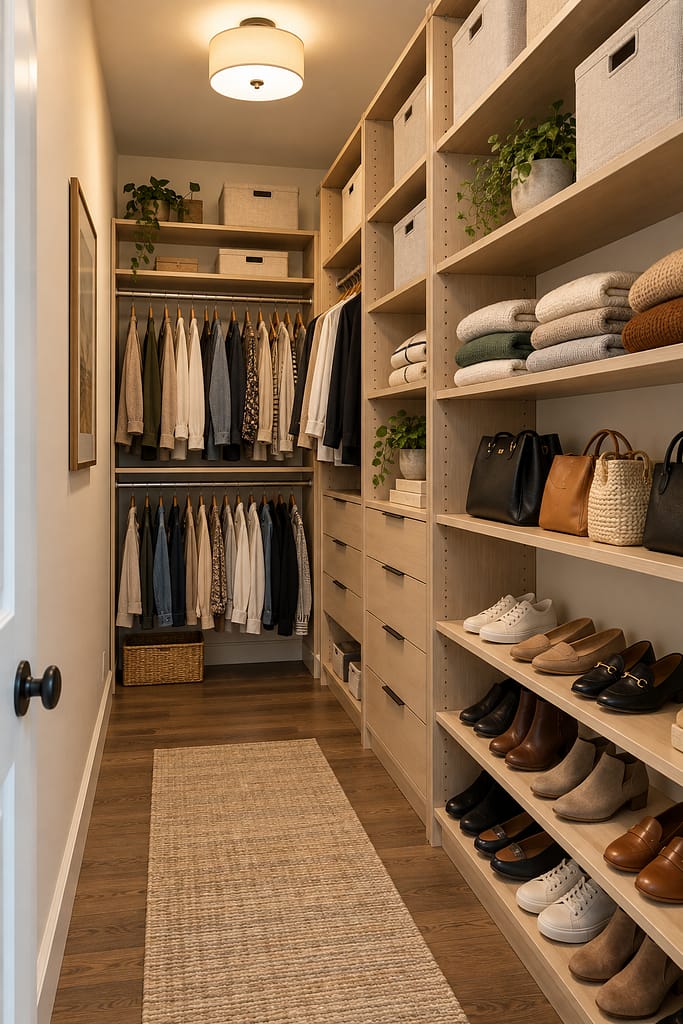
5. Create a Dedicated Shoe Wall
Shoes are much easier to manage when every pair has a predictable location.
Use shallow adjustable shelves from roughly floor level upward.
Keep everyday shoes at the easiest height to reach.
Occasional footwear can go higher or lower.
Adjustable shelves are particularly useful because sneakers, flats, ankle boots, and taller shoes don’t require identical spacing.
Don’t angle every shelf simply because luxury closets do it.
Flat shelves usually use space more efficiently.
Apparently your sneakers can survive without being displayed like rare museum artifacts.

6. Add Woven Baskets to Open Shelves
Open shelves look great until they’re filled with seventeen unrelated objects.
Baskets fix that quickly.
Use matching or coordinating woven baskets for scarves, belts, seasonal accessories, swimwear, or small bags.
Choose baskets that fit the shelf depth without hanging over the edge.
Keep frequently used baskets lower.
Lighter seasonal storage can go higher.
You don’t necessarily need a basket on every shelf.
Mix baskets with neatly folded clothing and a few visible accessories.
That variation keeps the closet useful without making it resemble the basket department of a home store.

7. Organize Clothes by Category
Before buying another organizer, try changing the order of what you already own.
Group clothing into categories such as shirts, jackets, pants, dresses, and outerwear.
Then organize within those groups by color if you enjoy the visual effect.
Category first usually makes the closet more functional than arranging everything purely by rainbow.
Why?
Because when you need a shirt, you probably want to look at shirts.
You shouldn’t need to remember whether Tuesday feels more beige or burgundy.
Keep your most frequently worn categories in the easiest positions to reach.
A beautiful closet is helpful.
Not an elaborate filing system you need to study.

8. Build a Small Closet Vanity Nook
If your walk-in has enough space, a narrow vanity can make the room more functional.
Install a compact drawer unit or shallow dressing table against an unused wall.
Add a securely mounted mirror above it.
Use one small stool that tucks underneath.
Keep cosmetics, jewelry, or grooming products inside drawers rather than covering the surface.
Good lighting matters too.
Use appropriate fixtures near the mirror rather than relying on one dim ceiling bulb behind you.
And preserve enough clearance to open drawers and walk comfortably.
If you have to climb over the stool to reach your clothes, congratulations—you’ve invented a closet obstacle course.

9. Use Clear-Front Storage for Accessories
Storage works best when you can remember what’s inside it.
Use clear-front bins or shallow transparent drawers for accessories you frequently forget about.
Scarves, belts, small bags, sunglasses, or seasonal pieces can work well here.
Keep the contents organized by category rather than filling each bin with random objects.
If you prefer less visual clutter, combine transparent storage with opaque baskets.
For example, use clear drawers for everyday accessories and woven bins for less attractive necessities.
Yes, the collection of spare tote bags counts as a necessity.
Apparently.

10. Add Hooks for Everyday Accessories
A few hooks can prevent everyday accessories from landing on the nearest chair.
Install sturdy wall hooks for handbags, belts, hats, or tomorrow’s outfit.
Place them on a side wall or the back of the closet door if appropriate for the door and hardware.
Don’t overload hooks beyond their rated capacity.
And don’t put them where hanging items narrow the walkway or interfere with the door.
Three well-positioned hooks can be more useful than an entire decorative shelf.
They’re especially good for items you’re currently using.
Because the bag you carry every day probably doesn’t need to be ceremonially returned to a storage box every evening.
Let’s be realistic.

11. Create a Warm Wood Closet
White isn’t your only closet option.
Warm wood can make even a small storage space feel much more intentional.
Use medium walnut or warm oak shelves and drawer fronts against cream or warm-white walls.
Keep hardware simple.
Matte black, aged brass, or understated bronze can all work.
Add warm LED lighting so the wood doesn’t look overly dark.
Use cream bins and matching hangers to keep the palette controlled.
You don’t need floor-to-ceiling custom cabinetry.
Even replacing a basic white shelf with a properly supported wood shelf can introduce warmth.
A closet is allowed to have a personality.
It’s storing half of yours anyway.

12. Try an Olive Green Closet Accent
Want something more interesting than white without making the closet too dark?
Try muted olive green.
Paint the back wall or selected built-in cabinetry olive while keeping surrounding surfaces warm cream.
Pair it with medium walnut shelves and aged-brass or matte-black hardware.
Neutral clothes and woven baskets look particularly good against the green.
In a very small closet, one accent wall may be enough.
Painting every surface deep green can visually shrink the room, especially if lighting is limited.
One strategic dose of color gives you the effect without making your closet feel like a fashionable cave.

13. Create a Boutique-Style Handbag Shelf
If you own several handbags, give them one dedicated shelf instead of scattering them throughout the closet.
Arrange bags upright with breathing room between them.
Use shelf dividers if necessary to prevent softer bags from collapsing into one another.
Keep frequently used bags at eye level.
Occasional pieces can go higher.
Don’t pack shelves so tightly that removing one bag causes three others to fall over.
And unless you’re actually running a luxury boutique, you don’t need one spotlight per handbag.
A sturdy shelf and decent lighting will manage.

14. Add a Full-Length Mirror
A mirror is one of the most practical closet additions.
Choose a full-length mirror mounted securely to a wall or door where appropriate.
Place it somewhere you can step back far enough to use it.
In a narrow walk-in, the end wall often works well.
Mirrors can also bounce light around a small closet, making the space feel brighter.
Keep the frame simple—thin black, warm wood, or aged brass.
Avoid leaning a large heavy mirror precariously in a narrow traffic route.
The goal is checking your outfit.
Not testing your reflexes every time you reach for socks.

15. Add Lighting Inside Dark Closet Sections
One overhead bulb often leaves shelves and hanging areas in shadow.
Add closet-appropriate LED lighting beneath shelves or along dark sections, following manufacturer instructions.
Warm white around 2700–3000K creates a cozy look.
A slightly more neutral white may make clothing colors easier to distinguish.
Use hardwired lighting installed appropriately or approved plug-in/battery solutions suitable for the location.
Don’t improvise electrical installations or hide unsuitable extension cords behind clothing.
Good lighting makes organization much easier because you can actually see what’s hiding in the back.
Revolutionary stuff.
Apparently the navy sweater was there the entire time.

16. Use Shelf Dividers for Sweaters and Bags
Open shelves often begin organized and slowly evolve into one enormous fabric landslide.
Add sturdy shelf dividers between folded clothing categories.
Create separate sections for sweaters, jeans, T-shirts, and bags.
Keep stacks relatively short.
If you need twelve sweaters in one vertical pile, the bottom sweater has essentially entered retirement.
Dividers are also useful for handbags that don’t stand upright easily.
Choose clear, metal, or simple wood-look dividers that suit your shelving.
It’s a small upgrade, but it can make maintaining the closet much easier.
Organization only counts if it survives Tuesday morning.

17. Create Seasonal Storage on the Top Shelf
You don’t need prime closet real estate for clothes you won’t wear for six months.
Use matching lightweight bins on the highest shelf for seasonal pieces.
Store summer accessories during winter and cold-weather accessories during summer.
Keep heavier items lower.
Use labels if they help you remember what’s inside.
Don’t stack unstable containers above your head.
And leave access to anything that needs ventilation, maintenance, or electrical clearance.
Seasonal rotation can free up a surprising amount of everyday space.
Plus, opening a bin of summer clothes in May feels slightly like receiving a package from your past self.
Occasionally that person had good taste.

18. Add a Small Laundry Hamper Station
Laundry needs somewhere to live before wash day.
Otherwise, the floor volunteers.
Use one or two narrow hampers tucked beneath shelving or against a side wall.
If space allows, separate lights and darks—or regular laundry and delicates.
Choose ventilated hampers appropriate for clothing storage.
Make sure they can be removed easily.
Don’t trap them behind hanging clothes or doors.
A built-in hamper can look beautiful, but a simple woven or fabric version works perfectly well.
The best laundry system is the one that makes throwing clothes on the floor slightly more difficult than using the hamper.
Set expectations realistically.

19. Create an Open Closet in a Small Bedroom
No built-in closet?
Create a tidy open wardrobe along one wall.
Use a stable freestanding wardrobe system or securely installed clothing rail with a lower dresser and upper shelf.
Keep the palette consistent so exposed storage doesn’t overwhelm the bedroom.
Matching hangers help enormously.
Store less attractive necessities inside drawers and baskets.
Leave only frequently worn clothes visible.
A curtain can conceal the system if desired, provided the track or rod is installed appropriately and doesn’t interfere with ventilation or other fixtures.
Open closets demand a little more discipline.
There is nowhere for the mystery chair-pile to hide.
Possibly a good thing.

20. Create a Calm Hotel-Inspired Closet
For a polished look, simplify rather than adding more.
Use a restrained palette of warm white, walnut, camel, black, and cream.
Choose matching hangers.
Fold clothing into short neat stacks.
Use two or three identical baskets.
Keep accessories grouped by category.
Leave some shelves intentionally empty.
Add a full-length mirror and warm lighting.
The result feels luxurious because it’s visually calm—not because the closet contains expensive materials.
This is particularly useful inspiration if you’re overwhelmed by elaborate Pinterest closets.
You don’t need glass doors, marble counters, chandeliers, or a velvet ottoman with its own ZIP code.
You need enough storage, good lighting, and a place for your socks.
Let’s maintain perspective.

How to Make a Closet Look More Organized
Start by removing everything that obviously doesn’t belong.
Closets have a strange ability to become unofficial storage rooms for shopping bags, old electronics, gift wrap, empty boxes, and objects nobody knows how to classify.
Then group what’s left into categories.
Keep shirts together.
Put dresses together.
Group shoes.
Give handbags one area.
Once you know how much you have in each category, you can choose storage that actually fits your belongings.
That’s much more effective than buying seventeen matching bins and later wondering what exactly they’re supposed to contain.
Declutter Before Buying Closet Organizers
Organization products cannot solve a volume problem.
Before installing new shelves or ordering bins, look through your clothes.
Consider what you regularly wear, what still fits your needs, and what you genuinely want to keep.
You don’t have to build a minimalist capsule wardrobe.
But storing things you never use takes space away from the things you do.
Create categories for keeping, donating or selling where appropriate, and items requiring repair or another decision.
Then organize what’s staying.
Buying storage first often leads to the surprisingly expensive hobby of organizing things you didn’t even want.
Measure Your Closet Carefully
Measure width, depth, and height.
Then measure again.
Record door locations, trim, baseboards, switches, outlets, vents, access panels, and anything else that affects storage placement.
Measure the length of your hanging clothes too.
Shirts require much less vertical clearance than dresses.
If you’re planning drawers, make sure they can open fully.
For walk-ins, preserve a comfortable clear passage through the center.
And don’t assume two walls are perfectly square simply because the house strongly implies that they should be.
Homes enjoy surprises.
Tape measures prevent many of them.
Divide the Closet Into Zones
A useful closet usually has several storage zones.
Keep everyday items in the easiest-to-reach area.
Occasional items can go slightly higher.
Seasonal storage belongs toward the top.
Shoes usually work well lower down.
Drawers can handle small clothing and accessories.
Long hanging sections are best reserved for dresses, coats, and similar garments.
Once every category has a zone, putting things away becomes much easier.
And that’s the real test of organization.
Not how the closet looks five minutes after you finish styling it.
How it looks three weeks later.
Use Vertical Space
Many closets waste the area between the existing shelf and the ceiling.
Adding another properly supported shelf can provide useful seasonal storage.
Likewise, a single hanging rod may leave a large empty area underneath shirts.
Double hanging can reclaim it.
Tall narrow shelving can store shoes, folded clothes, and bags without occupying much floor area.
The important word here is properly supported.
Choose shelving and hardware suitable for the wall and expected load, and follow installation requirements.
Your sweater collection should remain stationary.
Preferably.
Decide What Should Hang and What Should Fold
Not everything needs a hanger.
Shirts, dresses, jackets, trousers, and wrinkle-prone pieces often make sense hanging.
Sweaters and stretchy knitwear may be better folded to help maintain their shape.
T-shirts can go either way depending on available space.
Jeans are usually easy to fold.
Use your storage capacity to make the decision.
If hanging space is scarce but shelves are plentiful, fold more.
If drawers are limited but you have a long rod, hang more appropriate garments.
The closet should adapt to your wardrobe.
Your wardrobe shouldn’t need to pass an entrance exam.
Organize a Small Reach-In Closet
For a small reach-in closet, prioritize double hanging, upper shelves, and compact drawers.
Use the side walls where practical for hooks or narrow accessory storage.
Avoid very deep organizers that make the back of the closet difficult to access.
Keep the floor as open as possible.
If shoes must be stored low, use shallow shelving rather than piles.
The back of the door may also provide storage depending on the door style and available clearance.
Small closets benefit from consistency.
Matching hangers and bins reduce visual noise even when the closet is full.
You don’t need more square footage.
You need fewer dead zones.
Organize a Small Walk-In Closet
A small walk-in isn’t necessarily better than a reach-in if the layout wastes space.
Start with the walls.
Use one for hanging clothes.
Use another for shallow shelving or drawers.
The end wall can hold a mirror, narrow shelves, or another hanging section.
Preserve the central walkway.
Don’t add an island simply because large luxury closets have one.
If you can touch both walls while standing in the middle, the island has not been invited.
A small stool that tucks under a vanity is far more practical when seating is useful.
Function first.
Tiny imitation department store second.
Make Open Shelves Look Better
Open shelving needs repetition.
Use several matching baskets.
Keep folded stacks relatively short.
Repeat colors.
Group similar objects together.
Leave occasional open areas rather than filling every inch.
If shelves contain many unrelated small items, move those pieces into bins or drawers.
A handbag can look attractive displayed alone.
Four charging cables, six receipts, sunglasses, and an unidentified key?
Less compelling.
Closed storage exists for a reason.
Use it without shame.
Organize Shoes Without Wasting Space
Count your shoes before designing the storage.
Seriously.
Don’t build a gorgeous 12-pair shoe wall when you own 31 pairs.
Group footwear by height.
Flats and sneakers can use shorter shelf spacing.
Boots need more room.
Keep everyday shoes accessible and occasional pairs higher or lower.
If shoes are dirty from outdoor use, consider storage that is easy to clean and appropriately separated from clothing.
And don’t store every shoebox simply because it came with the shoes.
Unless you genuinely use the boxes, they’re mostly renting closet space for free.
Store Handbags Properly
Give handbags enough room to keep their shape.
Don’t stack heavy bags on softer ones.
Use shelf dividers if necessary.
For bags that need support, use suitable inserts or appropriate acid-free tissue where recommended for the material.
Keep handles positioned naturally rather than sharply folded.
Dust bags can be useful for pieces that aren’t used frequently.
Everyday bags should remain easy to reach.
If accessing a handbag requires removing three bins and a winter coat, you’re going to use whichever bag is already sitting by the door.
Design for actual human behavior.
Use Baskets Without Creating Basket Chaos
Baskets are excellent for loose categories.
They’re less useful when everything disappears into anonymous containers.
Assign each basket a purpose.
Scarves.
Swimwear.
Winter accessories.
Small bags.
Spare linens.
Use labels if you need them.
Choose basket sizes based on the category rather than buying one size for everything.
And avoid stacking several heavy baskets overhead.
The perfect storage system shouldn’t require protective equipment to retrieve a scarf.
Improve Closet Lighting
Good lighting makes both organization and getting dressed easier.
A central ceiling fixture can provide general light.
Additional closet-rated lighting beneath shelves can help illuminate dark storage sections.
Choose lighting appropriate for the closet and install it according to manufacturer requirements and applicable electrical rules.
Don’t crowd bulbs or fixtures with clothing.
Keep ventilation and required clearances intact.
If you’re unsure about hardwired electrical work, use a qualified professional.
No Pinterest closet makeover is improved by experimental wiring.
Choose Closet Colors That Feel Calm
Warm white is the easiest backdrop because it reflects light and works with almost everything.
Greige feels slightly softer.
Muted olive can add personality.
Warm walnut introduces richness through shelving and cabinetry.
Camel and cream work beautifully for baskets, upholstery, and storage accessories.
Black hardware can add definition.
Try limiting the closet to three or four major finishes.
Your clothing already provides plenty of color and visual detail.
The architecture doesn’t need to compete with it.
Create a Closet on a Budget
Start with changes that affect the most visible areas.
Matching hangers can make an immediate difference.
Add a few baskets.
Install hooks.
Improve the lighting.
Use simple, properly supported shelving.
Repurpose a small dresser if its dimensions work.
You can upgrade gradually.
There’s no rule saying a closet makeover must occur in one expensive weekend.
In fact, living with the first round of changes can reveal what storage you actually need next.
Much better than buying an elaborate organizer and discovering your closet apparently has different opinions about geometry.
Keep the Closet Floor Clear
An open floor makes even a small closet feel calmer.
Avoid storing random bags, boxes, and shoes directly on the floor.
Use low shelves, drawers, or designated bins instead.
Keep the area around doors and walkways unobstructed.
In a walk-in, preserve a clear route through the space.
If you use a hamper, give it a defined location.
The floor isn’t storage.
It’s infrastructure.
Treating it accordingly makes the entire closet easier to use and clean.
Your vacuum will also stop holding a personal grudge.
Maintain Your Closet Organization
A good closet shouldn’t require a full reorganization every month.
Create systems that are easy to maintain.
Leave a little extra space on shelves.
Don’t pack rods completely full.
Give new purchases somewhere obvious to go.
Return accessories to their designated zones.
Do a quick seasonal review when changing wardrobes.
And keep one small basket available temporarily for items that need sorting or putting away.
The goal isn’t maintaining showroom perfection.
It’s preventing the closet from reaching the point where opening the door feels like initiating negotiations.
Final Thoughts
The most useful closet inspo ideas aren’t necessarily the most expensive ones.
Double hanging can reclaim wasted space. Properly supported shelves make use of height. Matching hangers reduce visual clutter. Drawers hide smaller items, while baskets keep awkward categories under control.
And sometimes the biggest improvement is simply leaving a little empty space.
Start with your wardrobe, measure the closet, identify the storage problems, and build around how you actually get dressed.
A beautiful closet is great.
A beautiful closet that still works on a rushed Monday morning?
That’s the one worth copying.