

15 Halloween Door Decorations Contest Ideas That Stand Out
A Halloween door decorating contest is one of the few situations where being slightly dramatic is practically a requirement.
A couple of paper bats?
Cute.
A giant spider crawling across the entire doorway while glowing eyes stare from the window?
Now we’re competing.
The best Halloween door decorations contest ideas usually have one thing in common: you can understand the theme immediately. Whether it’s a giant monster, haunted forest, friendly ghost invasion, or creepy spider entrance, the strongest doors use one big focal point instead of 37 unrelated Halloween decorations fighting for attention.
And bigger doesn’t have to mean expensive.
Paper, cardboard, removable decorations, fabric, lightweight faux branches, and battery-operated LED lights can create a surprisingly impressive setup.
The important part is keeping the actual door functional. Handles, locks, hinges, vision panels, required signs, access controls, and exit routes still need to do their jobs.
Because winning the Halloween contest would be nice.
Winning while still being able to open the door?
Even better.
Here are 15 Halloween door decorations contest ideas that stand out for classrooms, offices, workplaces, homes, and other festive spaces.
1. Create a Giant Monster Door
Turn the entire door into one enormous monster face.
Use removable colored paper or another door-safe lightweight material as the base.
Create two oversized eyes near the top.
Add dramatic eyebrows.
Make large white teeth around the door opening.
Use paper horns or lightweight dimensional details around the frame if they can be secured safely.
Green, purple, orange, and black make a fun Halloween palette.
The trick is scale.
Don’t make 20 tiny monster details.
Make two enormous eyes and one giant mouth.
Contest doors need to read clearly from across the hallway.
Bonus points—figuratively, because your judges control the actual points—if the monster appears to be eating the doorway.

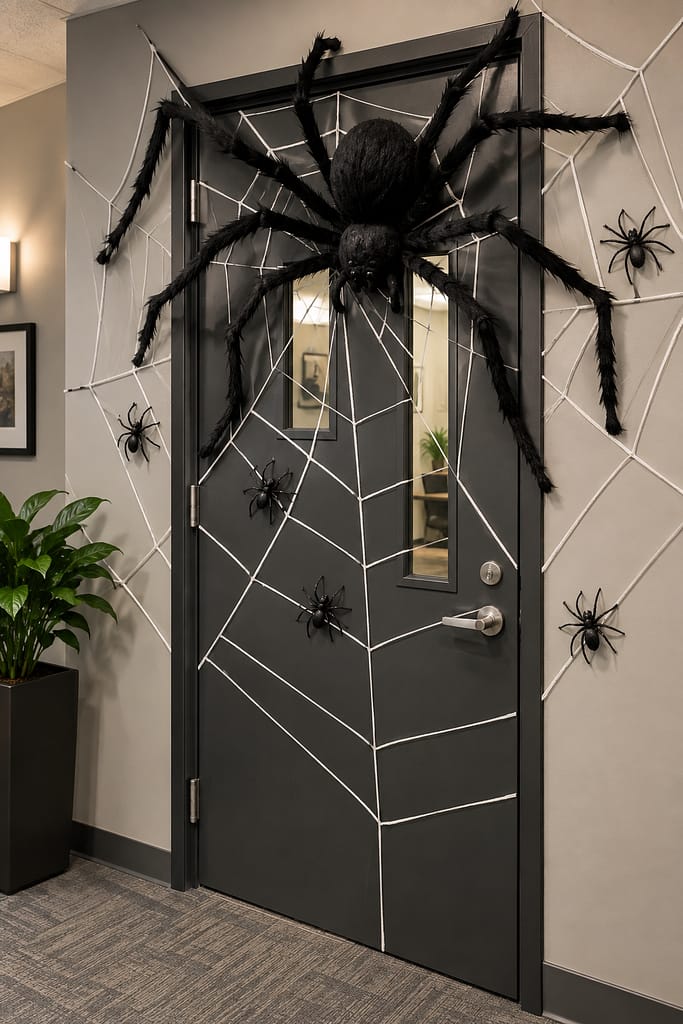
2. Build a Giant Spider Door
A huge spider creates instant contest impact.
Cover part of the door in a dark removable backdrop.
Create one oversized lightweight black spider as the focal point.
Extend its legs across the door and partially onto the surrounding wall if permitted.
Add a structured web made from securely attached white cord, removable paper strips, or another appropriate material.
Keep the web controlled rather than filling the hallway with loose synthetic webbing.
Add several smaller spiders for scale.
That’s what makes the big one look enormous.
Also, consider wildlife and entanglement risks if adapting this idea outdoors.
The spider should frighten people.
Not local birds.
Different objective.
3. Create a Friendly Ghost Invasion
This one is spooky enough for Halloween but still works beautifully in classrooms or family-friendly workplaces.
Cover the door with a deep charcoal or muted-black backdrop.
Add multiple white ghost shapes floating in different directions.
Give each ghost a slightly different expression.
Create one oversized ghost near the center and smaller ghosts around it.
Add a few paper stars or bats.
Use warm battery-operated LED lights around the outer display if appropriate and permitted.
The repetition makes the theme instantly recognizable.
And unlike a realistic horror scene, nobody from accounting is going to avoid the hallway for three weeks afterward.
Probably.

4. Turn the Door Into a Haunted House
Instead of decorating the door, make the door become the haunted house.
Use dark gray removable paper as the building facade.
Add crooked black window shapes.
Create a peaked roof effect above the door using lightweight flat materials if permitted.
Add yellow paper windows.
Use black bats flying upward.
Place several paper pumpkins near the bottom.
A full moon in one upper corner helps frame the composition.
The best part?
The door opening itself can become the haunted mansion’s entrance.
That’s a strong visual concept for a contest because every decoration supports one idea.
No random skeleton wearing a witch hat while holding a pumpkin required.
We have narrative discipline here.

5. Create a Skeleton Door Scene
Skeletons are excellent contest material because they can actually tell a story.
Use one lightweight posable decorative skeleton beside the doorway.
Have it appear to peek around the frame.
Add several skeletal hands made from lightweight decorative materials reaching around the door edges.
Use black paper bats above.
Place a few pumpkins near the base only where they won’t create a trip hazard.
For an office door, you could make the skeleton appear to be arriving for work.
For a classroom, it could be carrying books or school supplies.
Keep props generic and lightweight.
The skeleton doesn’t need 14 accessories.
It’s already made a fairly strong fashion choice.

6. Build a Haunted Forest Door
For something moodier, turn the doorway into a creepy woodland entrance.
Use a deep charcoal backdrop.
Add bare black tree silhouettes rising along both sides of the door.
Create twisted branches extending toward the center.
Add several raven silhouettes.
Place a pale cream full moon near the top.
Use restrained warm amber LED lights for atmosphere if allowed.
The vertical branches naturally frame the doorway, which makes this theme feel bigger without requiring bulky props.
Keep dimensional branches flat or shallow around busy hallways.
Nobody should have to duck beneath the haunted forest to reach the printer.
The forest can be creepy.
It must also respect workplace circulation.

7. Turn the Door Into a Mummy
This is one of the easiest high-impact ideas.
Cover the door with overlapping warm-white paper or fabric-look strips arranged like mummy bandages.
Leave a narrow opening near the upper third.
Place two oversized cartoon-style eyes peeking through.
That’s essentially the entire concept.
You can add several tiny spiders if you want extra detail.
Don’t overcomplicate it.
The strong white-and-black contrast makes the design readable immediately.
Keep all strips securely attached and flat enough that nothing catches on people walking through the doorway.
A mummy contest door?
Excellent.
A mummy that slowly unravels into the hallway throughout the day?
Less competitive.
More custodial.

8. Create a Witch’s Potion Door
Turn the doorway into a whimsical witch’s potion station.
Use deep plum, black, olive green, and muted orange.
Create a large cauldron shape near the lower half of the door.
Have colorful paper bubbles rise upward.
Add generic potion bottle silhouettes.
Use paper stars and a crescent moon.
Place a witch hat silhouette near the top.
The bubbles can travel beyond the door frame onto the surrounding wall if rules permit, making the display feel larger.
Avoid realistic glass bottles or heavy props in busy hallways.
Paper is your friend here.
The potion is imaginary.
The cleanup should also remain imaginary.

9. Create a Black Raven Door
Want something spooky without going cartoonish?
Use ravens.
Cover the door in a warm charcoal or deep black removable backdrop.
Add a bare tree branch silhouette.
Place several black raven silhouettes at different heights.
Use a pale cream moon.
Bring in a few muted burgundy leaves.
Add one antique-looking decorative frame shape without readable text.
This creates a more atmospheric Halloween door that works particularly well for office contests.
It’s dramatic without needing fake blood, severed limbs, or other things HR may have opinions about.
Ravens can handle the spooky atmosphere.
Very professional birds.
Excellent posture.

10. Turn the Door Into a Giant Jack-o’-Lantern
This one is simple, bold, and nearly impossible to misunderstand.
Cover the door in muted pumpkin orange.
Create enormous black triangle eyes.
Add a giant black smiling mouth.
Use a green paper stem and several leaves above.
Done.
For more dimension, layer several shades of orange vertically to suggest pumpkin ridges.
You could also add warm battery-operated LED lights around the frame if permitted.
The oversized scale is what makes this contest-worthy.
Don’t shrink the face.
Let the pumpkin own the door.
It’s been waiting all year for this level of responsibility.

11. Create a Vintage Halloween Door
Skip bright orange and use a more nostalgic palette.
Try muted pumpkin, faded black, warm cream, olive green, and dusty burgundy.
Add vintage-inspired black cat silhouettes.
Use crescent moons.
Bring in pumpkins.
Add stars.
Create a scalloped paper garland.
Use simple old-fashioned illustration-inspired shapes without copying recognizable copyrighted artwork.
The muted palette makes the door stand out from brighter contest entries.
Sometimes the best way to get noticed isn’t becoming louder.
It’s becoming different.
Also useful advice for group chats.

12. Build a Ghostly Graveyard Door
Create a miniature graveyard scene across the doorway.
Use a deep charcoal background.
Add gray headstone silhouettes across the bottom.
Create white ghosts rising behind them.
Place bare black branches on both sides.
Add a large pale moon.
Use a few black bats in the upper section.
Keep everything graphic rather than realistic.
That makes the design appropriate for a wider range of workplaces and classrooms while still looking unmistakably Halloween.
Layering the elements creates depth.
Foreground: headstones.
Middle: ghosts.
Background: moon and branches.
Look at us casually discussing composition like the hallway is an art gallery.
For October, it basically is.

13. Create a Spooky Eye Door
This is wonderfully simple and slightly weird.
Cover the door in black or deep plum.
Add dozens of different-size eye shapes peeking from the darkness.
Use warm cream, muted green, amber, and dusty purple for the irises.
Create two oversized eyes near the center as the focal point.
Add smaller eyes around the edges.
The concept works because repetition becomes increasingly creepy.
It’s also inexpensive.
Paper.
Scissors.
Adhesive appropriate for the door.
Suddenly the entire doorway is watching everyone.
Comforting?
No.
Excellent Halloween contest material?
Absolutely.

14. Create a Cute Bat and Pumpkin Door
Not every contest entry needs to scare the judges.
Use a warm cream or muted beige background.
Add a swarm of black bats flying diagonally across the door.
Place flat pumpkin shapes in cream, muted orange, dusty peach, and pale sage along the bottom.
Add a few olive leaves.
Use a simple black wreath at the center if appropriate.
The result is cute, graphic, and very Pinterest-friendly.
It’s especially useful for classrooms, childcare settings, or offices where genuinely creepy decorations aren’t ideal.
Halloween can be festive without psychologically testing the finance department.
Everyone wins.

15. Build a Full Haunted Halloween Doorway
For maximum contest impact, expand beyond the door itself.
Start with a charcoal door backdrop.
Add a large central ghost silhouette.
Create black branches around the frame.
Add bats flying upward.
Place lightweight pumpkin decorations safely to one side of the doorway.
Use two warm LED lanterns where appropriate.
Add a pale full moon above.
Keep the palette limited to black, cream, muted orange, and burgundy.
The trick is making everything support the same haunted entrance theme.
Don’t simply add every Halloween decoration you own.
Big displays still need editing.
Otherwise you’ve created less “haunted doorway” and more “seasonal storage closet suffered an explosion.”
Different vibe.

How to Win Attention in a Halloween Door Decorating Contest
You can’t control the judging criteria, but you can create a door that’s easy to understand and visually memorable.
The strongest entries usually have:
- One obvious theme
- One oversized focal point
- A limited color palette
- Strong contrast
- Repetition
- Some dimension
- Details that make sense up close
- A design that still looks good from farther away
The biggest mistake?
Trying to include everything.
Spider.
Ghost.
Witch.
Skeleton.
Pumpkin.
Mummy.
Bat.
Monster.
Raven.
Suddenly the theme is simply “Halloween aisle.”
Pick one idea and commit to it.
A giant spider will usually have more visual impact when it gets the entire doorway to itself.
Choose One Strong Halloween Theme
Before buying or making anything, finish this sentence:
“My door is a _____.”
A monster.
A haunted house.
A mummy.
A witch’s potion station.
A haunted forest.
A giant pumpkin.
If you can’t summarize the idea easily, the display may be too complicated.
A clear concept also makes shopping easier.
For a haunted forest, you need branches, ravens, moon shapes, and perhaps lights.
You don’t suddenly need a smiling candy corn decoration because it was on sale.
Stay focused.
The candy corn will recover emotionally.
Make One Element Oversized
Scale is one of the easiest ways to make a contest entry memorable.
Create enormous monster eyes.
Use one giant spider.
Make a huge moon.
Turn the entire door into a jack-o’-lantern.
Use one large ghost.
Small decorations often disappear when viewed from across a hallway.
An oversized focal point makes the concept readable immediately.
Then add smaller details around it.
Think headline first.
Supporting copy second.
Apparently the door has a content strategy now.
Use a Limited Halloween Color Palette
Black and orange works.
But you have plenty of other options.
Try:
Black + cream + muted orange
Black + burgundy + warm gray
Plum + olive + orange + black
Cream + black + sage + dusty peach
Charcoal + white + amber
A limited palette makes inexpensive materials look more intentional.
If you’re using paper, try selecting two or three coordinated colors instead of buying every Halloween shade available.
Restrictions can actually make the display look more polished.
Annoying but true.
Halloween Door Decorating Contest Ideas for Offices
Office doors can handle spooky themes, but consider the workplace.
Ravens.
Haunted forests.
Spiders.
Vintage Halloween.
Graphic eyes.
Moody pumpkins.
Those can create plenty of atmosphere without gore.
Also think about how busy the hallway is.
Large freestanding props may not be appropriate.
Flat or shallow wall-mounted elements are usually easier to manage.
And don’t obstruct room identifiers, required notices, access controls, locks, vision panels, or safety equipment.
Your contest entry should get attention.
Facilities management should not be providing that attention.
Halloween Door Decorating Contest Ideas for Classrooms
Classroom Halloween doors can lean playful.
Try:
Friendly ghosts.
Giant monsters.
Mummies.
Cute bats.
Pumpkins.
Friendly haunted houses.
Use lightweight materials.
Keep small detachable pieces in mind around younger children.
Avoid sharp or unstable props.
Keep the door fully functional.
Don’t cover required safety information or vision panels where they need to remain visible.
And remember that some students may prefer cute Halloween over genuinely frightening imagery.
A six-foot realistic zombie may not be necessary to establish that October has arrived.
The paper ghost gets the message across.
Halloween Door Decorating Ideas for Work
For a professional environment, graphic designs often work best.
A raven door can look sophisticated.
A haunted forest can be dramatic.
A giant spider can be funny.
A vintage-inspired Halloween display can stand out without being overly childish.
Choose a theme that fits the workplace.
Also check contest or building rules before attaching materials to doors and walls.
Some surfaces don’t appreciate aggressive adhesive.
Neither does whoever has to remove it in November.
Use removable materials appropriate for the surface.
Future You deserves consideration.
Create a Halloween Door on a Budget
Paper is incredibly useful.
Use black paper for bats.
White paper for ghosts.
Cardboard for dimensional shapes.
Existing fabric can become a backdrop where appropriate.
Battery-operated LED lights can be reused.
A single roll or pack of coordinated material can create a large visual area.
Focus spending on the focal point.
For example, make the web yourself and use one purchased lightweight spider.
Or create paper branches and use two reusable LED lanterns.
Contest impact comes from composition more than price.
Expensive clutter is still clutter.
Budget creativity has excellent ROI.
Add Dimension Without Creating a Hazard
Flat decorations are safe and easy, but a little dimension can make the display more interesting.
Layer paper shapes.
Use folded wings on bats.
Raise lightweight eyes slightly from the surface.
Create shallow spider legs.
Layer ghosts over a background.
But keep protruding elements out of walking routes and away from faces.
Secure everything properly.
Avoid heavy objects overhead.
A Halloween display should surprise people visually.
Not physically.
No contestant needs to be remembered as “the one whose giant spider fell on the principal.”
Add Halloween Lights
Warm amber, purple, or warm-white LED lights can transform a door after the hallway gets darker.
Use products appropriate for the intended location.
Battery-powered options can reduce cord problems in some setups.
Secure wires.
Keep cords away from door hinges and walking routes.
Don’t pinch wires in doors.
Don’t block access controls.
Follow manufacturer instructions.
And check workplace or school rules before adding electrical decorations.
Lighting should make the display more dramatic.
Not make the building electrician dramatically concerned.
Make the Door Look Good From Far Away
Walk to the opposite end of the hallway.
Can you still understand the theme?
If not, simplify it.
Increase the focal point.
Reduce tiny details.
Strengthen the contrast.
Contest doors are usually viewed from several distances.
The big shapes create impact from afar.
Smaller details reward people who come closer.
That’s why the giant monster eyes work.
You see them instantly.
Then you notice the little spiders later.
Design hierarchy.
But spooky.
Keep the Door Handle Accessible
This sounds obvious.
Halloween enthusiasm has a history of challenging obvious things.
Don’t cover the handle.
Don’t wrap material around locks.
Keep push bars accessible.
Preserve access-control readers.
Don’t interfere with hinges or door closers.
Make sure decorations don’t prevent the door from opening fully where required.
If the door needs to latch, it still needs to latch.
Your giant mummy is not authorized to renegotiate building operations.
Don’t Block Required Vision Panels or Signs
Some doors have windows, vision panels, safety notices, room numbers, exit markings, accessibility signs, or other information that needs to remain visible.
Keep those areas clear where required.
Don’t assume a contest allows them to be covered.
If you’re decorating a workplace, school, apartment building, or other shared facility, check applicable rules.
You can design around functional elements.
In fact, incorporating them often makes the finished door look more thoughtful.
Constraints occasionally do us favors.
Very occasionally.
Avoid Loose Synthetic Spiderwebs Outdoors
Loose fake webbing may look spooky, but outdoor installations can create problems for wildlife and can become messy in wind.
Use a more controlled web design instead.
Try securely attached cord.
Use paper strips.
Create a painted or printed web effect.
Or make a rigid lightweight web structure.
You still get the spider theme without loose fibers drifting around the yard.
Your enormous decorative spider will understand.
It can work with structured architecture.
Keep Freestanding Props Stable
If your design includes pumpkins, lanterns, skeletons, or other props around the doorway, make sure they’re stable.
Keep them outside the required walking route.
Don’t block door swings.
Avoid putting decorations on stairs.
Keep handrails usable.
For outdoor doors, account for wind and weather.
A lightweight plastic pumpkin traveling across the parking lot at 2 p.m. does create Halloween excitement.
Just perhaps not the type you planned.
Secure appropriately.
Create a Door That Photographs Well
Contest entries often get photographed.
Keep the strongest element near the center or upper-middle of the composition.
Use contrast.
Avoid dozens of tiny decorations.
Keep the color palette consistent.
Make sure the whole door can be captured from a reasonable distance.
For Pinterest-style photos, vertical framing naturally works well with doors.
Conveniently, doors have been preparing for vertical content their entire lives.
Finally, recognition.
Cute vs. Spooky Halloween Door Ideas
Both can stand out.
For cute Halloween, try:
Ghosts.
Pumpkins.
Monsters.
Bats.
Friendly mummies.
Use cream, muted orange, sage, dusty peach, and black.
For spooky Halloween, try:
Ravens.
Bare branches.
Spiders.
Haunted houses.
Graveyards.
Eyes.
Use charcoal, black, burgundy, plum, gray, and amber.
Pick the direction based on the setting and audience.
There’s no universal requirement that Halloween decor make someone regret walking down the hallway.
Add a Surprise Detail
After the big concept is finished, add one small detail people notice up close.
A tiny spider hidden in the mummy bandages.
One ghost peeking from behind another.
A miniature raven sitting on the door frame.
A tiny skeleton hand reaching around the side.
A pair of eyes hidden low on the door.
These little discoveries make the display more memorable.
Just don’t add 40 surprises.
At that point they’re no longer surprises.
They’re inventory.
Plan the Door Before You Start
Sketch the door as a rectangle.
Mark the handle.
Mark windows or vision panels.
Mark signs and access controls.
Then place your focal point.
Add supporting decorations.
Choose the palette.
This five-minute planning step can save a surprising amount of frustration.
Especially when you discover your giant spider’s head is exactly where the door window needs to remain clear.
Paper spider redesign meeting avoided.
Excellent productivity.
Keep Halloween Door Decorations Safe
Door decorations should never compromise the normal function of the doorway.
Keep handles, locks, hinges, closers, push bars, access controls, required vision panels, safety signs, and other necessary equipment unobstructed.
Preserve the full door swing and required exit route.
Keep floors, stairs, and walkways clear.
Use lightweight materials and attachment methods appropriate for the surface.
Avoid unstable or heavy overhead decorations.
Use LED lighting rather than open flames.
Keep electrical cords secured and away from hinges and walking routes.
For outdoor displays, use materials appropriate for exterior conditions and secure decorations against wind.
For schools, offices, workplaces, apartments, and other shared buildings, follow the relevant building, fire-safety, workplace, school, and contest rules.
A memorable door is great.
A functional door is mandatory.
Final Thoughts
The strongest Halloween door decorations contest ideas don’t depend on using the most decorations.
They depend on committing to one memorable concept.
Turn the entire door into a giant monster.
Build one enormous spider.
Create a haunted house.
Fill the doorway with friendly ghosts.
Make a spooky forest.
Use ravens for something moodier.
Or transform the whole door into a giant jack-o’-lantern.
Then exaggerate one element.
Use strong contrast.
Repeat a few shapes.
Keep the palette controlled.
Add dimensional details only where they won’t create hazards.
Most importantly, design around the actual door rather than forgetting that it’s still supposed to function.
The winning-looking display is the one people understand from across the hallway—and then walk closer to inspect.
Make it big.
Make it clever.
Make it unmistakably Halloween.
Just leave the door handle out of the costume. 🎃