

14 Winter Porch Pots Ideas for Beautiful Cold-Weather Displays
Empty porch pots can look a little sad once summer flowers and fall mums are finished.
Thankfully, winter is actually one of the easiest seasons for container decorating.
You don’t need complicated planting schemes or an entire cart of seasonal accessories. A few evergreen branches, bare twigs, pinecones, muted foliage, and warm natural textures can turn an empty pot into a beautiful cold-weather display.
And no, winter porch pots don’t have to look like Christmas decorations.
Skip the shiny ornaments, giant red bows, bells, and candy-cane accessories, and the same arrangement can work beautifully through January and February.
The best winter porch pots ideas are also practical.
Containers should be stable.
Branches should be secure.
Doors need to open.
Steps need to remain clear.
And nothing should become an airborne seasonal decoration during the first windy afternoon.
A surprisingly reasonable standard.
Here are 14 winter porch pots ideas for beautiful cold-weather displays that work for small stoops, covered porches, and realistic everyday entrances.
1. Fill a Porch Pot With Classic Evergreen Branches
Sometimes the simplest arrangement is the best one.
Start with a substantial outdoor pot.
Fill it with natural-looking evergreen branches.
Use shorter branches around the outside.
Place slightly taller pieces toward the center.
Let a few branches extend naturally beyond the rim.
Don’t force everything into a perfect sphere.
Winter greenery looks better when it feels slightly loose and organic.
Choose a charcoal, warm-gray, or medium-brown pot for an easy neutral base.
This is also a great post-Christmas arrangement.
If the pot originally contained ornaments or bows, remove them.
Congratulations.
You have redecorated.
Please enjoy the remaining 57 minutes of your afternoon.

2. Mix Evergreen and Tall Bare Branches
Want more height?
Add bare branches.
Fill the lower portion of the pot with evergreen.
Then insert three to seven tall brown branches through the center depending on the size of the container.
Keep them slightly irregular.
The branches add height while the greenery creates visual weight around the base.
This combination works especially well beside a front door because it draws the eye upward.
Just don’t make the arrangement unnecessarily wide.
Your decorative branches should frame visitors.
Not interact with them physically.
Secure taller pieces appropriately for outdoor conditions.
Wind remains deeply interested in poorly anchored porch decor.

3. Add Pinecones for Natural Winter Texture
Pinecones are basically made for winter containers.
Tuck a few natural brown pinecones between evergreen branches near the rim.
Keep them concentrated lower in the arrangement.
This creates texture without competing with taller branches.
Pair pinecones with dark evergreen and a charcoal planter for a classic look.
Or use a warm-cream pot for more contrast.
You don’t need dozens.
Three or five visible pinecones can be plenty.
We’re decorating a pot.
Not conducting a pinecone inventory audit.
If using collected natural materials, source them responsibly where permitted and prepare them appropriately before use.

4. Create a Red-Twig-Style Winter Porch Pot
Deep reddish-brown branches add beautiful winter color.
Use red-twig-style stems through the center of the pot.
Surround them with dark evergreen.
Add several pinecones around the base.
Choose a warm-gray or charcoal container.
The reddish branches provide enough color that you don’t need bright berries or ribbons.
This combination feels especially good against cream siding.
It’s colorful without looking overly festive.
Think natural winter landscape.
Not Christmas candy aisle.
A useful distinction.

5. Create a Burgundy and Evergreen Porch Pot
For something moodier, add burgundy.
Start with evergreen.
Insert a few deep muted burgundy botanical stems appropriate for outdoor seasonal display.
Add dark brown branches.
Finish with pinecones.
Use a charcoal pot.
The burgundy looks especially rich beside warm-cream siding or a walnut-toned door.
Keep it restrained.
You need a few burgundy accents.
Not enough burgundy stems to make the evergreen question why it showed up.
Balance remains useful.

6. Use Pale Birch-Look Branches for Contrast
Dark evergreen sometimes needs a lighter element.
That’s where pale branches come in.
Add three to five birch-look or naturally pale decorative branches through the center.
Surround them with dark greenery.
Use several pinecones lower down.
Choose a charcoal pot to maximize contrast.
The pale bark adds brightness without relying on artificial snow or white-painted accessories.
It also creates a slightly rustic winter look.
Just source natural branches responsibly if you’re using the real thing.
No porch pot is worth starting a neighborhood tree dispute.
Decor should remain surprisingly low in legal drama.

7. Make a Neutral Cream Winter Porch Pot
Let the container provide the lighter color.
Choose a matte warm-cream outdoor pot.
Fill it with dark evergreen.
Add warm-brown branches.
Bring in several pinecones.
The contrast makes even a simple arrangement look polished.
This works particularly well against darker doors.
Try burgundy.
Olive.
Charcoal.
Medium walnut.
You can keep the entire porch palette to cream, green, and brown.
Simple.
Warm.
Very difficult to mess up.
Which is sometimes exactly what seasonal decorating needs.
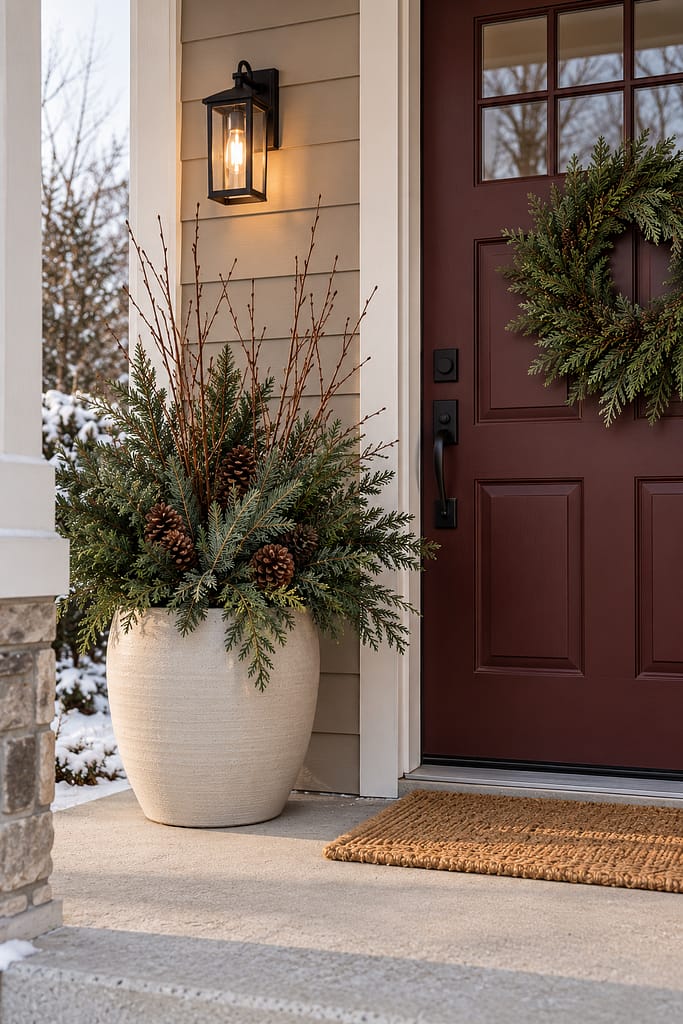
8. Build a Compact Winter Pot for a Small Porch
A small stoop doesn’t need a tiny forest.
Use one medium-size pot.
Keep the evergreen relatively short.
Add three upright branches.
Maybe include a couple of pinecones.
Then stop.
Place the pot on the side of the door where it won’t interfere with the handle or door swing.
Add a wreath to the door if you want more impact without consuming floor space.
The entire setup can be one pot, one wreath, one mat.
That’s plenty.
Your 4-foot-wide stoop does not secretly contain the spatial capacity of a Southern wraparound porch.
Pinterest cannot change physics.

9. Create Matching Winter Pots for a Symmetrical Entrance
If your front entrance is wide enough, matching pots can beautifully frame the door.
Use two identical containers.
Repeat the same greenery.
Use similar branch heights.
Add pinecones in both.
They don’t need to match branch-for-branch.
Actually, please don’t spend your afternoon attempting that.
Nature doesn’t believe in copy and paste.
The containers and overall proportions create enough symmetry.
This works especially well on traditional homes with centered doors.
Add one simple wreath between them and you’re done.

10. Make an Asymmetrical Winter Porch Pot
Not every pot needs a formal shape.
Place taller branches toward one side and the back.
Allow evergreen to extend farther on the opposite side.
Add pinecones near the lower center.
This creates a loose asymmetrical silhouette.
It’s particularly nice with contemporary homes or casual porch styling.
You can also orient the taller side away from the doorway to protect circulation.
Functional asymmetry.
Look at us being artistic and responsible simultaneously.
Who said decorating wasn’t a technical discipline?

11. Add Muted Olive Foliage
Dark evergreen plus muted olive creates subtle variation.
Use evergreen as the main material.
Add a smaller amount of muted olive-toned decorative foliage appropriate for outdoor seasonal use.
Bring in brown branches.
Choose a warm-cream or charcoal pot.
This works beautifully if your front door is burgundy or walnut-toned.
The olive softens the darker greenery without making the arrangement look busy.
Stick to two green families.
We’re creating depth.
Not assembling every shade from the paint store’s green section.

12. Create a Rustic Winter Porch Pot With Wood
Instead of ceramic-look or composite containers, use a properly constructed medium-toned wood planter.
Fill it with evergreen.
Add pinecones.
Bring in bare branches.
Include a small amount of tan dried-looking ornamental grass where appropriate for your conditions.
The wood grain adds warmth against winter greenery.
Keep everything natural.
No distressed sign required.
No miniature sled.
No plaid bow.
Rustic materials are capable of communicating their own aesthetic.
Let them speak.
They’ve rehearsed.

13. Add Subtle Warm Lights
A winter porch pot can look beautiful after sunset with a little light.
Use sparse outdoor-rated warm micro lights where appropriate.
Distribute them gently through evergreen.
Keep the lighting warm and steady.
Don’t wrap every branch until the pot resembles a glowing geometric object from space.
Less is more.
Use products rated for outdoor conditions and follow their installation instructions.
Protect electrical connections appropriately.
Keep cords completely out of walking routes.
Battery-powered outdoor-suitable options may simplify some setups where appropriate.
The goal is soft glow.
Not an electrical engineering side quest.

14. Create a Full Layered Winter Porch Pot
For a fuller display, use a simple four-part formula.
Start with evergreen for volume.
Add bare branches for height.
Use pinecones for texture.
Finish with one accent.
That accent could be burgundy stems.
Muted olive foliage.
Pale branches.
Red-twig-style stems.
Pick one.
Not four.
The limited material palette keeps the arrangement cohesive.
Use a substantial container so the finished display feels properly proportioned.
Then step back.
If you’re thinking, “Maybe it needs one more thing…”
It probably doesn’t.
This is how seasonal containers lure us into unnecessary craft-store purchases.
Stay strong.

What Do You Put in Winter Porch Pots?
You don’t need a complicated materials list.
A few basics can create dozens of different arrangements:
- Evergreen branches for fullness and color
- Bare branches for height
- Pinecones for warm natural texture
- Red-twig-style branches for reddish-brown contrast
- Pale birch-look branches for lighter contrast
- Muted olive foliage for softer green variation
- Burgundy stems for richer color
- Dried-looking ornamental grasses where suitable
- Outdoor-rated warm lights for evening glow
Choose three or four.
That’s enough.
One of the easiest formulas is evergreen + bare branches + pinecones.
If you want more color, add one accent.
The word one is doing important work there.
How to Arrange Winter Porch Pots
Start with the tallest material.
Position your main branches toward the center or back.
Next, add evergreen.
Use longer greenery to establish the overall width.
Fill gaps with shorter pieces.
Then add pinecones or other lower accents.
Finally, step back.
Look at the arrangement from the sidewalk or driveway.
This matters because you’re probably assembling it from approximately 14 inches away while slowly losing perspective.
What looks slightly empty up close may look perfectly balanced from the street.
Make small adjustments.
Then stop.
Stopping remains the advanced level of decorating.
Winter Porch Pots After Christmas
If your porch pots were originally decorated for Christmas, don’t rebuild them.
Edit them.
Remove:
Ornaments.
Bright bows.
Bells.
Candy-cane accessories.
Christmas signs.
Obviously festive picks.
Keep:
Evergreen.
Branches.
Pinecones.
Neutral containers.
Subtle warm lights.
Natural wood.
You may discover that underneath all the Christmas accessories was a perfectly good winter arrangement waiting patiently.
How convenient.
Winter Porch Pots Without Christmas Decor
Think about winter landscapes rather than winter holidays.
Use evergreen.
Bare trees.
Brown pinecones.
Pale bark.
Muted grass.
Dark green.
Warm brown.
Cream.
Charcoal.
Burgundy.
Olive.
These colors and materials feel naturally connected to cold weather.
No ornaments required.
No red bows required.
No decorative snowman supervising the entrance.
Just texture.
Simple, natural texture.
Winter Porch Pots With Evergreen
Evergreen is usually the foundation.
Use it around the perimeter of the container.
Layer branches at different heights.
Allow some pieces to extend naturally over the rim.
Keep other pieces more upright.
If you’re mixing different evergreen textures, make the variation subtle.
You don’t need seven varieties.
The goal is depth.
Not botanical speed dating.
If you’re using real cut greenery, monitor its condition through the season and keep drying material away from unsafe heat and flames.
Winter Porch Pots With Branches
Branches add structure.
Use upright branches for narrow porches.
Use slightly wider branching forms on larger entrances.
Keep them secured.
Place taller material toward the middle or back.
Avoid sharp branches at face level.
Don’t obscure house numbers, doorbells, windows, or exterior lights.
And remember that taller arrangements catch more wind.
If your porch is exposed, shorter may be smarter.
Gravity rarely cares about aesthetics.
Winter Porch Pots With Pinecones
Place pinecones lower in the arrangement.
Tuck them between evergreen branches.
Use a few visible pieces rather than covering the entire surface.
Natural brown provides enough contrast.
You can also repeat pinecones in the door wreath.
That creates a simple connection between the door and container.
If you’re collecting them yourself, follow local rules and source responsibly.
Inspect natural materials before use.
Your porch display does not require a hidden ecosystem.
Winter Porch Pots With Red-Twig-Style Branches
Deep reddish-brown stems are great when you want color without obvious Christmas decorations.
Use them vertically.
Surround them with dark evergreen.
Add pinecones.
Keep the container neutral.
The red-brown tone looks especially good against cream siding and dark doors.
Avoid pairing it with lots of bright red accessories.
Let the branches provide the color.
They’ve got this.
Winter Porch Pots With Birch-Look Branches
Pale branches create contrast.
Use them with dark evergreen.
Add brown pinecones.
Choose a charcoal container.
The result feels crisp without becoming icy.
If you want a warmer version, use a medium-brown container instead.
When using real natural materials, source them legally and responsibly.
Purchased decorative branches or appropriately sourced fallen material may be easier than turning your seasonal project into amateur forestry.
Probably wise.
Winter Porch Pots With Burgundy Accents
Burgundy works particularly well with dark evergreen.
Use just a few stems.
Add brown branches.
Bring in pinecones.
Choose a charcoal or warm-gray pot.
Repeat burgundy elsewhere only once if you want cohesion.
Maybe the front door.
Maybe a protected outdoor cushion.
You don’t need both plus six additional burgundy accessories.
A deep color creates impact quickly.
Let it.
Winter Porch Pots for Small Porches
Keep the arrangement narrow.
Use one pot.
Choose upright branches.
Keep evergreen relatively compact.
Avoid wide cascading pieces near the door.
Add seasonal interest vertically with a wreath.
This gives you two decorated areas while using only one piece of floor space.
Small-space decorating is mostly strategic refusal.
No bench.
No second planter.
No basket.
No decorative stool.
Look at all that money we’re saving.
Winter Porch Pots for Wide Porches
A wider entrance can support two matching containers.
Place one on each side of the door.
Use the same basic materials.
Keep heights similar.
They don’t need to be identical.
If your porch is very wide, you can create a second arrangement near a seating area.
But don’t automatically fill every corner.
The house is allowed to remain visible.
Very important architectural feature.
Winter Porch Pots for Covered Entrances
Covered porches may protect containers from some precipitation, but they remain outdoor environments.
Consider wind.
Temperature.
Light.
Moisture.
If using live plants rather than cut seasonal material, choose species appropriate for the climate and actual growing conditions.
Don’t assume a plant will thrive because Pinterest photographed it near snow.
Plants have requirements.
Inconvenient but true.
Winter Porch Pots for Uncovered Entrances
Choose durable containers.
Use weather-appropriate materials.
Secure branches well.
Keep arrangements compact in exposed locations.
Ensure drainage where necessary.
Use only lighting rated for outdoor conditions.
Consider whether the pot material tolerates freezing temperatures and freeze-thaw cycles if those conditions apply.
Some materials can crack.
And while a dramatically cracked planter certainly has texture, it’s not the texture we were planning.
Winter Porch Pot Color Ideas
Keep the palette limited.
Try:
Evergreen + brown + charcoal
for classic winter.
Evergreen + cream + walnut
for something warmer.
Evergreen + burgundy + chocolate brown
for a rich display.
Evergreen + olive + warm brown
for earthy winter styling.
Evergreen + pale branches + charcoal
for more contrast.
Choose one combination and repeat it throughout the entrance.
Simple palettes usually make inexpensive materials look more intentional.
Neutral Winter Porch Pots
Use charcoal, cream, warm gray, or brown containers.
Fill them with evergreen.
Add bare branches.
Use pinecones.
Skip colorful accents.
The different textures provide plenty of interest.
This is particularly useful if your home’s exterior already has a strong color.
Brick.
Blue siding.
Green door.
Burgundy door.
Let the architecture contribute.
It lives there year-round.
Might as well put it to work.
Rustic Winter Porch Pots
Choose wood containers or warm matte finishes.
Use natural evergreen.
Add pinecones.
Bring in branches.
Use a small amount of dried-looking grass where appropriate.
Keep everything earthy.
Avoid adding a miniature collection of rustic props around the pot.
The container doesn’t need a crate beside it.
And a sled beside the crate.
And a lantern on the sled.
We have entered a nesting-doll situation.
Stop earlier.
Modern Winter Porch Pots
Use clean-lined charcoal containers.
Keep arrangements tall and narrow.
Use fewer materials.
Try evergreen plus bare branches.
Or evergreen plus pale branches.
That’s enough.
Repeat the same pot on both sides of the door for a symmetrical modern entrance.
Choose a simple door wreath or skip it entirely.
Negative space works beautifully with modern styling.
Also conveniently requires no storage bin.
Winter Porch Pots on a Budget
Reuse containers you already own.
Transform Christmas pots by removing festive accessories.
Reuse branches where they’re still in good condition.
Reuse pinecones.
Choose responsibly sourced natural materials where appropriate.
Avoid buying lots of decorative picks.
A good neutral container can be restyled through every season.
That’s where spending a little more may actually make sense.
The accessories?
Those can stay simple.
The tree outside has been making branches for free this whole time.
Though, again, source responsibly.
We are not raiding the neighborhood landscaping.
How to Make Winter Porch Pots Look Expensive
Use a substantial container.
Choose a restrained palette.
Limit the number of materials.
Vary heights.
Use realistic greenery.
Keep branches naturally irregular.
Secure everything neatly.
Avoid excessive shiny finishes.
Repeat materials elsewhere on the porch.
Leave space around the arrangement.
And remove one thing before declaring it finished.
That last trick works suspiciously often.
Expensive-looking seasonal decor is usually less about adding luxury items and more about eliminating visual noise.
Very convenient for the budget.
Should Winter Porch Pots Match?
Matching containers work especially well around symmetrical entrances.
Use the same pot.
Repeat the same materials.
Keep overall heights similar.
Let individual branches vary naturally.
For asymmetrical entrances, you may only need one substantial pot.
Don’t force a pair simply because pairs are popular.
Your architecture gets a vote.
Actually, it gets several votes.
How to Keep Winter Porch Pots From Blowing Over
Choose a stable container with an appropriate base.
Consider how exposed the porch is.
Keep tall arrangements more compact in windy locations.
Secure branches.
Avoid excessively wide shapes.
Add appropriate weight or anchoring only using methods suitable for the planter and installation.
Bring vulnerable decorative components inside before severe weather where appropriate.
And inspect the arrangement periodically.
If the pot starts leaning, that’s feedback.
Listen before the wind completes the redesign.
Protect Winter Porch Pots From Cold Weather
Choose containers rated for the conditions they will experience.
Some materials tolerate freezing and thawing better than others.
Check manufacturer guidance.
Provide drainage where appropriate.
Avoid leaving damaged pots outdoors through severe conditions.
If the arrangement contains live plants, follow species-specific care rather than general decorating advice.
Cut branches and live plants are not interchangeable.
One is decor.
The other has expectations.
Keep Winter Porch Pots Safe Around Walkways
Keep containers outside the primary walking route.
Preserve the full door swing.
Don’t block locks, doorbells, lights, or house numbers.
Keep handrails accessible.
Don’t place large pots on narrow stair treads.
Avoid branches extending at face level.
Keep mats flat around the containers.
And consider deliveries.
A delivery driver carrying a large package should not need professional slalom skills to reach the door.
Beautiful entrance.
Normal entrance.
We can have both.
Use Lights Safely in Winter Porch Pots
Only use lights intended for outdoor conditions.
Follow manufacturer instructions.
Protect connections appropriately.
Keep cords out of walkways.
Don’t pinch cords in doors.
Don’t overload circuits.
Use steady warm light for a subtle winter appearance.
Battery-powered outdoor-suitable lights may be useful in some setups when used as directed.
And avoid combining electrical products with standing water or unsuitable containers.
Cozy lighting is excellent.
Electrical experimentation is not part of the aesthetic.
Keep Dry Materials Away From Flames and Heat
Evergreen, dried grasses, pinecones, bare branches, and wood are combustible.
As natural greenery dries, the risk can increase.
Keep porch pots away from grills, open flames, portable heaters, and other unsafe heat sources.
Don’t place real candles directly inside arrangements.
Use suitable LED alternatives for decorative glow.
Monitor natural materials as the season progresses.
Remove anything deteriorated or excessively dry.
We want winter ambiance.
Not a surprisingly vertical campfire.
When Should You Put Out Winter Porch Pots?
Winter porch pots can replace fall containers as autumn materials fade.
If you decorate for Christmas, you can create evergreen pots in late fall or December and then simplify them after the holiday.
Remove ornaments and bows.
Keep the greenery and natural materials.
That lets one arrangement serve two seasonal phases.
Efficient.
Your storage room approves.
How Long Can Winter Porch Pots Stay Out?
That depends on your climate, weather exposure, and the materials used.
Decorative winter arrangements can stay as long as they remain secure, attractive, and appropriate for the season.
Monitor real greenery.
Replace damaged materials.
Remove excessively dry plant material.
As spring approaches, gradually simplify the arrangement.
Remove evergreen.
Keep a few branches.
Then transition the container to appropriate spring planting when conditions allow.
No dramatic overnight seasonal change required.
The porch can ease into spring like the rest of us.
Final Thoughts
The best winter porch pots ideas for beautiful cold-weather displays don’t require complicated materials.
Start with evergreen.
Add branches.
Bring in pinecones.
Then choose one optional accent.
Deep burgundy.
Muted olive.
Pale branches.
Red-twig-style stems.
Or subtle warm lighting.
Use a cream pot for a softer look.
Choose charcoal for something modern.
Bring in wood for rustic warmth.
Create one compact arrangement for a small stoop.
Or use matching pots to frame a wider entrance.
Most importantly, design the arrangement for your actual porch and weather.
Keep containers stable.
Secure branches.
Maintain clear steps and walkways.
Use outdoor-rated products correctly.
And know when the arrangement is finished.
Because sometimes the most sophisticated thing you can add to a winter porch pot is absolutely nothing.