

17 Winter Window Boxes Ideas for Beautiful Cold-Weather Planters
Window boxes don’t have to sit empty just because summer flowers are finished.
Actually, winter may be one of the easiest seasons to style them.
You don’t need complicated flower combinations or constant blooms. A few evergreen branches, bare twigs, pinecones, muted foliage, and natural textures can turn an empty box into a beautiful cold-weather display.
And winter window boxes don’t automatically have to become Christmas decorations.
Skip the shiny ornaments, giant bows, bells, and bright holiday picks, and your arrangement can comfortably stay outside long after December.
The best winter window boxes ideas also respect the practical stuff.
The box needs to be securely installed.
Drainage still matters.
Branches shouldn’t cover the window.
Decor shouldn’t interfere with shutters, walkways, vents, or exterior fixtures.
And everything needs to tolerate the actual weather conditions where you live.
Because a Pinterest-worthy window box that relocates itself during the first windy afternoon is perhaps a little too dynamic.
Let’s keep the movement in the branches.
Here are 17 winter window boxes ideas for beautiful cold-weather planters that work on realistic American homes, cottages, porches, and small exteriors.
1. Fill a Window Box With Classic Evergreen Branches
Start with the easiest winter formula.
Fill the window box with layered natural-looking evergreen branches.
Use slightly longer pieces toward the back.
Allow shorter greenery to spill gently over the front edge.
Keep the arrangement loose.
Don’t trim everything into a perfect hedge.
The variation in branch direction gives the box a more natural look.
A charcoal, warm-gray, or medium-brown window box provides an easy neutral foundation.
And if you originally created the arrangement for Christmas?
Remove the ornaments and ribbon.
Congratulations.
Your Christmas window box has received its January promotion.

2. Mix Evergreen With Bare Winter Branches
Evergreen provides fullness.
Bare branches provide structure.
Combine both.
Fill the lower section with dark greenery.
Then insert several slender bare brown twigs toward the back.
Keep them low enough that they don’t cover the window.
This creates height while preserving the view.
The brown branches also warm up all that green.
Add a few pinecones if you want another texture.
Then stop.
The window box doesn’t need 11 botanical ingredients.
It’s a planter.
Not soup.

3. Add Pinecones for Natural Texture
Pinecones are practically designed for winter window boxes.
Nestle several natural brown pinecones among the evergreen.
Keep them toward the front so they’re visible from the yard or sidewalk.
Use different natural sizes if you like.
Avoid covering the entire arrangement.
Three, five, or seven may be plenty depending on the size of the box.
Pair them with dark evergreen and warm-brown twigs.
Simple.
Textural.
Seasonal.
And no glitter required.
Nature spent quite a while designing pinecones.
It seems rude to assume they immediately need craft-store enhancement.

4. Create a Red-Twig-Style Winter Window Box
Deep reddish-brown branches can add winter color without making the box look Christmasy.
Use evergreen as the foundation.
Add red-twig-style branches toward the back.
Keep the stems below the main window sightline.
Add a few pinecones.
Use a charcoal or warm-gray box.
The reddish branches look especially beautiful against cream or pale greige siding.
They’re colorful enough to create contrast.
But natural enough to stay appropriate through January and February.
Basically, they’re red with excellent seasonal boundaries.
Respect.

5. Add Burgundy Accents
Burgundy works beautifully with winter greenery.
Use just a few deep muted burgundy decorative botanical stems appropriate for outdoor seasonal display.
Place them among dark evergreen.
Add brown twigs.
Use natural pinecones.
The burgundy gives the box depth without looking bright or overly festive.
This is especially pretty if your home already has a burgundy front door.
You get repetition across the exterior without matching every single object.
Coordinated.
Not cloned.
Much healthier relationship.

6. Use Pale Birch-Look Branches
Pale branches provide beautiful contrast against dark evergreen.
Add three to five birch-look or naturally pale decorative branches toward the back of the window box.
Keep them short enough to preserve the window view.
Surround them with evergreen.
Add a few pinecones.
A charcoal window box makes the pale bark particularly noticeable.
This creates a crisp winter look without needing artificial snow.
Which is useful because fake snow occasionally has a special talent for looking like shaving cream.
Natural contrast is easier.
And considerably less foamy.

7. Create a Neutral Winter Window Box
Winter decor doesn’t require lots of color.
Build the arrangement around green, cream, warm brown, and charcoal.
Use dark evergreen.
Add brown branches.
Bring in pinecones.
Choose a warm-cream or charcoal window box.
That’s it.
The contrast between the foliage, bark, and container creates enough interest.
This works especially well on homes with stronger architectural colors.
Brick.
Blue-gray siding.
Olive doors.
Burgundy doors.
Neutral window boxes let the house participate.
It has been standing there all year.
Might as well give it a role.

8. Add Muted Olive Foliage
Mixing two green families creates subtle depth.
Start with dark evergreen.
Add a smaller amount of muted olive-toned foliage suitable for outdoor seasonal use.
Bring in brown branches.
Use a charcoal or cream window box.
The olive softens the deeper green without introducing another strong color.
This is particularly good if your exterior already uses earthy shades.
Warm cream.
Walnut.
Burgundy.
Olive.
Apparently these colors refuse to stop getting along.
I’m not going to interfere.

9. Create a Compact Window Box for a Small House
A small exterior doesn’t need an oversized arrangement.
Keep the greenery relatively low.
Use short evergreen branches.
Add three or four upright twigs.
Include several pinecones.
Keep everything close to the window box.
This is particularly useful on cottage-style homes, small porches, or windows near walkways.
You still get seasonal texture without turning the window into a botanical disguise.
Windows have jobs.
Mostly involving light and seeing things.
Let’s allow them to continue.

10. Create a Full Cascading Evergreen Window Box
For a slightly fuller look, let some evergreen branches extend gently over the front edge.
Use longer flexible greenery along the front.
Keep more upright evergreen toward the back.
Add pinecones between the layers.
The effect should look loose and natural rather than like a perfectly symmetrical garland.
Be careful not to create excessively long hanging branches over walkways or siding features.
A little cascade?
Beautiful.
Window box attempting to reach the foundation?
Ambitious.
Trim accordingly.

11. Make an Asymmetrical Winter Window Box
Window boxes don’t need to be perfectly balanced.
Place taller branches toward one end.
Use fuller evergreen toward the opposite side.
Add pinecones through the middle.
This creates an asymmetrical arrangement that feels relaxed and natural.
It works especially well on modern or cottage-style exteriors.
Just make sure the taller side isn’t blocking a shutter, window opening, light fixture, or important sightline.
Artistic freedom still has to respect architecture.
The window was there first.
It has seniority.

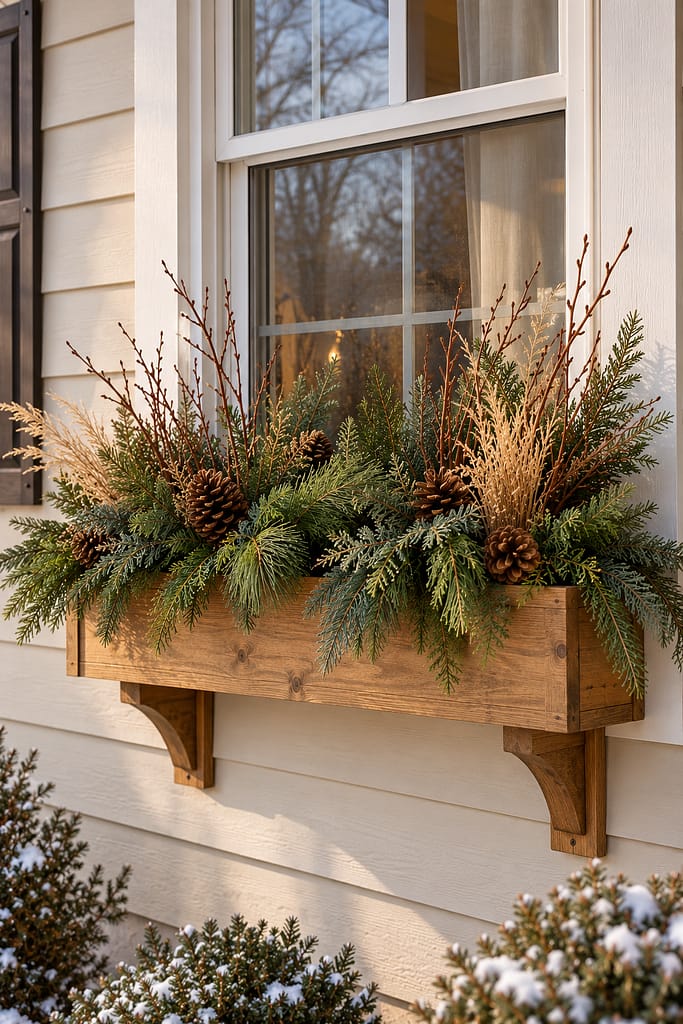
12. Create a Rustic Wood Winter Window Box
A wood window box brings warmth to an exterior immediately.
Choose a properly constructed medium-toned outdoor wood box.
Fill it with evergreen.
Add pinecones.
Use bare branches.
Bring in a small amount of dried-looking ornamental grass where appropriate.
Keep the palette natural.
The visible wood grain already provides plenty of rustic character.
You don’t need to hang a wooden sign beside it explaining the situation.
The wood has spoken.
Message received.
13. Create a Modern Charcoal Window Box
For a modern exterior, simplify.
Use a clean-lined matte charcoal window box.
Fill it with one main evergreen texture.
Add a few sculptural bare branches.
Skip pinecones if you want an especially minimal look.
Keep the overall shape controlled and relatively low.
This works beautifully against cream, greige, or medium-brown exteriors.
And because you’re using only two materials, there’s less visual clutter.
Also less shopping.
Modern design continues making a surprisingly compelling financial argument.

14. Add Soft Warm Winter Lights
A little light can make window boxes beautiful after sunset.
Use sparse outdoor-rated warm micro lights where suitable.
Distribute them subtly through evergreen.
Keep the light warm and steady.
Avoid wrapping every individual branch.
We’re creating gentle evening texture.
Not outlining the box for air-traffic visibility.
Use outdoor-rated electrical products correctly.
Protect connections according to manufacturer instructions.
Keep wiring away from windows, moving parts, and walking routes.
Battery-powered outdoor-suitable lights may work for some setups when used as directed.

15. Repeat Matching Winter Window Boxes
If your home’s facade has two or three matching windows, repeating the same arrangement creates a polished look.
Use matching window boxes.
Fill each with similar evergreen.
Repeat the same branch material.
Add pinecones consistently.
They don’t need to be identical.
Actually, slight variation makes them look more natural.
Keep the heights roughly consistent.
The repeated rhythm ties the exterior together.
And unlike decorating each window differently, you only have to make one design decision.
Then copy the recipe.
Excellent.
Decision fatigue has left the building.

16. Build a Moody Burgundy Winter Window Box
For a deeper winter palette, combine evergreen with burgundy and chocolate brown.
Use dark greenery as the base.
Add a small number of burgundy stems.
Bring in dark brown branches.
Finish with pinecones.
Choose a charcoal window box.
This looks particularly beautiful against warm-cream siding.
If you have a burgundy door elsewhere on the facade, even better.
The repeated color creates cohesion without needing identical decorations everywhere.
Keep the burgundy muted.
Bright red changes the mood immediately.
Suddenly Santa is involved.
We were doing so well.

17. Build a Full Layered Winter Window Box
For the fullest display, use a simple formula.
Evergreen for volume.
Branches for structure.
Pinecones for texture.
One accent for contrast.
The accent could be burgundy stems.
Muted olive foliage.
Pale branches.
Or red-twig-style stems.
Choose one.
Layer shorter evergreen toward the front.
Use taller materials toward the back.
Keep the center full but not packed.
And maintain a clear view through the window.
The finished box should complement the architecture.
Not attempt to consume it.
Very important distinction.
Your house is not becoming a hedge.

What Do You Put in Winter Window Boxes?
Winter window boxes don’t need flowers to look finished.
Try a combination of:
- Evergreen branches for volume
- Bare branches for height and structure
- Pinecones for texture
- Red-twig-style branches for natural reddish color
- Pale birch-look branches for contrast
- Muted olive foliage for softer green variation
- Burgundy stems for deeper color
- Dried-looking ornamental grasses where appropriate
- Outdoor-rated warm micro lights for evening interest
Choose three or four materials.
Not nine.
A very reliable formula is evergreen + branches + pinecones.
Then decide whether the arrangement actually needs another accent.
Sometimes it doesn’t.
That’s allowed.
How to Make Winter Window Boxes
First, inspect the window box itself.
Make sure it’s securely mounted and appropriate for outdoor use.
Check the support brackets.
Check drainage.
Look for damage.
A full winter arrangement can become heavier when wet or loaded with snow or ice, depending on your climate.
The installation needs to handle actual conditions—not just look nice in a photograph.
Then add your materials.
Start with taller branches toward the back.
Add evergreen through the middle.
Use softer or slightly cascading greenery along the front.
Finish with pinecones and your optional accent.
Step back.
Look at the entire window.
Make sure the arrangement doesn’t cover too much glass.
Then make adjustments.
The view from inside counts too.
How to Arrange Evergreen in Window Boxes
Use a layered approach.
Place more upright greenery toward the back.
Fill the middle with medium-length branches.
Use slightly softer pieces along the front edge.
Let some extend over the box naturally.
Avoid creating a perfectly flat horizontal line.
A little irregularity looks more organic.
If you’re using multiple evergreen types, keep the combination restrained.
Two textures may be plenty.
Seven varieties start to feel less like a window box and more like a landscaping résumé.
Winter Window Boxes After Christmas
You probably don’t need to rebuild them.
Remove:
Ornaments.
Bright bows.
Bells.
Holiday signs.
Candy-cane accessories.
Obviously Christmas-specific picks.
Keep:
Evergreen.
Bare branches.
Pinecones.
Natural wood.
Neutral containers.
Subtle warm lighting.
You can also keep burgundy or reddish-brown branches if they feel natural rather than overtly festive.
Often the difference between a Christmas window box and a winter window box is approximately four ornaments and one enormous bow.
Excellent news for January energy levels.
Winter Window Boxes Without Christmas Decor
Focus on what the landscape actually looks like during winter.
Dark evergreen.
Bare brown branches.
Pale bark.
Pinecones.
Muted grasses.
Olive foliage.
Cream.
Charcoal.
Warm brown.
Burgundy.
Avoid shiny decorations.
The result will feel seasonal without belonging to a specific holiday.
This makes it much easier to leave the arrangement up through the colder months.
Nobody will look at it in February and wonder whether you’ve lost track of the calendar.
Always a decorating success.
Winter Window Boxes With Evergreen
Evergreen is usually the easiest foundation.
It provides color when many other plants are dormant.
Use cut branches for decorative arrangements where appropriate, or live plants suited to the container and climate if you’re creating an actual planted box.
Those are different situations.
Live plants need proper growing conditions.
Cut branches need monitoring as they dry.
Know which one you’re working with.
Your greenery deserves accurate job classification.
Winter Window Boxes With Pinecones
Pinecones work best as a lower accent.
Place them between evergreen branches.
Use enough to be visible.
Don’t cover the entire box.
Natural brown creates beautiful contrast against green.
You can repeat the same pinecones in nearby porch planters or a door wreath to tie the exterior together.
If collecting them, source responsibly and legally.
Inspect natural materials before use.
The window box is for seasonal texture.
Not biodiversity research.
Winter Window Boxes With Birch-Look Branches
Pale branches stand out beautifully against evergreen.
Use them sparingly.
Place several toward the back.
Keep them below the main glass area.
Pair with pinecones.
Use a dark window box for contrast.
The combination looks especially good against cream or greige siding.
And unlike artificial snow, pale bark doesn’t require pretending your house has experienced an extremely localized weather event.
Much easier.
Winter Window Boxes With Red-Twig-Style Branches
Use reddish-brown branches vertically.
Keep them below the main sightline.
Surround them with evergreen.
Add pinecones.
A neutral container lets the branch color stand out.
This combination works beautifully through the heart of winter because the reddish stems feel botanical rather than decorative.
Again:
Deep reddish brown.
Not candy-apple red.
The difference is doing substantial aesthetic work.
Winter Window Boxes With Burgundy
Burgundy is useful when you want richer color.
Add only a few stems.
Pair them with evergreen.
Bring in chocolate-brown branches.
Use natural pinecones.
Keep the container charcoal, warm gray, or cream.
Repeat burgundy somewhere else on the exterior if you want cohesion.
A door.
A protected cushion.
Maybe another planter.
One repetition is enough.
The house does not need a burgundy loyalty program.
Winter Window Boxes for Small Homes
Keep the arrangement low and controlled.
Use compact evergreen.
Add a few upright branches.
Avoid dramatic cascading material.
Keep the window fully functional.
If the box sits near a narrow walkway, make sure nothing projects far enough to interfere with people passing.
Small houses often look better with restrained window boxes anyway.
The architecture stays visible.
The planter adds detail.
Everyone keeps their assigned role.
Very organized.
Winter Window Boxes for Farmhouse Exteriors
Use medium-toned wood window boxes or simple matte containers.
Fill them with evergreen.
Add bare branches.
Bring in pinecones.
Use a small amount of dried-looking grass if appropriate.
Keep the styling natural.
Avoid adding lots of signs, plaid bows, and novelty pieces.
Farmhouse style doesn’t require text explaining itself.
Wood plus greenery plus warm natural texture?
Message received.
Modern Winter Window Box Ideas
Choose clean-lined charcoal boxes.
Use fewer materials.
Try evergreen and sculptural branches.
Or evergreen and pale branches.
Keep the shape relatively low.
Repeat matching boxes across multiple windows.
Skip excessive cascading greenery.
The repeated dark containers create strong architectural lines.
And because modern styling rewards restraint, you’re allowed to stop early.
Rare and beautiful permission.
Rustic Winter Window Box Ideas
Choose visible wood grain.
Use evergreen.
Add pinecones.
Bring in warm-brown branches.
Include muted dried grasses where appropriate.
Keep the materials slightly loose and natural.
Avoid excessive symmetry.
Rustic arrangements can feel a little more organic.
Just don’t confuse organic with unsecured.
The wind has no respect for design genres.
Neutral Winter Window Box Ideas
Stick with:
Dark green.
Warm brown.
Cream.
Charcoal.
Mushroom.
Use texture rather than bright color.
Evergreen against a cream planter can look beautiful.
So can dark greenery against charcoal.
Natural branches keep everything warm.
This palette also makes the transition into early spring easier.
The container itself doesn’t have to change.
Just the contents.
Seasonal efficiency continues its winning streak.
Winter Window Boxes on a Budget
Reuse existing boxes.
Transform Christmas arrangements by removing holiday pieces.
Use existing evergreen where it’s still in appropriate condition.
Reuse pinecones.
Reuse decorative branches.
Choose responsibly sourced natural materials where appropriate.
If you’re buying anything new, prioritize the actual window box and secure mounting hardware.
A good container can serve you through multiple seasons.
Winter greenery now.
Spring planting later.
Summer flowers after that.
Fall foliage eventually.
Very hardworking rectangle.
How to Make Winter Window Boxes Look Expensive
Use a limited palette.
Choose realistic greenery.
Vary branch lengths.
Keep pinecones natural-looking.
Repeat the same materials across multiple boxes.
Make sure containers are securely and neatly installed.
Hide or minimize unnecessary visible wiring.
Avoid excessive shiny accessories.
Leave some natural irregularity.
And don’t overfill.
Expensive-looking arrangements tend to feel deliberate.
Every branch appears to have a reason for being there.
Even if the actual reason was, “I had three left in the garage.”
Nobody needs to know.
Should Winter Window Boxes Match?
If multiple boxes appear on the same facade, using the same basic recipe usually creates the most cohesive result.
Use matching containers.
Repeat your main evergreen.
Repeat branch types.
Keep heights similar.
Let small details vary.
You don’t need identical pinecone placement.
Please value your time.
If the windows differ significantly in size, adjust each arrangement proportionally rather than forcing identical designs.
Consistency is useful.
Rigidity isn’t.
How to Secure Winter Window Boxes
The container itself needs secure support before you think about decorating it.
Use mounting systems appropriate for the window box, wall construction, expected load, and manufacturer requirements.
Remember that moisture, snow, ice, soil, plants, and decorative materials can add weight.
Don’t improvise structural mounting.
If you’re unsure whether an existing box is safely installed, have it properly evaluated before loading it.
Then secure decorative branches so they can’t easily blow loose.
The prettiest arrangement in the world becomes considerably less charming after gravity gets involved.
Protect Winter Window Boxes From Weather
Choose containers designed for outdoor conditions.
Consider rain.
Wind.
Snow.
Ice.
Freeze-thaw cycles.
Sun exposure.
Different materials respond differently to winter conditions.
Ensure drainage remains functional where appropriate.
Inspect boxes periodically.
Replace damaged or deteriorating materials.
If you’re using live plants, follow plant-specific winter care.
If you’re using cut greenery, monitor drying.
Decorative branches and living plants have very different HR departments.
Treat them accordingly.
Keep Window Boxes Clear of the Window
Don’t cover too much glass.
Avoid blocking operable window sections.
Keep branches away from shutters.
Don’t obstruct exterior vents.
Keep arrangements clear of nearby lights and electrical fixtures.
If the window serves as an emergency egress point, don’t create an arrangement or installation that interferes with its required operation or access.
Seasonal decorating does not outrank safety.
Not even really good pinecones.
Use Lights Safely in Winter Window Boxes
Only use lights designed for outdoor use.
Follow manufacturer instructions.
Protect electrical connections appropriately.
Don’t pinch cords through windows.
Keep wiring secure.
Avoid loose cords hanging down the exterior.
Don’t overload electrical circuits.
Use subtle warm steady lights if you want a non-Christmas appearance.
And keep electrical products compatible with the actual weather exposure.
Water and improvised electrical installations remain famously poor collaborators.
Keep Dry Winter Materials Away From Heat and Flame
Evergreen, pinecones, dried grasses, wood, and bare branches can be combustible.
Real greenery becomes drier over time.
Keep window boxes away from unsafe heat sources and open flames.
Don’t place real candles in window boxes.
Use appropriate outdoor LED products if you want light.
Monitor the condition of natural material.
Remove anything excessively dry or deteriorated.
Your winter window box should provide visual warmth.
Literal warmth is outside its job description.
When Should You Put Out Winter Window Boxes?
You can transition fall boxes as autumn displays fade.
If you decorate for Christmas, evergreen window boxes can go up during the holiday season and then be simplified afterward.
Remove the holiday pieces.
Keep the natural winter materials.
This gives you a longer useful season from the same arrangement.
Depending on your climate, winter window boxes may remain appropriate through February or even into early spring.
The weather gets a vote.
A rather powerful one.
How Long Should Winter Window Boxes Stay Up?
Keep them while they remain attractive, secure, and appropriate for your local season.
Replace dried or damaged greenery.
Remove loose branches.
Check the container and mounting.
As winter begins transitioning into spring, simplify gradually.
Remove dense evergreen.
Keep some structural branches if appropriate.
Then replace the arrangement with spring planting when local conditions allow.
No midnight seasonal swap required.
Your neighbors probably weren’t monitoring that closely anyway.
Final Thoughts
The best winter window boxes ideas for beautiful cold-weather planters rely on a few simple materials.
Start with evergreen.
Add bare branches.
Bring in pinecones.
Then choose one accent.
Deep burgundy.
Muted olive.
Pale birch-look branches.
Red-twig-style stems.
Or subtle warm lights.
Use wood boxes for rustic warmth.
Choose charcoal for a cleaner modern exterior.
Keep arrangements compact on smaller homes.
Repeat matching boxes across wider facades.
And above all, make sure the installation is secure and appropriate for actual winter conditions.
Keep windows functional.
Maintain drainage.
Control branch height.
Use outdoor-rated products correctly.
And resist adding one more decorative pick just because there’s technically room.
A winter window box doesn’t need to contain everything associated with winter.
Sometimes evergreen, branches, and a few pinecones are already doing the whole job beautifully.