

11 Porch Enclosure Ideas for Winter for a More Usable Outdoor Space
A porch can be one of the nicest parts of a home—right up until winter decides otherwise.
Cold wind starts cutting through the seating area.
Rain or snow blows sideways.
Furniture stays damp.
And suddenly that cute outdoor chair becomes something you admire exclusively through the window.
The good news?
You don’t necessarily need to build an expensive four-season room to make a porch more useful during colder months.
There are plenty of porch enclosure ideas for winter ranging from removable clear panels and outdoor curtains to framed screen-panel systems and more permanent glass enclosures.
The right choice depends on your porch, climate, budget, local building requirements, and how you actually want to use the space.
Maybe you simply want to block wind.
Maybe you need better protection for outdoor furniture.
Or perhaps you’re considering converting an existing covered porch into a genuinely conditioned room.
Those are very different projects.
And one important note before we get creative: enclosing a porch can change ventilation, structural loads, emergency egress, moisture behavior, and requirements for electrical work or heating. Permanent installations may require permits or professional design depending on your location.
So yes, we’re making the porch cozy.
But we’re keeping physics invited to the meeting.
Here are 11 porch enclosure ideas for winter for a more usable outdoor space.
1. Install Clear Removable Porch Panels
If you want to block cold wind without losing daylight, clear removable panels can be a practical option for some covered porches.
The concept is simple.
Panels fit into or over existing porch openings and create a transparent wind barrier.
Because they’re clear, you can still see the yard.
And when warmer weather returns, a properly designed removable system can be taken down.
This works particularly well when your main problem is wind rather than extreme cold.
Choose exterior-rated products specifically designed for the application rather than improvising with random plastic sheets.
The panels need secure attachment.
Loose material and winter wind are not a productive partnership.
Also remember that closing porch openings changes airflow.
Don’t use fuel-burning appliances or other equipment requiring ventilation inside an enclosed area unless the space and appliance have been professionally designed for that use.
Your porch should become less windy.
Not unexpectedly complicated.

2. Use Clear Roll-Down Porch Curtains
A roll-down system gives you more flexibility.
Install exterior-rated clear curtains or roll-down panels designed for porch use.
Lower them when wind or precipitation becomes a problem.
Raise them when conditions improve.
This can work nicely for a porch that’s used differently throughout the year.
Clear material also preserves natural light better than opaque curtains.
The key is proper installation.
The upper hardware needs secure structural attachment.
The sides and bottom need an appropriate method of controlling movement.
And the system should be rated for the conditions it will experience.
Because a giant clear curtain flapping dramatically during a storm is less “cozy winter porch.”
More “low-budget sailing experiment.”

3. Add Outdoor Curtains for Partial Wind Protection
Not every porch needs to become completely enclosed.
On a protected porch, heavy exterior-rated curtains can provide partial wind protection and make the space feel more sheltered.
Use them on one or two particularly exposed sides.
Choose mushroom, warm greige, or cream for a soft neutral look.
Mount the curtain hardware securely to appropriate structural elements.
Add suitable tiebacks so the panels can be controlled when open.
This isn’t the same as weatherproofing a porch.
Curtains won’t create a sealed room.
But they can make a noticeable difference where you’re mainly trying to reduce drafts and visual exposure.
They’re also softer than clear panels.
Just choose products intended for exterior conditions.
Your indoor linen curtains have not trained for this assignment.

4. Install Framed Clear Panels Between Porch Posts
For a cleaner appearance, consider rigid framed clear panels fitted between existing porch posts.
Compared with flexible curtains, framed panels can create a more architectural look.
The frames might use exterior-appropriate materials designed for the system.
Depending on the product and installation, some sections may be removable seasonally.
This works especially well on porches with evenly spaced structural posts because each opening becomes a natural panel location.
The result can feel almost like a simple sunroom while remaining visually connected to the outdoors.
But measure carefully.
And don’t assume existing railings, posts, headers, or floors are suitable for supporting an enclosure without evaluation.
The porch existed first.
The new enclosure has to cooperate with it.
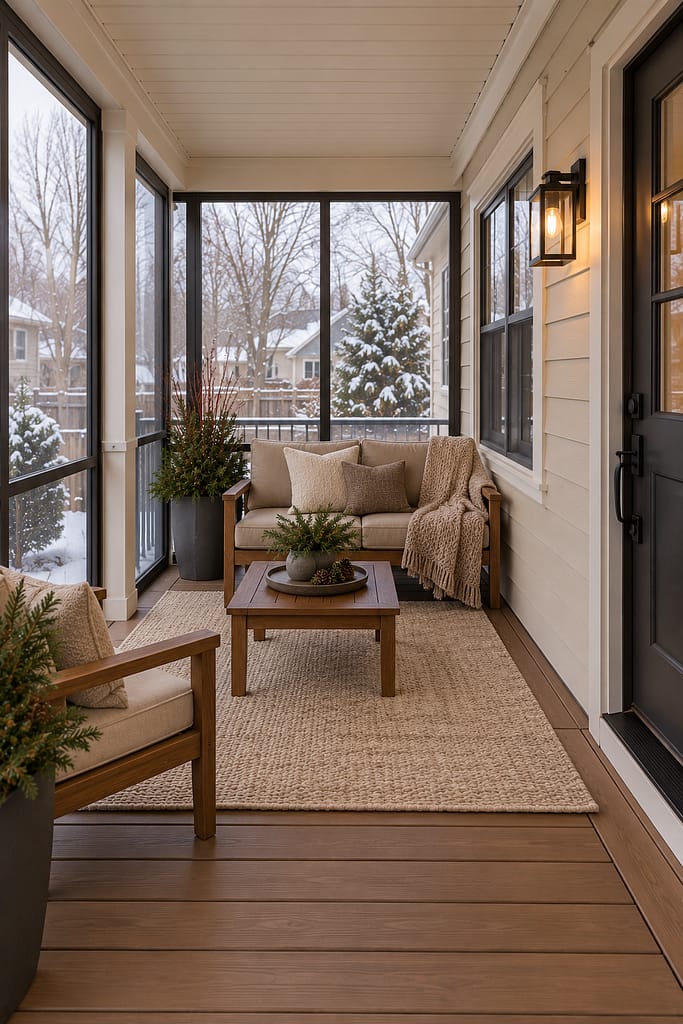
5. Use Removable Screen-and-Panel Inserts
If your porch already has screened openings, consider whether the system supports seasonal clear inserts or interchangeable panels.
During warmer months, screens provide airflow.
During colder weather, compatible clear panels can reduce wind and precipitation.
This can make a screened porch more versatile without permanently converting it into an interior room.
The exact system matters.
Use inserts designed for the existing framing or have an appropriate system professionally fitted.
Don’t simply cover screens in ways that could damage framing, trap moisture, or create unsafe wind loads.
Done properly, though, this is one of the neatest ways to get more seasonal use from an existing screened porch.
Summer ventilation.
Winter protection.
Same porch.
Look at it multitasking.

6. Enclose One Exposed Side of the Porch
Sometimes the entire porch isn’t the problem.
One side is.
If prevailing winter wind or rain consistently enters from one direction, enclosing only the most exposed side may provide useful protection while preserving more openness elsewhere.
Depending on the porch, that might involve a properly designed clear panel system, exterior-rated curtain, or other weather-rated barrier.
This can be more affordable and visually lighter than enclosing everything.
It’s especially useful for covered side porches and back porches.
Pay attention to where water goes after the barrier is installed.
Changing wind and rain patterns can shift moisture toward floors, walls, thresholds, or other areas.
Water is remarkably talented at finding whatever detail you forgot to consider.
Plan accordingly.

7. Create a Winter-Enclosed Porch Seating Nook
If you don’t need the entire porch for winter use, concentrate protection around a smaller seating zone.
Use an appropriate enclosure system along the exposed perimeter.
Then create a compact seating nook inside.
Add two outdoor chairs.
Use weather-appropriate cushions.
Bring in a small rug suitable for the protected conditions.
Add a sturdy side table.
Keep the layout compact and leave circulation open.
This works particularly well on longer porches where only one section gets regular use.
You don’t need to transform 200 square feet when everyone inevitably sits in the same 40 square feet anyway.
Humans are very predictable furniture users.
Use that information.

8. Convert a Screened Porch With Clear Winter Panels
A screened porch is already halfway toward being enclosed.
For colder months, a compatible clear winter panel system can reduce wind while maintaining the view.
The panels may fit over or replace screened sections depending on the design.
Keep the interior styling simple.
A small outdoor sofa.
Two chairs.
A low table.
Warm cream and camel textiles.
Maybe a muted olive cushion.
The enclosure itself provides most of the transformation.
Don’t immediately fill the room with indoor furniture unless the space truly provides the temperature and moisture control those materials require.
A protected porch and an interior living room are not automatically the same thing.
Your upholstered sofa would like you to understand the distinction.

9. Create a More Permanent Glass-Enclosed Porch
If you want substantially more seasonal use, a professionally designed glass porch enclosure may be worth considering.
This is a much larger project.
Existing porch framing, foundation, roof, drainage, windows, doors, insulation, ventilation, electrical systems, and local building requirements may all come into play.
Done properly, however, the result can create a bright protected space that feels connected to the yard.
Use realistically sized windows rather than enormous luxury glass walls.
Keep the interior attainable.
Medium walnut.
Warm cream.
Camel.
Muted olive.
A modest rug.
Simple seating.
If you intend to heat or cool the enclosure as conditioned living space, treat that as a real building conversion—not a decorating project.
Because at that point, you’re not just hanging curtains anymore.
The building inspector may have entered the chat.

10. Create a Three-Season Porch With Operable Windows
A three-season porch can provide more protection while preserving ventilation during warmer months.
Use properly installed operable windows or porch window systems.
In winter, the windows close to reduce wind and precipitation.
During milder weather, they can open for airflow.
This creates much more flexibility than a permanently sealed clear panel.
However, a three-season porch usually shouldn’t automatically be treated as fully conditioned living space.
Its thermal performance may differ significantly from the rest of the home.
Use furniture and finishes appropriate for those conditions.
Add a camel outdoor-style sofa.
Use cream cushions.
Bring in warm wood.
Keep the palette cozy.
Let the windows do the technical work.

11. Build a Full Four-Season Porch Conversion
If your goal is to use the porch comfortably throughout winter in a cold climate, you may ultimately need a true four-season conversion.
That’s a construction project.
Not a weekend decorating hack.
A properly designed conversion may involve:
Insulation.
Weather-resistant exterior assemblies.
Appropriate windows and doors.
Air sealing.
Moisture management.
Electrical work.
Heating and cooling.
Structural evaluation.
Foundation considerations.
Roof details.
Local permits.
Once completed properly, though, the former porch can function much more like an interior room.
Decorate it accordingly.
Use warm-cream walls.
Medium-walnut flooring.
A camel loveseat.
Mushroom textiles.
A burgundy cushion.
Warm 3000K lighting.
And large—but realistically proportioned—windows overlooking the winter yard.
It’s the biggest investment on this list.
But it’s also the option that most fundamentally changes how the space can be used.
Just don’t start by buying the sofa.
Start with the building.
The sofa is notoriously poor at structural engineering.

What Is the Best Way to Enclose a Porch for Winter?
That depends on what you’re trying to achieve.
If your main problem is wind, removable clear panels or exterior-rated curtains may be enough.
If you already have a screened porch, compatible seasonal inserts may be a logical solution.
If you want better weather protection for several months, framed clear panels or an appropriate three-season system may make more sense.
If you want the porch to function like an interior room throughout a cold winter, you’re moving into four-season conversion territory.
Those are very different levels of enclosure.
Don’t buy a temporary wind-blocking product and expect it to perform like an insulated wall.
And don’t build permanent walls when all you really wanted was somewhere less windy to drink coffee.
Define the goal first.
Your budget will appreciate the clarity.
Temporary vs. Permanent Porch Enclosures
Temporary or seasonal enclosures are useful when you want flexibility.
Examples include:
- Removable clear panels
- Compatible seasonal screen inserts
- Exterior-rated roll-down clear curtains
- Heavy outdoor curtains
- Removable framed systems
These may primarily reduce wind and precipitation exposure rather than creating a conditioned room.
Permanent enclosures are different.
They can involve:
- Framed walls
- Windows
- Exterior doors
- Insulation
- Electrical work
- Heating and cooling
- Moisture management
- Structural modifications
That’s renovation territory.
If you’re changing the building envelope or converting the porch into living space, check local requirements and involve qualified professionals where appropriate.
Clear Porch Enclosure Ideas for Winter
Clear materials are popular because they preserve daylight and outdoor views.
You can potentially use:
Clear roll-down panels.
Rigid transparent panels.
Compatible seasonal inserts.
Permanent windows.
The right solution depends on the existing porch.
Flexible clear panels may work for seasonal wind protection.
Rigid framed panels create a cleaner architectural appearance.
Permanent windows provide a much more substantial enclosure.
Whatever you choose, use products intended for the actual exterior application.
Random clear plastic from the garage is not automatically a porch enclosure system.
Enthusiasm is not a building material.
Porch Enclosure Ideas on a Budget
If you’re mainly trying to reduce wind, start small.
Identify the most exposed side.
You may not need to enclose the entire porch.
One properly installed exterior-rated curtain or seasonal panel system could make the seating area more comfortable.
If you already have screens, investigate whether compatible clear inserts are available.
Reuse existing outdoor furniture.
Add only a few weather-appropriate textiles.
And don’t spend heavily on interior-style decor until you understand how much moisture and temperature variation the enclosed porch will still experience.
Protect the building first.
Decorate second.
Pinterest will survive the delay.
Porch Enclosure Ideas for Small Porches
Small porches usually benefit from simple systems.
Clear panels preserve visual openness.
Use slim framing where structurally appropriate.
Keep furniture compact.
Try two chairs rather than a sofa.
Use one small table.
Avoid adding bulky storage cabinets.
Preserve the primary walking route from the house to the exterior.
A small porch can feel surprisingly comfortable when wind is controlled.
But it can also feel surprisingly tiny once you add three chairs, a bench, coffee table, floor lamp, storage chest, and 11 pillows.
The square footage has limits.
Negotiate respectfully.
Porch Enclosure Ideas for a Screened Porch
Screened porches are often good candidates for seasonal adaptation because openings already have defined frames.
Possible approaches include compatible clear inserts or purpose-designed seasonal panels.
Some homeowners may consider more permanent window systems.
The right choice depends on the existing structure.
Before adding panels, check:
Frame condition.
Structural attachment.
Water drainage.
Screen configuration.
Door operation.
Roof condition.
Electrical installations.
And any applicable local requirements.
Don’t assume screens can simply be sealed over without consequences.
Moisture still needs somewhere sensible to go.
It always finds somewhere.
The question is whether you planned for it.
Porch Enclosure Ideas for a Front Porch
Front porches need special attention to appearance and access.
Keep the main entrance visually obvious.
Preserve door swing.
Don’t narrow stairs.
Keep handrails accessible.
Don’t block house numbers, exterior lights, doorbells, or security equipment.
Clear enclosure systems can be particularly useful because they preserve the visual connection between the front door and street.
If you’re considering permanent changes, think about how the enclosure affects the home’s facade.
A front porch is part of the architecture.
Treat it like architecture.
Not just additional square footage waiting to happen.
Porch Enclosure Ideas for a Back Porch
Back porches usually give you more flexibility.
You may be able to enclose a seating zone.
Protect a dining area.
Convert an existing screened porch.
Or create a more permanent three-season space.
Start by studying exposure.
Where does wind come from?
Where does rain enter?
How does sunlight move through the porch?
Where does water drain?
You may discover that one side needs significantly more protection than another.
Solving the actual problem is usually cheaper than enclosing everything.
Remarkably sensible.
I know.
Porch Enclosure Ideas for Wind
Wind control doesn’t always require a sealed room.
A properly designed barrier on the prevailing-wind side can make a major difference.
Clear panels preserve views.
Exterior curtains add softness.
Rigid panels provide more structure.
Whatever system you choose, it needs secure attachment.
Wind loads can be significant.
Large flexible surfaces can act like sails.
Large rigid panels transfer loads into their framing.
This is why “just staple some plastic up” is not the sophisticated engineering solution it initially appears to be.
Use a system appropriate for the porch and conditions.
Porch Enclosure Ideas for Snowy Climates
Snow adds additional considerations.
Roof loading matters.
Drifting matters.
Drainage matters.
Freeze-thaw cycles matter.
Doors still need to operate.
Snow removal routes need to remain accessible.
If you’re creating a permanent enclosure, the design needs to account for local structural and weather requirements.
Temporary panels also need to tolerate the conditions they’re exposed to.
Don’t assume a lightweight system designed primarily for rain will automatically handle heavy winter conditions.
Winter has specifications.
Unfortunately, it does not provide them in a cute downloadable PDF.
How to Make an Enclosed Porch Feel Cozy
Once the weather protection is sorted, then we can have fun.
Use warm cream.
Add camel.
Bring in mushroom taupe.
Use medium walnut.
Add muted olive.
Try one deep burgundy accent.
Layer weather-appropriate cushions and textiles.
Use a rug suitable for the actual conditions.
Add warm lighting.
Keep the palette restrained.
If the porch remains unconditioned, choose furniture and textiles that can handle temperature and humidity changes.
Don’t turn a seasonal porch into an indoor-furniture retirement home.
Materials matter.
Winter Porch Furniture Ideas
Choose furniture based on the actual enclosure level.
For temporary or partially enclosed porches, outdoor or indoor-outdoor furniture is usually the practical direction.
Try:
A compact outdoor loveseat.
Two sturdy armchairs.
A small wood or weather-resistant table.
Weather-appropriate cushions.
A flat-woven rug suitable for the conditions.
For a fully conditioned four-season room, you have more interior furniture options.
But maintain clear circulation.
A porch should feel cozy.
Not densely furnished enough to qualify as furniture storage.
Winter Porch Color Ideas
A warm winter palette can make even a simple enclosed porch feel inviting.
Try:
Warm cream + camel + walnut
for classic coziness.
Mushroom + cream + olive
for something softer.
Cream + walnut + burgundy
for richer warmth.
Greige + camel + charcoal
for a more modern look.
Keep the enclosure framing relatively neutral.
Let textiles and furniture carry most of the color.
That makes seasonal changes much easier.
Future spring-you will be grateful.
Add Warm Lighting to an Enclosed Porch
Winter daylight disappears early.
Lighting matters.
Use exterior- or damp-location-rated fixtures where the porch conditions require them.
For a properly conditioned interior conversion, use lighting suitable for that room and installation.
Warm light around 2700K–3000K generally creates a cozy appearance.
Use ceiling lighting for overall illumination.
Add task or accent lighting where appropriate.
Keep cords controlled.
Don’t run extension cords through doors.
Don’t improvise electrical installations.
And if you’re changing permanent electrical systems, use qualified help as required.
Electricity has very little appreciation for DIY confidence.
Can You Heat an Enclosed Porch in Winter?
Maybe—but the answer depends heavily on the enclosure.
A temporary wind-blocking system is not automatically a safe heated room.
Heating can introduce electrical loads, fire risks, ventilation requirements, condensation, and carbon monoxide concerns depending on the equipment.
Never use outdoor grills, charcoal devices, generators, or other inappropriate combustion equipment to heat an enclosed porch.
Fuel-burning heaters require careful attention to their listing, installation, ventilation requirements, and local rules.
For a permanent four-season conversion, heating should be designed as part of the overall building system.
If regular winter comfort is the goal, insulation and air sealing matter too.
Trying to heat a poorly enclosed porch can become an expensive hobby in warming the neighborhood.
Control Moisture and Condensation
When you block cold airflow, moisture behavior changes.
Warm humid air meeting cold surfaces can create condensation.
That moisture may collect on clear panels, windows, framing, floors, or walls.
Provide ventilation appropriate to the enclosure.
Don’t trap water inside wall or floor assemblies.
Maintain drainage.
Monitor condensation.
Use materials suitable for the conditions.
Permanent conversions need properly designed moisture control as part of the building envelope.
A porch that feels warmer but quietly develops moisture damage is not an upgrade.
It’s a plot twist.
Keep Winter Porch Enclosures Ventilated
Don’t assume tighter is always better.
Some spaces and equipment require ventilation.
Temporary enclosures may need airflow to manage moisture.
Combustion equipment may have strict ventilation and installation requirements—or may not be appropriate for the enclosure at all.
Never block required vents.
Don’t cover appliance exhausts.
Don’t obstruct building ventilation openings.
If you’re uncertain about ventilation after enclosing a porch, get appropriate professional guidance.
Air is annoyingly essential.
Design accordingly.
Keep Doors and Emergency Routes Clear
Any enclosure needs to preserve safe movement.
Keep doors fully operable.
Don’t block required exits.
Keep stairs and handrails accessible.
Don’t narrow the main walking route with furniture.
Avoid loose curtains near doorways.
Secure panels properly.
Don’t place heaters where people have to squeeze past them.
And don’t create complicated panel arrangements that make leaving the porch difficult.
A cozy room should remain easy to exit.
Very basic.
Very important.
Check Local Rules Before Permanently Enclosing a Porch
Permanent porch conversions can affect more than appearance.
Depending on your location and project, requirements may apply to:
Structural work.
Foundations.
Glazing.
Insulation.
Electrical systems.
Heating and cooling.
Ventilation.
Emergency egress.
Fire safety.
Energy efficiency.
Property setbacks.
Historic or community restrictions.
Permits.
Requirements vary considerably.
Check the rules that apply to your property before construction.
A beautiful finished porch is significantly more enjoyable when nobody later asks you to dismantle it.
Protect Outdoor Furniture During Winter
Even inside a temporary enclosure, furniture may still experience cold and moisture.
Choose appropriate materials.
Keep furniture away from persistent condensation.
Store vulnerable cushions during severe conditions if necessary.
Allow airflow around furniture.
Don’t push everything tightly against damp exterior walls.
Clean the space periodically.
And monitor for moisture.
“Enclosed” doesn’t automatically mean “indoors.”
Sometimes it just means the rain now has to work harder.
Temporary Winter Porch Enclosures vs. Four-Season Rooms
The distinction matters.
A temporary winter enclosure primarily provides weather protection.
A three-season porch offers more substantial enclosure but may still have limited thermal performance.
A four-season room is designed much more like conditioned living space.
Each requires different expectations.
If you simply want to block January wind while sitting outside occasionally, you probably don’t need a full renovation.
If you want to sit comfortably in the room every evening regardless of outdoor temperature, temporary curtains probably won’t deliver that experience.
Match the project to the goal.
It’s less exciting than impulse-buying materials.
But dramatically more effective.
Final Thoughts
The best porch enclosure ideas for winter for a more usable outdoor space start with one question:
What problem are you actually trying to solve?
If it’s wind, try an appropriate clear panel or curtain system.
If one side gets hammered by winter weather, protect that side first.
If you already have screens, investigate compatible seasonal inserts.
If you want more substantial protection, consider framed panels or a three-season system.
And if you want the porch to function like a true interior room all winter, explore a properly designed four-season conversion.
Then make it cozy.
Bring in warm cream.
Add camel.
Use medium walnut.
Try mushroom taupe.
Add a little burgundy or muted olive.
Use warm lighting.
Choose furniture suitable for the actual conditions.
But don’t confuse decorating with construction.
A pillow can make a porch prettier.
It cannot fix condensation, carry wind loads, provide ventilation, or insulate a wall.
Frankly, the pillow already has enough responsibilities.
Build the enclosure properly first.
Then give it the cozy winter styling it deserves.