

15 Minimalist Scandinavian Kitchen Ideas for a Clean, Aesthetic Look
A well-designed Scandinavian Kitchen doesn’t look clean because every kettle, bowl, and cutting board has been banished from sight. It feels calm because the storage, cabinet layout, materials, and everyday objects have been edited so the room is easy to use without becoming visually noisy.
The most useful principle is simple: reduce visual noise before adding decorative minimalism.
That usually means improving drawer storage, using consistent cabinet fronts, limiting open shelving, repeating the same few materials, and leaving only genuinely useful items on the counter. A coffee machine you use every morning can stay. The blender that appears twice a month probably needs a cabinet. Three decorative trays sitting beside both of them usually don’t.
Warm beige, pale oak, muted green, honed stone, and soft off-white are especially effective because they give a minimalist kitchen depth without relying on lots of decor.
The ideas below focus on kitchens that still need to handle groceries, pans, breakfast, dishes, appliances, recycling, and real cleanup—not showroom kitchens where nobody seems to cook.
15 Minimalist Scandinavian Kitchen Ideas for a Clean, Aesthetic Look
1. Use Warm Putty-Beige Slab Cabinets With Pale Oak Accents
Warm putty cabinetry can make a minimalist kitchen feel softer than stark white without losing the clean lines associated with Scandinavian design.
Use flat-panel slab fronts across the main lower cabinets and any tall storage, then bring in pale oak through one short shelf, a pair of drawer fronts, or a breakfast ledge. Pair the cabinetry with an off-white quartz or honed stone countertop and a backsplash with very little grout contrast.
In a small L-shaped kitchen, that limited palette creates visual continuity because the cabinets read as one calm block rather than several competing finishes.
Keep visible counter items to things you actually use: perhaps one kettle, one wood cutting board leaned against the backsplash, and a small ceramic utensil crock.
The pale oak matters because a completely beige room can look flat. Wood grain introduces enough texture to keep the kitchen warm.
If you use push-to-open or integrated handle cabinetry, expect fingerprints to show more readily on matte slab fronts. Minimalist cabinet doors can still require very ordinary wiping.

2. Pair Warm White Cabinets With a Full Oak Pantry Wall
A wood pantry wall can become the warmest element in an otherwise very quiet Scandinavian kitchen.
Use warm white or soft cream cabinets for the primary work zone, then dedicate one wall to full-height oak pantry cabinetry. Keep the doors plain and consistent so the wood grain provides the interest rather than decorative moldings.
This works particularly well in a compact open-plan kitchen because the pantry wall reads almost like furniture. It gives you substantial Scandinavian kitchen storage without filling the main counter run with more upper cabinets.
Inside, use practical pull-out drawers, baskets, and grouped pantry zones rather than styling every shelf like an open pantry photo. Deep storage only feels minimalist if groceries can actually be found.
Pair the oak with pale quartz, a warm off-white backsplash, and brushed stainless or restrained edge pulls.
The biggest advantage is visual calm: packaged food, appliances, grocery bags, and bulk items can disappear behind one continuous material.
The reality check is scale. A wall of full-height timber cabinets can feel heavy in a narrow room, so keep the remaining surfaces lighter and avoid repeating oak on every cabinet.

3. Turn a Small Galley Into a Full-Height Storage Kitchen
A minimalist kitchen stops looking minimal quickly when there is nowhere sensible to put the toaster, dry food, food containers, and cleaning supplies.
In a narrow galley, use one side primarily for cooking and prep while taking selected cabinetry on the opposite side all the way to the ceiling. Keep those tall units the same warm beige or creamy greige so the vertical storage reads as one continuous surface.
This strategy works well for a small Scandinavian kitchen because it uses height instead of sacrificing more floor area.
Use deep drawers below the counter for pots and plates, a narrow pull-out for oils or spices where the layout allows, and full-height pantry storage for infrequently used appliances.
Keep the backsplash simple and avoid adding several open shelves just because upper wall space exists.
The clean small-kitchen aesthetic comes from reducing the number of different cabinet lines and keeping the central aisle clear.
Full-height cabinetry can make an already narrow galley feel dense, especially if both sides are tall. Concentrate the tallest storage on one side and keep the opposite wall visually lighter.

4. Use One Short Oak Shelf Instead of a Wall of Open Shelving
Scandinavian minimalism doesn’t require three long shelves displaying every bowl and mug you own.
One short oak shelf can be enough.
Mount it over a clear counter section and use it for six or eight genuinely useful pieces: everyday ceramic bowls, two mugs, and perhaps one small jar. Keep the rest of the kitchen storage closed.
Pair the shelf with mushroom-beige cabinets, pale stone counters, and a simple handmade-look cream tile backsplash. The shelf then adds wood texture without turning the wall into another styling job.
This works especially well in small aesthetic kitchen ideas because the open section creates breathing room between cabinets.
The trick is resisting the temptation to expand the display. If every open shelf becomes filled with decorative vessels, cookbooks, plants, candles, and art, the kitchen starts to carry more visual information than before.
Open shelving also needs more frequent wiping than closed cabinetry, particularly near cooking areas.
Keep the shelf away from heavy grease zones and use it where the things stored there are reached often enough to justify being visible.

5. Build a Small Appliance Garage Into the Counter Run
A clean counter is much easier to maintain when small appliances have somewhere convenient to go.
Create one appliance garage at the end of a counter run or within a tall cabinet zone. Use the same beige or warm-white cabinet front as the surrounding cabinetry so the storage disappears visually when closed.
Inside, keep frequently used items such as a toaster, blender, or compact food processor together. The point is not to hide everything every morning; it’s to keep appliances that aren’t always needed from permanently occupying work space.
This is a strong Scandinavian kitchen storage move because it reduces visible clutter without sacrificing usability.
Pair the garage with deep lower drawers for attachments, lids, or blender parts. That keeps the countertop compartment from becoming a chaotic appliance cupboard.
Use warm under-cabinet lighting along the rest of the counter so the kitchen still feels inviting when the cabinet front is shut.
An appliance garage is only useful if access is easy. If using the toaster means opening two doors, moving a tray, and dragging it across the kitchen, you’ll probably leave it out anyway.

6. Use a Muted Green Pantry Wall as the Only Strong Color
Green cabinetry can still feel minimalist when it is concentrated in one clear zone.
Use beige or warm-white cabinetry throughout the cooking area, then paint one full-height pantry wall a muted moss, eucalyptus, or soft olive. Keep the pantry doors flat and hardware minimal.
This approach gives a modern kitchen pantry with green cabinets real presence without making the entire kitchen colorful.
Natural oak is a useful bridge between the green and beige. Use it sparingly through a shelf, stool, or flooring rather than covering every surface.
Inside the pantry, use pull-out drawers and baskets so deep shelves don’t become places where half-used bags disappear.
This is a particularly useful Scandinavian style pantry design because the strong color marks the storage zone while the working cabinetry stays quiet.
Repeat the green once at most—perhaps in a linen towel or small ceramic bowl.
The pantry is already the focal point. If you add green stools, green tile, green pendant lights, and green decor, the color stops feeling controlled.
Warm light also matters; cooler bulbs can make olive cabinetry look gray or dull.

7. Combine Olive Base Cabinets With Pale Timber Tall Storage
If every cabinet is the same color, a compact kitchen can sometimes feel flatter rather than calmer.
Try muted olive lower cabinets through the main work zone, then use pale oak or ash for the full-height pantry and refrigerator cabinetry. Keep the uppers warm white or eliminate some upper cabinetry where storage allows.
This is a practical interpretation of timber green kitchen cabinets that feels modern rather than rustic.
The olive gives the lower half visual weight while the timber tall units bring warmth and vertical texture. A pale stone countertop and off-white backsplash keep both materials from competing.
Use edge pulls or understated handles rather than high-contrast decorative hardware.
Storage should stay functional: deep drawers for cookware, integrated recycling near prep, and pantry drawers behind the wood fronts.
In a small kitchen, keep the green muted. A highly saturated emerald paired with strong wood grain can feel much busier.
Also watch how much timber you add. Once the flooring, pantry, shelving, table, stools, and accessories are all different woods, the restrained Scandinavian material palette starts to disappear.

8. Hide a Coffee Station Behind Tall Pantry Doors
Coffee equipment tends to spread.
A machine becomes beans, mugs, syrups, filters, spoons, and eventually an entire corner of the counter. A hidden coffee station can solve that problem if you use it often enough to justify dedicated storage.
Set aside one section of a tall pantry cabinet for the coffee machine and everyday supplies. Use internal drawers below for pods, filters, tea, and extra mugs, with shelves above for less-used items.
Keep the exterior doors identical to the rest of the creamy beige or mushroom cabinetry.
This works well in a minimalist Scandinavian kitchen because the cabinet is visually calm when closed, but the morning routine remains concentrated in one practical zone.
If opening the station every day is easy, you’re less likely to migrate coffee items back onto the countertop.
A compact wall light or appropriately designed internal lighting can make the nook feel intentional without turning it into a decorative display.
Don’t hide a machine you use ten times a day behind cumbersome doors. Minimalism should remove friction, not create it.
And any power setup should be part of a properly designed kitchen installation rather than an improvised modification.

9. Give a Small Peninsula Deep Drawer Storage
A peninsula can be far more useful than a decorative island in a compact kitchen.
In a small open-plan layout, extend a short peninsula from the main cabinet run and use deep drawers on the kitchen side for mixing bowls, cookware, plates, or pantry items. Keep the outer face simple and uninterrupted.
Use soft clay-beige or oatmeal cabinetry with a pale stone worktop and one or two oak stools.
The peninsula creates extra prep area and subtle separation from the living space without requiring enough floor clearance for a freestanding island.
This fits a clean small kitchen aesthetic because the storage is built into something the layout already needs.
Avoid open shelving at the peninsula end unless it serves a real purpose. The end panel often looks calmer when it stays plain.
Understated pendant lighting can mark the zone without overwhelming the small footprint. One compact pendant or two very slim fixtures are usually enough.
The reality check is circulation. A peninsula that creates a narrow pinch point at the refrigerator or oven can make the whole kitchen harder to use. Floor clearance matters more than gaining another cabinet.

10. Use Mushroom Beige, Walnut, and Pale Quartz for More Depth
A beige aesthetic kitchen needs contrast somewhere.
Pair mushroom-beige cabinetry with a restrained amount of light walnut—perhaps a pantry cabinet, breakfast ledge, or lower drawer bank—and pale quartz counters.
The slightly darker walnut gives the eye somewhere to land while the beige keeps the kitchen calm.
This combination works especially well in a medium-small kitchen where an all-pale scheme might otherwise look washed out. The deeper wood adds warmth without requiring black cabinetry or strong color.
Use brushed stainless or muted bronze hardware and keep the backsplash close in tone to the countertop.
Texture should carry more of the design than decoration: matte cabinet fronts, real-looking wood grain, honed stone, and a linen towel can provide enough variation.
Keep only daily-use objects visible.
A fruit bowl and kettle are fine. Three decorative boards, two vases, candles, books, and a sculptural tray are no longer helping the minimal aesthetic.
Walnut is visually heavier than pale oak, so keep it to one defined zone. Repeating dark wood on every surface can make a compact kitchen feel much denser.

11. Add Modern-Vintage Character With Beige Shaker Cabinets
Scandinavian minimalism doesn’t need to mean completely flat cabinetry.
A small modern-vintage kitchen can use slim Shaker-style beige cabinets, tiny brass knobs, one oak shelf, and a restrained vintage-inspired pendant while keeping the internal storage thoroughly modern.
Choose a creamy oatmeal or light mushroom paint rather than stark white. Pair it with pale stone counters and a simple ceramic backsplash.
The traditional cabinet detail gives the kitchen warmth, but the rest of the room should stay edited.
Use deep internal drawers, concealed recycling, and a tall pantry cabinet so the visible surfaces remain clear.
One short oak shelf with everyday cups works better than filling several walls with vintage decor.
This is a good example of how simple kitchen design can carry personality without adding more objects.
Small brass knobs also make cabinetry feel lighter than oversized pulls, although they can be less convenient on large deep drawers. Use function to decide where they belong.
Avoid stacking every vintage cue together. Patterned curtains, ornate handles, retro appliances, open plate racks, and decorative signs would pull the room away from the restrained Scandinavian direction.
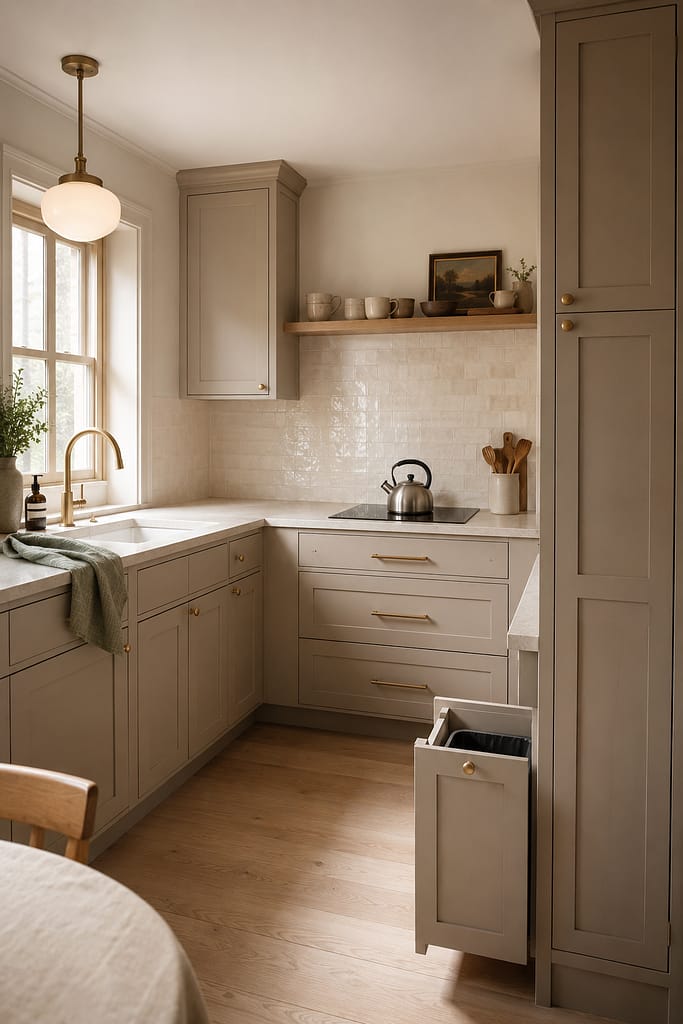
12. Use Soft Gray-Beige Cabinets With Small Black Accents
Black can sharpen a Scandinavian kitchen without taking over the room.
Start with soft gray-beige slab cabinetry, pale quartz, and natural oak flooring. Then use black only for a few functional details: a slim faucet, small edge pulls, and perhaps one compact pendant.
This restrained contrast keeps the room from looking washed out while preserving the calm neutral palette.
It works especially well in a beige kitchen where the cabinetry, backsplash, and countertop are otherwise very close in value.
Storage should stay closed and practical. Use deep drawer stacks and one tall pantry instead of adding open black shelving simply to repeat the accent color.
Keep the countertop objects similarly edited—a dark kettle could count as another black repeat, but you don’t need black canisters, black cutting boards, black stools, and black light fixtures all at once.
In a tiny kitchen, too many dark outlines can visually divide every cabinet and surface.
Warm lighting is important here. Cool lighting can push gray-beige cabinetry toward cold gray, which works against the warmer Nordic effect.

13. Integrate Appliances Into a Small Warm-White Kitchen
Appliances can create a lot of visual interruption in a small kitchen, particularly when several large finishes compete in the same narrow view.
Where practical, use integrated or panel-ready-looking cabinetry around the refrigerator and dishwasher so the cabinet rhythm stays more continuous. Keep the remaining visible appliances simple stainless or black rather than mixing several finishes.
Use warm white cabinets, light ash accents, and a soft stone countertop.
This is one of the strongest strategies for small aesthetic kitchen ideas because visual continuity can make a compact room feel calmer even when the actual dimensions don’t change.
Add one narrow pantry pull-out if space allows and use drawers for smaller appliances or kitchen tools.
Under-cabinet lighting keeps the work surface bright without adding decorative fixtures everywhere.
Integrated appliances do raise the renovation complexity and cost, so this isn’t necessary for every Scandinavian kitchen. You can achieve a similar effect in a more modest update by simplifying the visible appliance finishes and keeping surrounding cabinetry consistent.
Minimalism is not dependent on expensive custom panels; the principle is reducing unnecessary visual breaks.

14. Build a Beige Pantry With Internal Drawers Instead of Deep Shelves
A pantry can look beautifully minimal from the outside and still be frustrating inside.
Use a full-height soft clay-beige pantry cabinet with internal drawers or pull-out trays in the lower half, shallow shelves above, and grouped storage zones for dry food.
This is a practical Scandinavian style pantry design because everything disappears behind simple cabinetry without becoming inaccessible.
Deep fixed shelves often encourage groceries to form two or three hidden rows. Internal drawers solve that by bringing the contents forward.
Keep small appliances that aren’t used daily on a reachable pantry shelf instead of leaving them permanently on the counter. Bulky serving pieces can go higher.
Use simple cabinet fronts that match the surrounding kitchen and perhaps one restrained oak interior detail rather than turning the pantry into a decorative feature.
Warm task lighting elsewhere in the kitchen is enough; the pantry does not need to become an illuminated display cabinet.
The reality check is cost and complexity. Pull-outs and internal drawers generally cost more than plain shelves. If the budget is limited, sturdy labeled baskets on shallower shelves can provide some of the same organization without redesigning the entire cabinet.

15. Add a Storage Breakfast Bench to a Compact Open-Plan Kitchen
In a small open-plan kitchen, a breakfast area can provide storage instead of simply using more floor space.
Place a built-in or freestanding storage bench against one wall near the kitchen and pair it with a compact round or rectangular table. Use lift-up or drawer-style storage beneath the bench for occasional linens, serving pieces, or household items that don’t need prime kitchen drawer space.
Keep the bench in pale oak or a warm neutral finish that repeats the cabinetry.
This works well in a modern Scandinavian kitchen because dining, storage, and visual warmth are combined in one modest footprint.
Use simple oatmeal upholstery or cushions and one understated pendant or wall light.
The kitchen itself can remain soft beige with pale stone counters and minimal hardware, allowing the breakfast nook to supply the natural texture.
Don’t overload the bench with five pillows and layered throws. One or two seat cushions are enough.
Also make sure the hidden storage is genuinely accessible. A bench that requires moving a heavy table every time you need something will quickly become long-term storage rather than useful storage.

A Simple Framework for a Minimalist Scandinavian Kitchen
A successful Scandinavian Kitchen isn’t defined by how empty it looks. It works because simple cabinet fronts + useful closed storage + a warm neutral palette + one natural material + clear but functional counters make everyday routines easier.
Start with clutter before decor.
Ask what actually deserves to remain on the countertop because it’s used daily. A kettle, coffee machine, cutting board, or ceramic utensil holder may make complete sense. Items used occasionally should have a drawer, pantry shelf, appliance garage, or cabinet that is easy enough to access that they will actually be put away.
Then look at the cabinetry. Is one deep pantry shelf wasting space? Would drawers work better? Is open shelving helping, or has it become another surface that needs constant styling?
Finally, edit the material palette. Beige, warm white, muted green, oak, walnut, pale stone, brushed metal, and handmade-look ceramic can create plenty of visual interest when they are repeated carefully.
Minimalist Scandinavian design shouldn’t force a household to hide every sign of life. The goal is a kitchen that looks clean and aesthetic in photographs while remaining warm, practical, and genuinely easy to cook in every day.