

15 Unique Reading Nook Ideas That Give Awkward Spaces More Character
Some of the best reading nook ideas start with a part of the house that’s slightly inconvenient.
A deep bay window that’s difficult to furnish. A narrow alcove that doesn’t fit a standard cabinet. The low end of an attic room. A dead corner beside a doorway. Even a tiny box room that feels too small to become a proper bedroom can have just enough space for a chair, books, and a good lamp.
Those architectural quirks are often what give a reading nook its character. But character alone isn’t enough. A beautiful built-in bench isn’t much use if the seat is too shallow to sit comfortably. Quirky bookshelves become frustrating if they can’t hold actual books. And that oversized cozy chair from your Pinterest board may be considerably less appealing once it blocks half the walkway.
The most successful nooks balance atmosphere with ordinary practical details: comfortable seating, reachable books, useful lighting, somewhere for a drink, and enough clearance to get in and out without turning sideways.
Here are 15 ways to make those overlooked spaces work harder.
1. Build a Reading Seat Into a Deep Bay Window
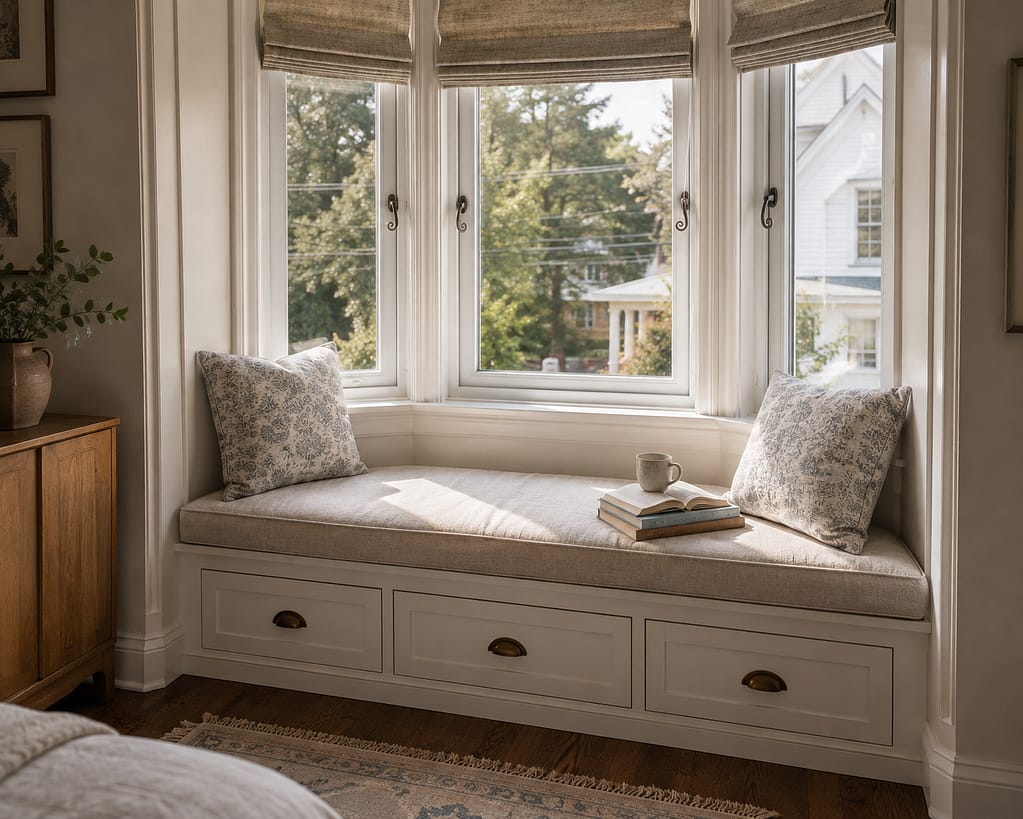
A deep bay window is one of those architectural features that almost seems designed to become a reading nook. Instead of placing an armchair in front of the windows and losing some of the usable floor area, a fitted bench can occupy the otherwise awkward footprint of the bay itself.
Measure carefully before ordering timber or cutting panels. In an angled bay, measure each wall section separately rather than assuming both sides are identical. Older houses in particular can be surprisingly uneven.
For comfortable adult seating, I’d aim for roughly 18–22 inches (46–56 cm) of usable seat depth after accounting for back cushions. Around 18–20 inches (46–51 cm) from the finished floor to the top of the compressed seat cushion generally feels chair-like, although your own height and preferred sitting position matter more than following a rigid number.
Check the windows before settling on the final bench height. Handles need to remain accessible, and inward-opening windows require enough clearance to operate. Curtains can also become trapped behind a bench, so Roman blinds, shades, or curtains positioned outside the bay may work better.
Underneath, drawers are usually more convenient than a giant lift-up lid because you don’t have to remove cushions every time you want a blanket. Lift-up storage can still make sense for things you rarely need.
If there’s a radiator in the bay, don’t simply box it in. Heating and ventilation requirements should be considered before building anything permanent.
Finally, think about sunlight. A bright window is wonderful for reading, but prolonged direct sun can fade book covers and fabrics. Washable or removable cushion covers are particularly useful here.
2. Work With a Curved or Circular Bay Window
Circular bay window ideas look spectacular in photographs, but they can become expensive surprisingly quickly. Proper curved cabinetry usually requires specialist fabrication, and that’s difficult to justify if you’re trying to create an attainable reading nook.
Fortunately, the furniture doesn’t actually have to reproduce the curve perfectly.
One approach is a faceted bench made from several straight sections. Another is arranging two or three simple storage modules so they loosely follow the shape, then using a made-to-measure cushion to visually connect them. If the bay is relatively shallow, forget built-ins entirely and try a rounded lounge chair or compact swivel chair positioned centrally.
Whichever route you choose, measure the bay at several points. Curved walls can reduce usable seat depth toward the edges.
Don’t let cushions cover window handles or ventilation openings. If there are floor vents, keep airflow unobstructed. A radiator makes a freestanding chair particularly attractive because you aren’t constructing cabinetry around the heat source.
A small pedestal table is useful in this kind of nook because its single base is easier to position on an irregular footprint than a four-legged side table.
You get the character of a circular bay without paying for furniture that looks like it belongs on a yacht.

3. Turn an Architectural Alcove Into a Tucked-Away Reading Nook
An alcove doesn’t have to be particularly large to become useful. In fact, a slightly enclosed space can feel more convincing as a nook than a chair sitting randomly in the middle of a room.
Start with the seating rather than the shelving.
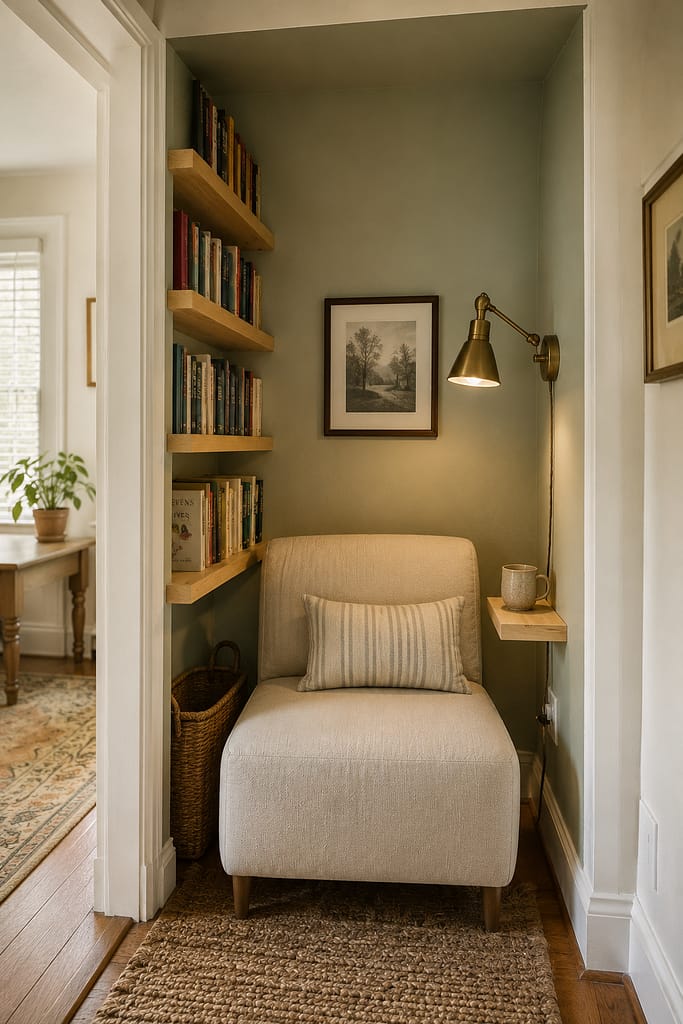
If the alcove is wide enough for an armchair, place the chair first and check that the arms aren’t scraping the walls. For tighter spaces, an armless slipper chair can save several valuable inches. A fitted bench is another possibility, but make sure it has enough depth and back support to be comfortable for more than ten minutes.
Shallow shelves can take advantage of the walls without crowding your shoulders. Most ordinary books are comfortable on shelves around 8–10 inches (20–25 cm) deep; oversized art books need more. There’s little reason to install 14-inch-deep cabinetry for standard paperbacks if you’re already short on room.
A plug-in wall sconce is useful where a floor lamp would consume precious floor area. Position its switch where you can reach it while seated rather than requiring an awkward stretch behind the chair.
Add a narrow shelf for a drink if a side table won’t fit.
That tiny practical surface makes an alcove considerably more usable.
4. Surround a Cozy Chair With Quirky Asymmetrical Bookshelves
Quirky bookshelves don’t need to lean at strange angles or make books nearly impossible to store.
Some of the most interesting designs simply break the expected grid.
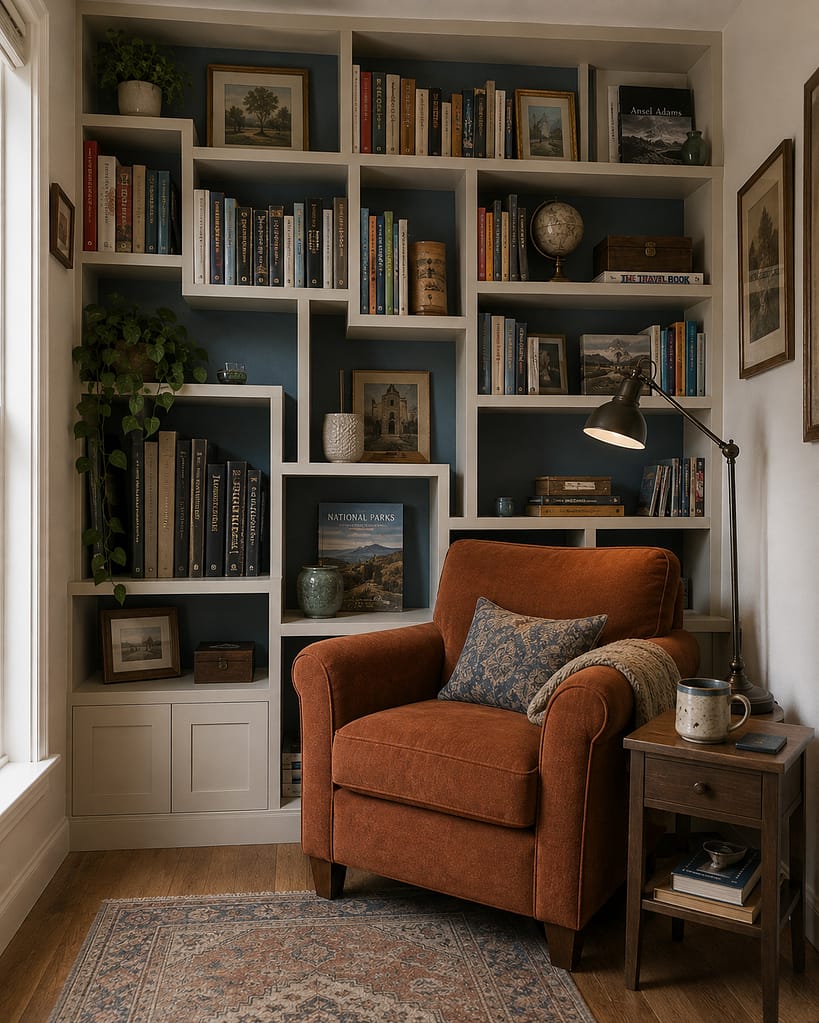
Try staggered shelf lengths, a mixture of tall and short compartments, painted shelf backs, or closed cabinets interrupting sections of open shelving. You can even leave an intentionally oversized opening around a favorite chair.
The important part is keeping the shelves functional. Give ordinary books roughly 8–10 inches (20–25 cm) of depth, and make sure long shelves have enough support to prevent sagging under their weight.
Asymmetry also works better when there’s some repetition. Perhaps three shelves line up while the fourth shifts. Or the cabinet doors below repeat the same width even though the open shelves above don’t.
Books themselves provide plenty of visual variation, so you don’t need to fill every cubby with decorative objects. Leave a few gaps and allow some shelves to look like actual working book storage.
Tall freestanding bookcases should be secured appropriately to the wall, particularly where children or pets could climb or pull on them.
5. Create a Miniature Library From a Tiny Spare Room
A tiny spare room often gets stuck in decorating limbo. It’s too small for a comfortable guest bedroom but too useful to ignore.
That’s exactly the sort of space where an interior design reading room can make sense.
You don’t need shelving on all four walls. In a narrow room, that can make the center feel like a corridor. Put book storage along one main wall, then position a comfortable chair where you can still enter easily.
Measure the chair before buying it. A substantial armchair can easily reach 35–40 inches (89–102 cm) wide and almost as deep. A compact armchair or slipper chair may make much more sense in a box room.
Try to preserve roughly 30–36 inches (76–91 cm) for a comfortable main passage where the room allows. Tight existing spaces may force compromises, but physically marking the furniture footprint with painter’s tape before ordering anything is incredibly useful.
Closed cabinets at the bottom of the bookcase can hide charging cables, spare stationery, board games, and everything else that inevitably sneaks into a supposedly dedicated library.
One properly lit chair and a wall of books can create the atmosphere of much larger library rooms without requiring an enormous house.

6. Create a Cottage-Style Nook With Painted Shelves and Patterned Textiles
Room decor cottage style is particularly forgiving in an awkward nook because it doesn’t rely on perfectly seamless cabinetry.
Painted shelves, a secondhand chair, slightly mismatched furniture and patterned fabrics can actually make the space more interesting.
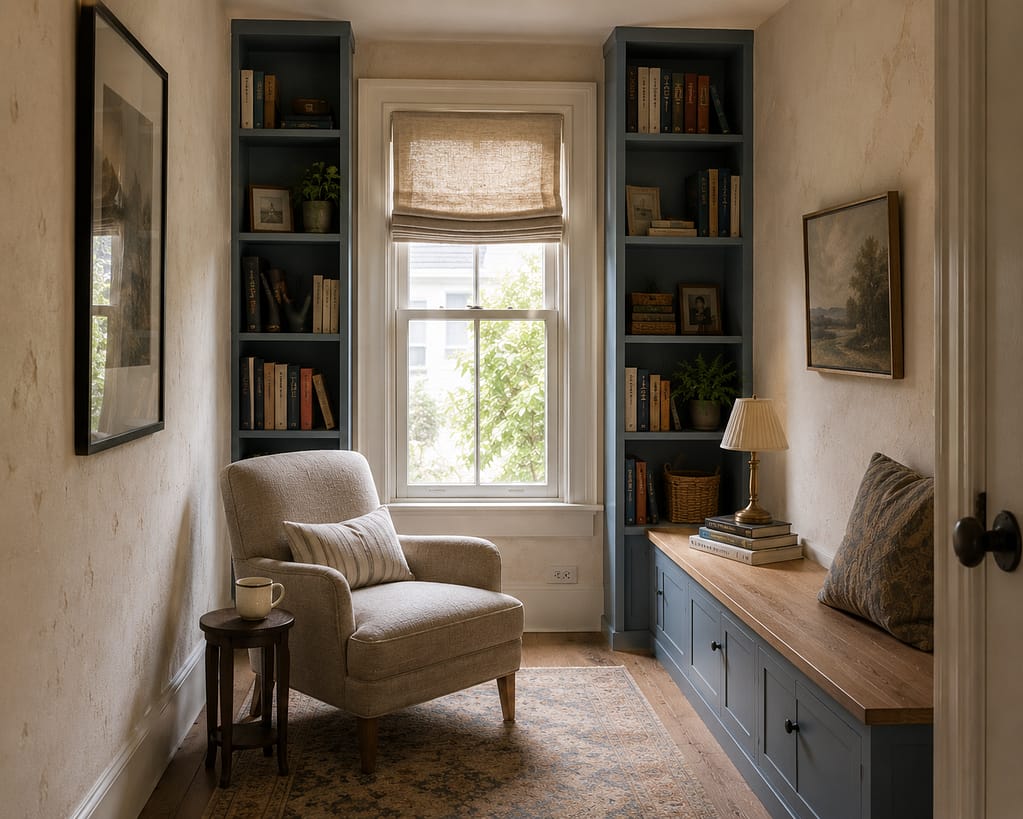
Try muted sage, dusty blue, warm cream or mushroom for shelving rather than defaulting automatically to white. Then introduce pattern through a cushion, small Roman blind, or throw instead of covering every surface in florals.
If you’re using an old upholstered chair, check its seat depth and support before falling in love with the fabric. Vintage chairs can look wonderfully characterful but vary enormously in comfort.
A tiny wooden table beside the chair gives you somewhere for tea, reading glasses and a phone. It can be secondhand too.
For books, simple painted pine boards or affordable MDF shelves can look surprisingly convincing once they’re properly supported and finished. You don’t need bespoke cabinetry to achieve this style.
The slight imperfections are part of what makes the nook feel as though it belongs in the house.

7. Use the Space Underneath a Staircase for a Reading Retreat
Under-stair spaces are frequently used for cupboards, but a staircase with enough headroom can create a surprisingly effective reading nook.
Headroom is the first thing to check.
The lowest part of the slope doesn’t need standing height if it’s behind a bench, but you don’t want to hit your head every time you sit down or stand up. Sit in the proposed position before committing to cabinetry and pay attention to where the stair slope crosses above your body.
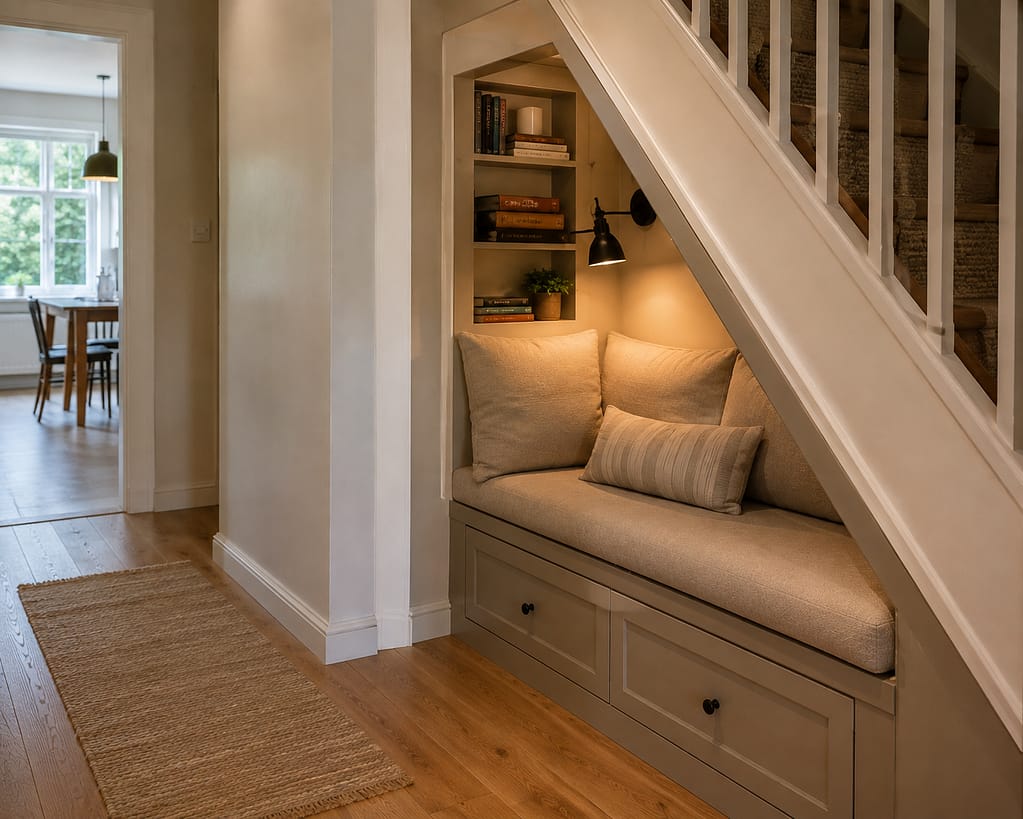
A built-in bench works particularly well because its back can sit against the lowest wall while drawers occupy the space underneath.
Aim for a seat depth that genuinely supports lounging—roughly 18–22 inches (46–56 cm) of usable depth is a sensible starting range for many adults. Add a supportive back cushion rather than filling the entire nook with loose pillows.
Under-stair areas can be dark even during daytime. A wall-mounted reading light or plug-in sconce solves that without sacrificing floor space.
If the nook opens directly into a hallway, keep the bench within the stair footprint so cushions and feet don’t spill into the main circulation route.
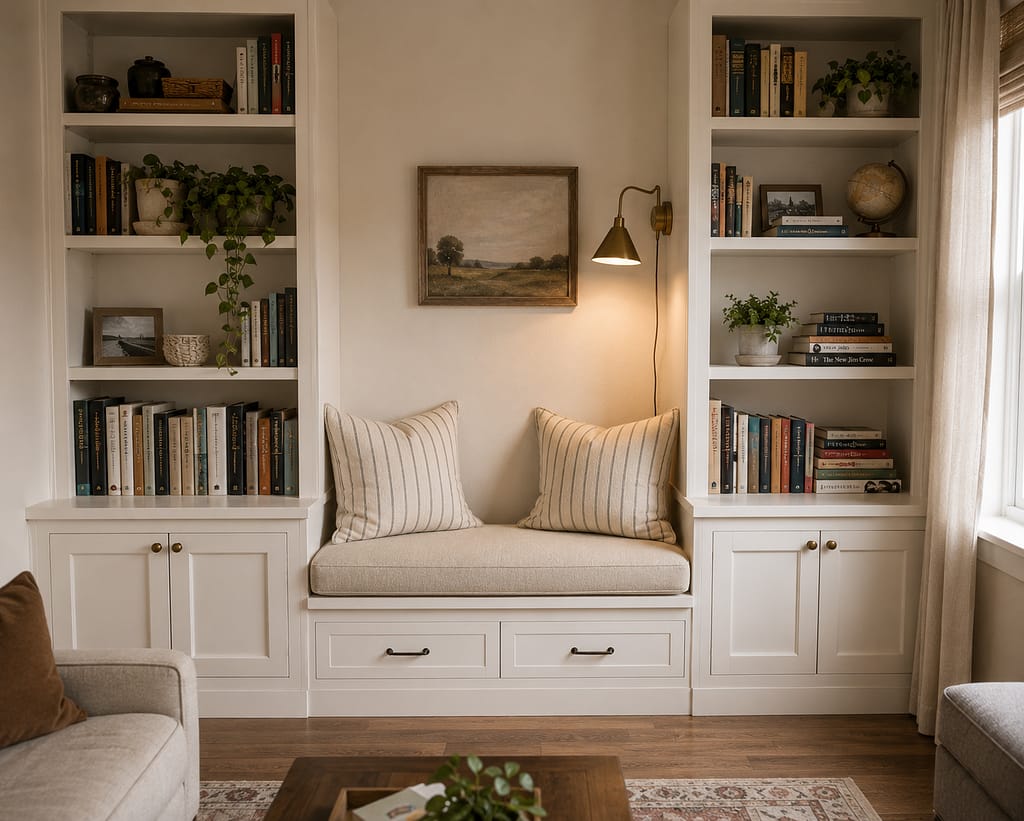
8. Create a Built-In Reading Bench Between Two Bookcases
A bench positioned between two bookcases creates one of the strongest built-in reading nook looks, yet the basic arrangement is quite simple.
The bookcases provide the visual enclosure. The bench connects them.
This layout works particularly well on an otherwise blank wall where a freestanding chair might feel lost. The bench can be constructed from plywood or MDF, or you can adapt a sturdy ready-made storage bench and flank it with matching modular bookcases.
Don’t let the bookcases make the seat uncomfortably narrow. For one adult who likes room to shift position, a bench around 36–48 inches (91–122 cm) wide is far more inviting than squeezing into a tiny opening.
Drawers beneath are excellent for blankets and less attractive household items. Lift-up storage costs less to construct in some cases, but remember that you’ll have to move the seat cushion whenever you open it.
A wall sconce above or beside the bench keeps the reading light focused without adding another piece of furniture.
If you’re combining separate furniture units, matching paint and adding filler strips can make the whole wall appear surprisingly cohesive.
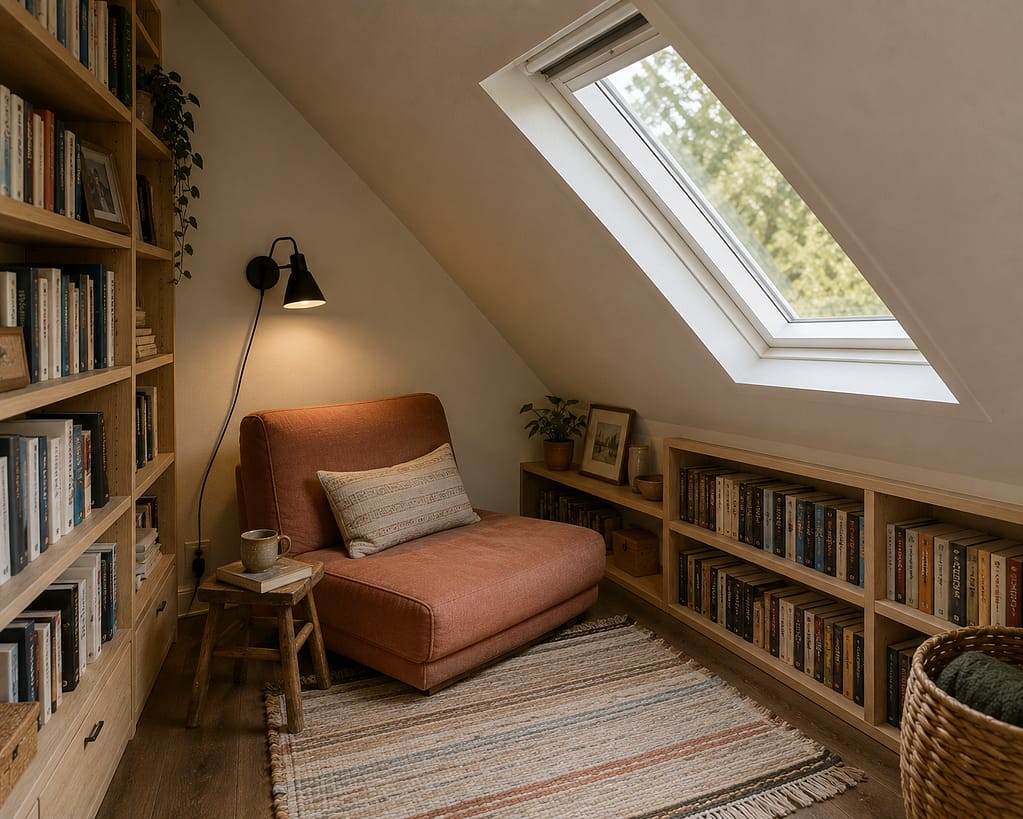
9. Turn an Attic Corner or Sloped-Ceiling Area Into a Reading Nook
The low part of an attic is often frustrating for normal furniture and excellent for seated activities.
Instead of fighting the sloping ceiling, keep furniture intentionally low.
A compact lounge chair, low upholstered bench, or thick floor-level seat can occupy the area where standing headroom disappears. Place bookshelves against a taller wall rather than forcing full-height shelving beneath the slope.
If you do install low shelving, measure your largest books first. A row of short shelves might handle paperbacks beautifully while leaving art books with nowhere to go.
Lighting deserves extra attention. Attic corners often have limited outlets, so work out how the lamp will be powered before finishing the space. A plug-in wall light with properly managed cable can be easier than adding new electrical wiring.
Also check attic temperatures. Spaces directly beneath a roof can become very warm, and books don’t appreciate prolonged heat, dampness or direct sunlight.
A small rug can make the nook comfortable, but keep thick edges away from the main walking path where they become a trip hazard.
10. Create a Moody Adult Reading Corner Inspired by Traditional Library Rooms
You don’t need an entire mahogany-paneled room to borrow the atmosphere of an old library.
Concentrate the effect in one corner.
A deep olive, muted burgundy or dark mushroom wall immediately creates more intimacy. Add one bookcase—or even a half-wall of shelving—a comfortable chair and warm directional lighting.
The chair matters more than decorative accessories. If you tend to curl your legs up while reading, look for a wider seat with enough depth. If you prefer upright reading, firmer support and a more vertical back will probably be more comfortable.
Position the light so it illuminates the page from above and slightly behind your shoulder rather than shining directly into your eyes. Adjustable floor lamps and swing-arm sconces are especially useful.
Use closed cabinetry below the books if this corner also has to store household clutter. Chargers, paperwork, games and spare cables can disappear behind doors while the shelves remain primarily for books.
The result feels library-inspired without pretending an ordinary living room is an English country estate.

11. Build Bookshelves Around a Doorway
Doorways create unused wall area that can become surprisingly effective book storage.
Start with shallow bookcases on either side of the opening. If ceiling height and construction allow, connect them with shelving above the door to create the appearance of a continuous library wall.
This immediately feels more unusual than a standard bookcase without making the shelves themselves impractical.
Keep the door operation completely unobstructed. Handles shouldn’t hit shelving, and books shouldn’t protrude into the opening. If there’s a light switch beside the doorway, design around it rather than hiding it somewhere behind a cabinet.
The upper shelves are best for books you don’t reach every week because they’ll probably require a small step stool.
Visually, this works beautifully beside a reading chair positioned just outside the door’s swing.
Using stock bookcases can keep costs under control. Matching trim across the top, filling awkward gaps at the walls, and painting the individual pieces the same color helps disguise the fact that they weren’t custom-made.
Secure tall units properly rather than relying on trim to hold everything together.

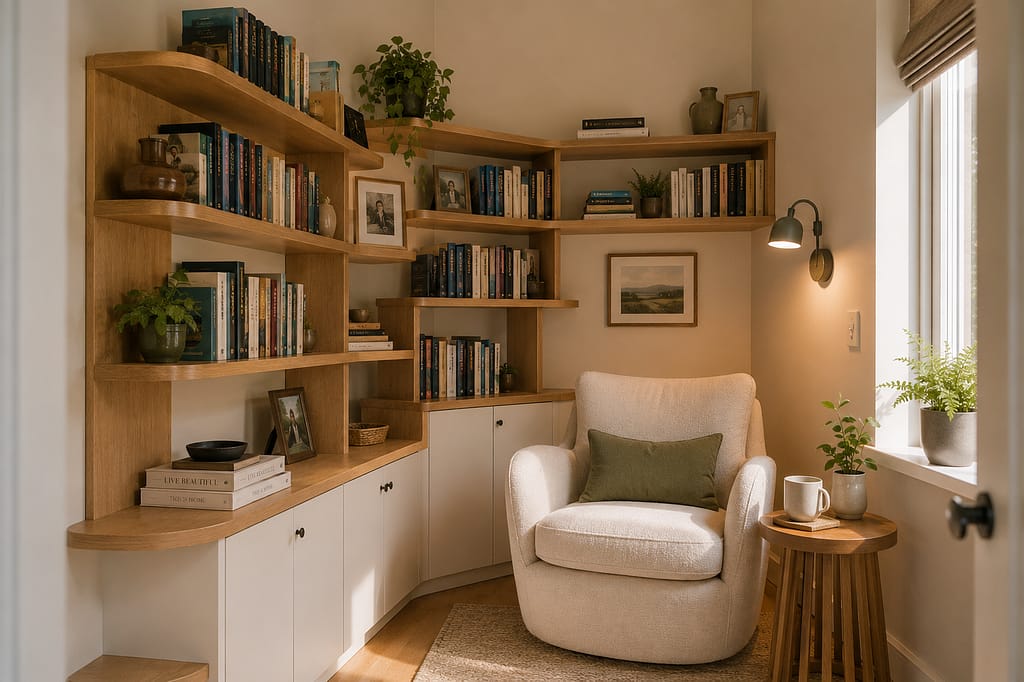
12. Use Curved or Stepped Shelving to Soften an Awkward Corner
An awkward corner doesn’t automatically require expensive curved cabinetry.
You can create the impression of a softer shape with several shallow shelving sections that step around the corner. From across the room, the repeated changes in angle feel much more intentional than simply pushing a rectangular bookcase into the space.
Another option is shelves with rounded outer corners while the actual cabinetry remains straight.
Keep book-bearing portions practical. The decorative curve can happen at the exposed end while the main shelf retains enough flat depth for books to stand securely.
This is also a good location for alternating open and closed storage. Books can occupy the accessible shelves while the lowest compartments hide cables, blankets or miscellaneous items.
If the shelves wrap around the reading chair, check shoulder and elbow clearance. Being surrounded by books sounds cozy until you’re bumping into shelving every time you move.
Leave some breathing room around the seat.
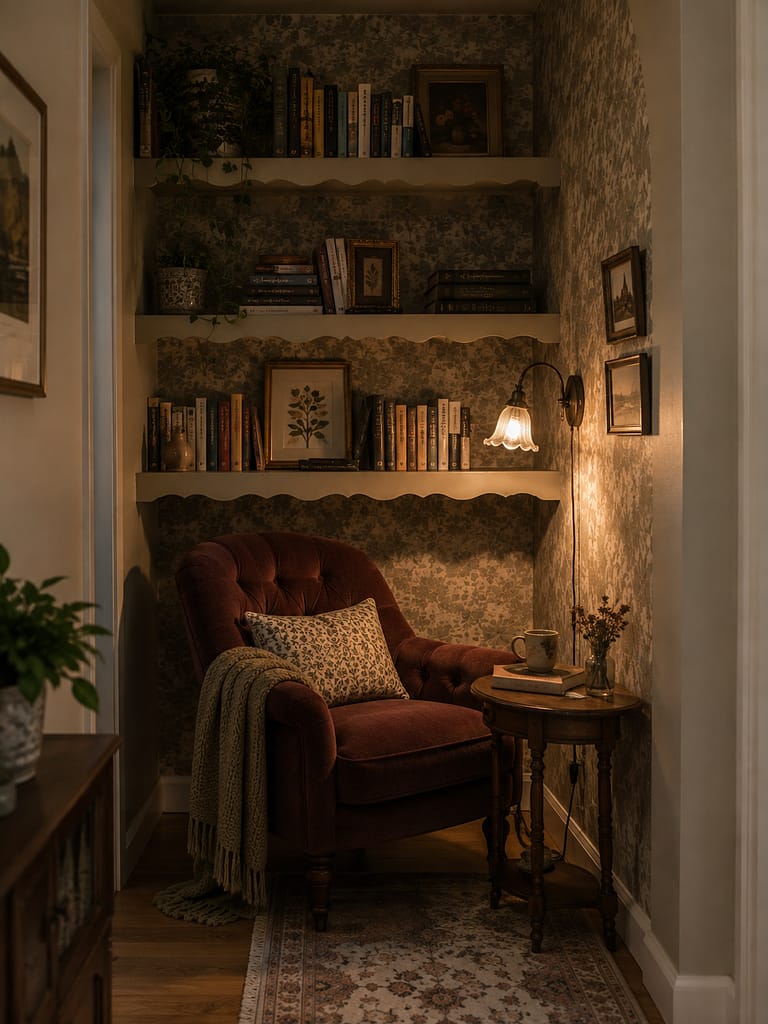
13. Create a Whimsical Reading Nook That Still Feels Grown-Up
Whimsical room design doesn’t have to mean filling a corner with fairy lights, novelty furniture and every pattern you can find.
For an adult reading nook, choose one or two playful details and give them room to stand out.
Botanical wallpaper inside an alcove can be enough. So can a painted arch behind a chair, scalloped shelf trim, an unusual vintage lamp or a surprising wall color.
I’d avoid combining all of those in one tiny space.
A restrained palette helps. For example, botanical wallpaper with muted green leaves can sit beside mushroom-painted shelves and a simple burgundy chair. The pattern supplies personality while the larger pieces remain relatively calm.
Secondhand furniture is especially useful here because slightly mismatched pieces prevent the room from looking like a coordinated furniture set.
Just keep functionality in charge. The lamp still needs to illuminate a book. Shelves still need to support their contents. And the side table needs enough flat surface for an actual mug rather than six decorative objects.
That’s often the difference between whimsical and chaotic.
14. Make an Unusual Old-House Window the Focus of the Nook
Older houses often contain windows that don’t fit neatly into modern furniture layouts: narrow interior windows, unusually low sills, off-center windows or openings squeezed between architectural features.
Instead of disguising the awkwardness, build the reading area around it.
If the window is too low for a normal bookcase underneath, try a low storage bench. If it’s narrow, frame it with shallow shelves rather than attempting to center a large piece of furniture below it.
Leave the opening visually clear. Covering half an unusual window with shelving tends to make the arrangement look accidental.
Also check for condensation or dampness before storing books directly beside an old window. A charming original frame isn’t worth damaging a shelf full of books.
Curtains or blinds need enough room to operate without knocking books from nearby shelves. And if there’s a radiator underneath, keep the reading chair far enough away for heat to circulate normally.
The architectural feature should remain the star; your furniture is simply giving it a purpose.
15. Fake a Custom Built-In Reading Nook With Affordable Modular Furniture
Some of the best house nook ideas look custom without actually starting that way.
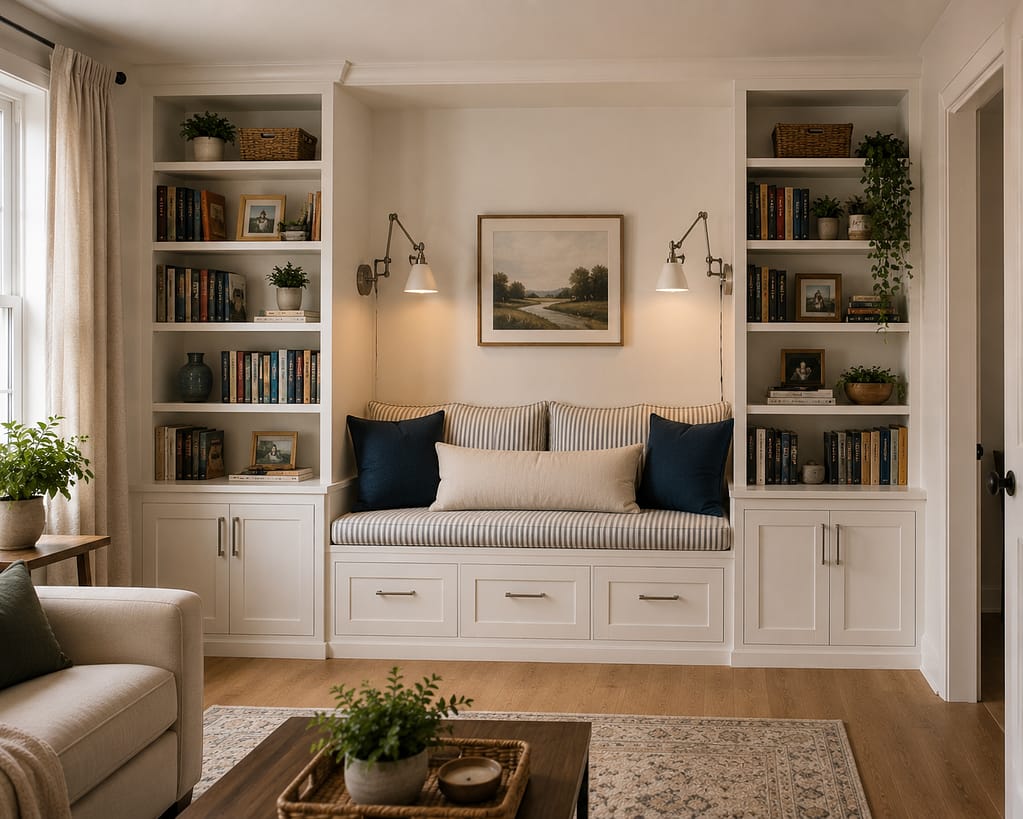
A pair of modular bookcases, a ready-made storage bench and a few sheets of MDF can get surprisingly close.
The trick is making separate components visually relate to one another.
Choose units with compatible depths. Align important horizontal lines, especially the tops of lower cabinets and major shelves. Small filler panels can close awkward gaps between bookcases and walls, while simple trim across the top makes several pieces read as one installation.
Then paint everything the same color.
If you’re working around baseboards, don’t force furniture against them and leave a mysterious half-inch gap. Either notch appropriate trim components carefully or use filler pieces so the finished installation looks deliberate.
A ready-made bench can sit between two bookcases, with a plywood or MDF back panel connecting the composition. Add a washable cushion instead of paying for elaborate upholstery.
Plug-in sconces provide the built-in-lighting look without hiring an electrician, provided cords are safely routed rather than dangling across the seating area.
This is one area where spending strategically makes sense. Pay for a genuinely comfortable cushion and sturdy furniture; save money on decorative trim, paint and simple hardware.
Custom carpentry can absolutely be worthwhile for an extremely irregular bay or difficult architectural opening. But most reading nooks in houses don’t need to begin with a cabinetmaker.
They need thoughtful measurements.
Making an Awkward Space Worth Using
Unusual architecture doesn’t have to be corrected or hidden. A deep bay window, sloping ceiling, odd alcove, curved wall or tiny spare room can become one of the most useful areas in the house when the reading nook is designed around the way someone will actually use it.
Start with measurements, then choose the seating. Sit in chairs before buying them when you can, check the real footprint against your available floor area, and decide where the reading light, books, drink and charging cable will go.
Only after those practical decisions are solved would I start worrying about wallpaper, cushions and decorative accessories.
A successful cosy reading nook isn’t the one with the most Pinterest-worthy styling. It’s the one you find yourself using when you have twenty quiet minutes and a book you don’t want to put down.