

15 Built-In Cabinet and Bookshelf Ideas for a Living Room Without a TV
Removing the television from a living room creates an opportunity, but it also removes the automatic focal point most rooms rely on. The strongest built in shelves living room designs solve that by giving the wall another clear center—art, a fireplace, a mirror, a generous book bay, or an architectural niche—then letting the storage support it.
A useful rule is to choose the center of the wall first, then design the cabinets and shelves around it.
That keeps the room from looking as though a television was removed and nothing replaced it. Lower cabinets can hide games, blankets, paperwork, toys, cords, household overflow, and electronics that don’t need to dominate the room. Above them, books should do a meaningful amount of the visual work. Add a few framed pieces, pottery, baskets, or sculpture, but leave breathing room.
No-TV rooms also benefit from furniture arranged for reading and conversation rather than screen viewing. A sofa can face two chairs, a pair of reading chairs can sit near the books, or the fireplace can anchor the group.
Here are 15 ways to make the storage wall feel complete, practical, and intentional without putting a screen at the center.
15 Built-In Cabinet and Bookshelf Ideas for a Living Room Without a TV
1. Frame One Oversized Landscape Painting With Warm-White Built-Ins
A long living-room wall can feel complete without a TV when one large artwork clearly holds the center.
Run warm-white lower cabinets across the wall, then add open bookcases on the left and right while keeping the middle bay noticeably wider. Place one oversized landscape painting above the center cabinet and use a slim black or aged-brass picture light above it.
The lower cabinets can hide board games, paperwork, blankets, toys, and household overflow. The shelves above should hold real books rather than functioning mainly as decor niches. Mix vertical book groups with a few horizontal stacks, one larger ceramic object, and visible empty areas.
This works because the painting carries more visual weight than a cluster of small frames would. The shelves become supporting architecture rather than competing focal points.
For a 10- to 12-foot wall, two side book bays and one generous center opening are often enough. Too many narrow bays can make the composition busy.
A cream sofa can face the wall while two chairs sit at right angles, turning the room toward conversation instead of screen viewing.
Warm-white paint visually lightens a large built-in wall, making this especially useful in an eight- or nine-foot room.

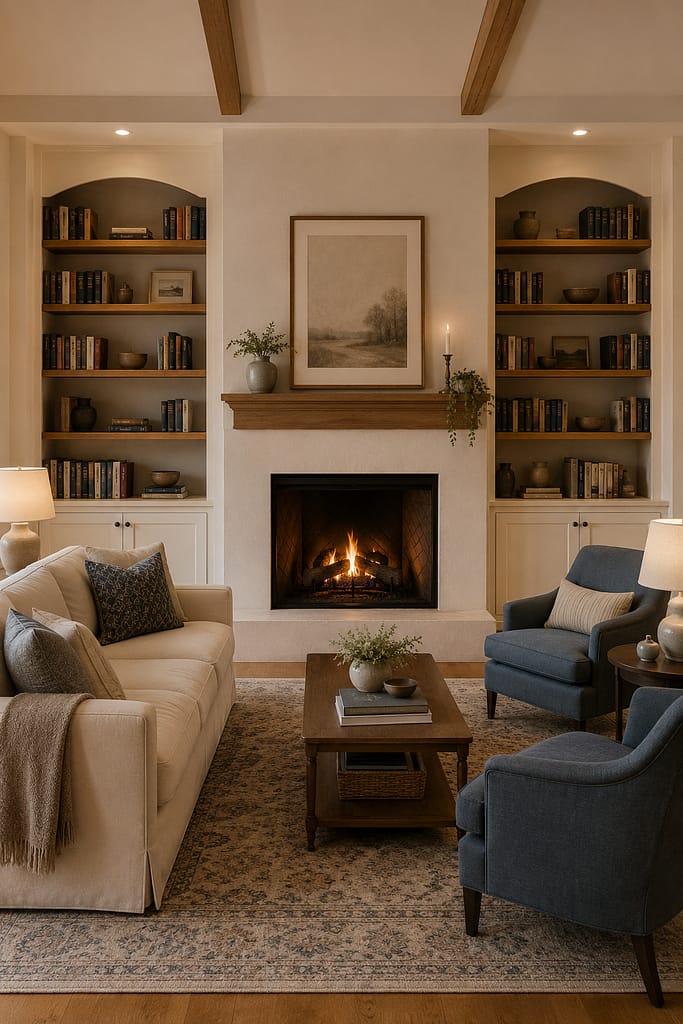
2. Build a Symmetrical Fireplace Library With Books on Both Sides
A fireplace is the easiest non-screen focal point to organize a no-TV living room around.
Use a simple plaster, painted-brick, or pale limestone fireplace in the center, then install matching lower cabinets and open shelving on both sides. Keep the mantel relatively restrained: one large framed artwork or an antique-style mirror, plus one small pottery grouping.
The shelves should be book-heavy. On each side, alternate vertical books, short horizontal stacks, one framed piece, and quiet shelf areas.
This is one of the strongest fireplace built-ins without TV arrangements because the firebox naturally carries the center of gravity. The built-ins fill the side walls without turning them into competing displays.
Closed base cabinets can hold games, electronics, blankets, seasonal decor, or kids’ supplies. The heavier lower storage also grounds the open shelves above.
Symmetry suits a classic front room or traditional living room, but the shelf styling does not need to mirror perfectly. Identical object placement can make the wall feel stiff.
Position a sofa parallel to the fireplace with two chairs opposite or at gentle angles. That keeps conversation central while the fireplace remains visible.
Fireplace clearances, heat exposure, and any electrical or structural work should follow manufacturer requirements and applicable local rules.
3. Paint a No-TV Den Deep Olive and Let Books Become the Focal Point
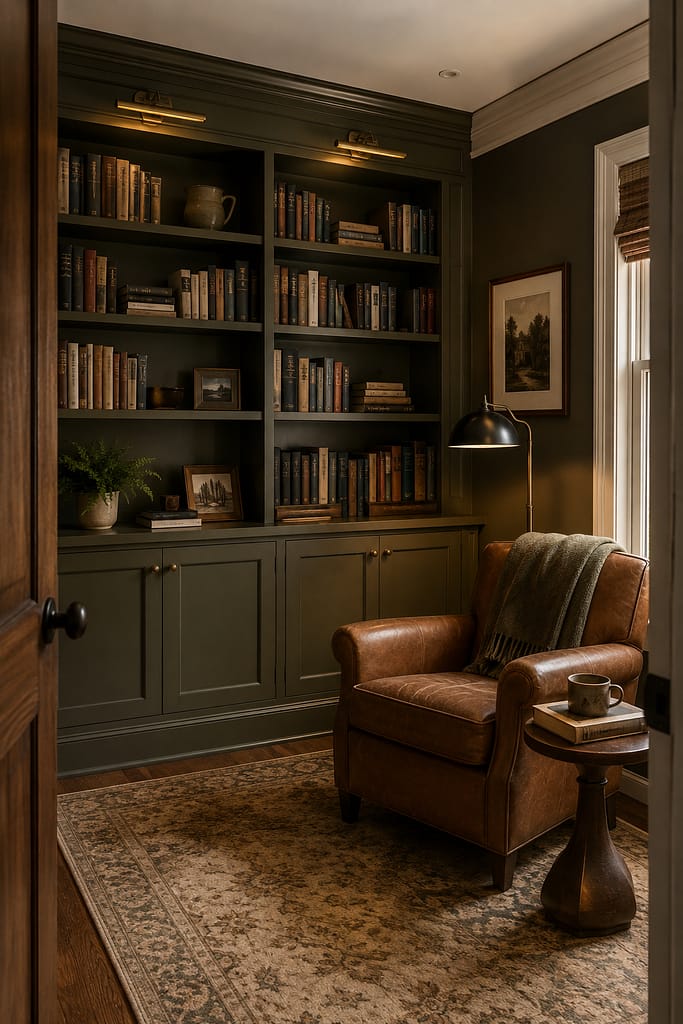
A small den can support darker built-ins because the room benefits from feeling enclosed and book-centered.
Paint an entire built-in wall deep olive or muted forest green. Use closed lower cabinets for games, paperwork, craft supplies, and household overflow, then run open book shelves above.
Instead of leaving a blank center niche, make the book wall continuous. A slightly wider center bay can hold taller books, a framed photograph, and one larger ceramic vessel.
This is a useful answer to den shelving ideas because the room doesn’t need a conventional focal object at all; the book collection itself becomes the focus.
Use two aged-brass picture lights or small shelf lights across the top to make the dark cabinetry feel intentional at night. Add a compact reading chair, small side table, and floor lamp nearby.
The styling rhythm should stay simple: books + one larger object + breathing room.
Dark paint makes the built-ins visually heavier, so keep the ceiling light and the furniture relatively simple. In a 9-by-10-foot den, shallow upper shelves are usually more comfortable than deep bookcases projecting far into the room.
Closed storage is especially important here because open shelves already carry plenty of visual information through the books.
4. Use a Natural Oak Library Wall With a Large Center Book Bay
Natural oak can give a no-TV living room enough warmth that the wall doesn’t need much decorative styling.
Build floor-to-ceiling oak or oak-veneer cabinetry with lower closed storage and three broad upper bays. Make the center bay wider and slightly taller than the side bays so it becomes the visual anchor.
Fill that center with larger-format books, a framed textile or one sculptural object, and generous space between groupings. The side bays can carry denser book storage.
This is a strong living room library wall because the focal hierarchy comes from bay proportion rather than paint contrast or a screen.
In a room with 10- or 11-foot ceilings, keep the shelf count lower than you might expect. Wider vertical spacing prevents the wall from becoming dozens of tiny compartments.
A cream sofa can sit perpendicular to the shelving with two reading chairs near a window. That makes the wall part of a reading and conversation room rather than something everyone faces like a television.
Upper shelf access matters. If the built-ins truly reach ten or eleven feet, the top shelves should hold occasional-use books or objects rather than everyday items.
Natural wood also hides a little visual clutter better than stark white because the grain carries its own movement.

5. Center an Antique-Style Mirror Between Mushroom Built-Ins
A large mirror can replace a TV successfully when the reflection is worth looking at.
Use mushroom-painted built-ins across the wall, with lower closed cabinets and open book shelves on both sides. Leave the center bay wide enough for a tall antique-style rectangular or softly arched mirror above a low cabinet.
The mirror should have enough scale to read from the doorway. A small mirror floating in a wide opening tends to make the center feel unfinished.
This setup works well in a formal front room because it creates a polished focal point while still leaving the wall practical. Lower cabinetry can hold serving pieces, games, linens, paperwork, or household storage.
Repeat aged brass in the mirror frame, cabinet hardware, and one picture or wall light nearby. Keep the shelves book-heavy with a few framed pieces and pottery.
A mirror changes the room by doubling whatever sits opposite it. If it reflects a cluttered coat rack, kitchen counter, or doorway, the built-in wall may feel busier rather than more elegant.
Use the furniture to support conversation: a settee can face two chairs, with the mirror and shelving sitting behind or beside one side of the group.

6. Create an Asymmetrical Fireplace Wall With One Tall Cabinet Tower
An off-center fireplace often looks more convincing with asymmetrical built-ins than with forced matching shelves.
On the wider side, use one tall closed cabinet tower plus open book shelving. On the narrower side, keep only low cabinetry with a large framed artwork or a simple wall sconce above.
Paint the entire composition soft taupe or olive so the different storage masses still feel related.
This works because the larger cabinet tower provides serious storage for games, blankets, paperwork, serving pieces, and household overflow, while the open shelving keeps that side from becoming a solid block.
The fireplace remains the focal point, but the asymmetry makes the wall feel tailored to the room’s actual architecture.
Use books heavily on the open side. The quieter side should stay visually restrained so the fireplace doesn’t compete with two equally busy display zones.
A sofa can sit perpendicular to the fireplace with two chairs angled inward. That lets the fireplace and books frame the conversation area instead of creating one viewing direction.
Large closed cabinets carry substantial visual weight, so keep them on the wider wall section. Trying to squeeze a full-height tower into a narrow return can make the room feel cramped.

7. Use Navy Built-Ins Around a Large Framed Textile in a Front Room
A framed textile can replace a television beautifully because it has scale, texture, and softness.
Paint a formal front-room built-in wall deep navy or blue-gray. Use lower cabinets across the full width, then build book shelves on either side of a wider center niche.
Inside that niche, hang one large framed textile, tapestry fragment, or abstract fabric artwork. A slim bronze picture light above it helps establish the focal point after dark.
The lower cabinets can hide games, extra table linens, stationery, serving pieces, and other storage that keeps the formal room useful.
Books should still occupy most of the side shelves. Use a few pottery pieces and perhaps one basket, but avoid turning the wall into a collection of decorative objects.
The deeper color gives the wall architectural weight and works particularly well with ivory upholstery and walnut furniture.
This is a strong example of living room built ins no TV because the room has a clear center that doesn’t imitate the proportions of a screen.
Navy needs sufficient daylight or warm artificial lighting. In a dim room, use a softer blue-gray rather than the darkest possible shade.

8. Turn Billy-Style Bookcases Into a Warm-White No-TV Library Wall
A stock-bookcase wall can work in a no-TV room when it stops looking like separate pieces of furniture.
Use several Billy-style bookcases across one wall, align the shelf heights, fill side gaps, add a continuous base, and use simple top trim appropriate to the ceiling height. Paint the bookcases, filler panels, base, and trim the same warm white.
Instead of creating a television opening, keep the wall continuous and reserve one wider shelf bay for oversized art or larger books.
Add simple cabinet doors to the lower sections where possible so games, toys, paperwork, cords, and household overflow stay hidden.
This is one of the clearest answers to how to make bookshelves look built in. The biggest visual improvement comes from removing the obvious furniture outline: gaps at the sides, separate bases, mismatched heights, and unfinished tops.
Books should remain the dominant content. Use a few baskets and framed pieces, but don’t fill every shelf edge to edge.
Tall stock units still need accurate leveling and secure installation. Trim can improve appearance, but it doesn’t correct instability.
A small sofa facing two chairs works well here because the library wall becomes the backdrop to conversation rather than a viewing destination.

9. Put Stock Bookcases Above Real Base Cabinets and Add a Center Art Niche
Combining deeper base cabinets with shallower stock shelves creates a more substantial no-TV storage wall than bookcases alone.
Run simple lower cabinets across the wall, then place stock bookcase units above on each side. Leave the middle open as a wide art niche.
A continuous countertop or ledge above the cabinets helps the deeper lower section transition into the shallower shelving. Add side fillers and top trim, then paint the entire wall soft mushroom, sage, or warm white.
This IKEA Billy built-in hack direction works because the lower cabinets give the composition visual weight and useful hidden storage while the shelves remain lighter.
Use the center niche for one oversized painting and perhaps a small lamp or ceramic object on the cabinet surface below it.
The bookshelves should carry plenty of books, with a few pottery pieces and empty space. The wall shouldn’t look like decorative shelving framing an art print.
This is a budget-conscious bookcase upgrade that can feel far more custom when the cabinet line, shelf heights, paint, and trim align.
The change in depth should be deliberate. If the upper bookcases appear to perch randomly on the lower cabinets, the built-in effect is lost.

10. Use Charcoal Cabinets and Pale Oak Shelves Around a Large Photograph
A dark cabinet wall can feel contemporary without becoming visually heavy when the shelf surfaces are warm wood.
Use matte charcoal lower cabinets and vertical side frames, then install pale-oak shelves in the open sections. Leave a wide center bay with one large framed black-and-white photograph.
A picture light above the photograph can make the center focal point feel deliberate in the evening.
This works well in a contemporary ranch or den because the charcoal gives the built-in wall enough depth, while the oak keeps the books and objects from disappearing into a dark background.
Lower cabinets can hide electronics, paperwork, games, cords, or blankets. The open shelves should hold books plus only a few larger ceramic or sculptural pieces.
The central photograph needs enough wall area around it to read as art rather than one more object squeezed between shelves.
In a small room, keep the upper shelves relatively shallow. Dark cabinetry that projects too far can visually narrow the space.
A cream sofa and two tan leather chairs can sit in a conversational U-shape rather than directly facing the wall.
This is also a good built in shelves living room paint idea for readers who want something stronger than white but less traditional than navy.

11. Center an Arched Mirror Within Soft-Sage Built-Ins
An arched mirror can soften the strong vertical and horizontal lines of a cabinet-and-bookcase wall.
Paint the built-ins soft sage, use closed lower cabinets across the bottom, and arrange open shelving on either side of a wider center bay. In the middle, hang a tall arched mirror above the low cabinet.
The mirror works particularly well in a front room with a window opposite it because it reflects daylight and visually deepens the room.
Keep the shelf styling book-heavy, with only a few framed pieces and ceramics. The curved mirror already provides decorative shape, so the side shelves don’t need additional visual complexity.
This arrangement suits a formal but usable front room. The cabinets can conceal linens, board games, paperwork, or occasional serving pieces.
Use a pair of small wall lights or one picture light above the mirror if the architecture supports it.
The biggest reality check is reflection. A mirror opposite a cluttered hall, kitchen counter, or open storage zone will duplicate that visual noise.
Symmetry works well here because the arch breaks up the rigidity. Just avoid perfectly matching every shelf object from side to side.

12. Use Arched Shelf Bays and a Wide Center Sculpture Niche
Built-ins don’t need a screen-shaped rectangle in the middle.
Create three broad arched upper openings above a continuous row of lower cabinets. Make the middle arch wider and use it as a sculpture or art niche rather than another dense bookcase.
Paint the wall soft taupe, warm white, or mushroom. Keep the lower cabinets practical, with games, craft supplies, toys, paperwork, or household overflow stored behind doors.
The side arches can hold meaningful book collections, while the center holds one sculptural ceramic piece, framed art, or small stone object with substantial negative space around it.
This works because the center niche becomes clearly intentional. The wall doesn’t look like it is waiting for a television.
Arches also soften the cabinetry grid, which works especially well in cottage-inspired or transitional living rooms.
Keep the openings broad. Too many narrow arches can make an eight- or nine-foot room feel visually chopped up.
This is another useful wall unit design example: the lower cabinet run anchors the wall, while the upper geometry establishes rhythm and hierarchy.
If you’re adapting stock bookcases, applied face framing can approximate the look, but accurate trim alignment is what makes the upgrade convincing.

13. Build a Tall Warm-White Library Wall With Fewer Shelf Levels
Tall rooms need larger proportions, not simply more shelves.
On an 11- or 12-foot wall, use floor-to-ceiling warm-white built-ins with substantial lower cabinets and three wide upper bays. Space the shelves farther apart so there is room for larger books, framed art, pottery, and real negative space.
One center bay can hold a large vertical artwork or framed textile, while the side bays carry denser book storage.
This is a strong tall wall built ins living room solution because the built-in relates to the height of the room without turning the wall into a grid of fifty small compartments.
Add two or three picture lights across the upper trim or use ceiling wash lighting so the wall remains legible at night.
Lower cabinet storage is especially useful in a tall room because the open shelving already creates plenty of visual detail.
For furniture, float a sofa and two chairs closer together on a large rug rather than spreading them to the perimeter. That keeps the room conversational and lets the tall book wall act as architecture.
Upper shelves need safe access. Treat the highest levels as occasional-use storage rather than daily shelving.

14. Create a Reading-Room Wall With One Tall Walnut Cabinet and an Offset Art Bay
A reading-focused room benefits from storage that feels deliberately uneven rather than showroom-symmetrical.
Use one tall walnut cabinet tower at the left end for bulkier closed storage. Next to it, add lower cabinets with open shelves above. Shift a wider art niche toward the right instead of centering it exactly.
The different bay widths make the wall feel custom because they respond to the storage needs rather than forcing every section to match.
Use the tall cabinet for blankets, games, household overflow, or rarely used items. The open shelves should carry books, with a few pottery objects and framed pieces.
Inside the wider niche, use one large painting and a picture light. A reading chair with a small side table and floor lamp can sit nearby.
This is a strong asymmetrical built-in strategy for a den or front room because the large cabinet mass is balanced by the open art bay rather than by another matching cabinet.
Walnut brings enough visual warmth that the wall doesn’t need much decorative styling.
Large cabinet towers can overwhelm narrow rooms, so place them where the wall has the greatest uninterrupted width and where they won’t crowd doorways.

15. Build Shallow Alcove Shelves Around a TV-Free Fireplace in a Small Room
A small fireplace room often benefits from built-ins that feel recessed rather than projected into the space.
If the fireplace already sits between shallow side alcoves, use low cabinets in each recess with shallower open shelves above. Paint the cabinetry the same warm white or pale mushroom as the surrounding walls so the shelves appear built into the architecture.
Keep the mantel free of electronics. Use a large mirror or framed artwork above it, then let the side shelves carry books.
One side can be slightly book-heavier, while the other uses a mix of books, one framed image, and a ceramic object. The styling doesn’t need to mirror perfectly.
This is a practical small living room built ins no TV idea because shallow shelves preserve floor area while the cabinets still provide hidden storage.
A loveseat can sit facing two compact chairs, with the fireplace visible at one end of the conversation group.
True recessed shelves may involve wall framing, wiring, vents, or fireplace-adjacent construction. Existing niches are easy to use, but cutting into structural walls casually is not.
The built-ins should fit the alcoves rather than force the room to lose more depth than necessary.

How to Make a No-TV Built-In Wall Feel Complete
The strongest built in shelves living room ideas without a TV usually follow one simple framework: one clear non-TV focal point + lower closed storage + real books + edited display shelves + lighting.
Start by deciding what the room is actually for. Is it a reading room, a conversation room, a formal front room, a fireplace room, or simply a family room that doesn’t need a screen?
Then decide what should visually hold the center of the wall. A fireplace, large painting, mirror, book bay, framed textile, or architectural niche can all work. What matters is that the center feels deliberate.
Around it, use lower cabinets for the categories that don’t improve the shelves visually: games, toys, paperwork, cords, blankets, household overflow, and serving pieces. Let the upper shelves hold books first, then add a smaller amount of art and pottery.
Built-ins look most convincing when the paint, shelf spacing, trim, cabinet proportions, and lighting all read as one wall rather than separate pieces of furniture.
Removing the television doesn’t leave the room without a focal point. It gives books, art, architecture, and conversation more room to matter.