

15 Built-In Shelves Living Room Ideas for a Stylish Storage Wall
The best built in shelves living room designs solve two problems at once: what you want to display and what you want to hide. A wall of open shelves can look beautiful in a styled photo, but everyday living rooms also need somewhere for games, electronics, paperwork, toys, blankets, cords, and the other things that don’t benefit from being on display.
A useful rule is to put the messiest storage low and the most decorative storage high.
Lower cabinets and drawers give the wall visual weight while concealing practical clutter. Upper shelves can then hold books, framed art, pottery, baskets, and a smaller amount of decor without becoming overloaded.
The wall also needs to fit the room. Floor-to-ceiling shelves can make a tall living room feel finished, but the same treatment may overwhelm an eight-foot ceiling if every bay is narrow and every shelf is packed. Paint color matters too: warm white makes built-ins recede, while olive, navy, charcoal, or mushroom can make the wall feel more architectural.
Here are 15 distinct ways to design a storage wall that looks permanent, useful, and connected to the room around it.
15 Built-In Shelves Living Room Ideas for a Stylish Storage Wall
1. Run Warm-White Built-Ins Wall to Wall With a Wide Art Bay
A long blank wall can become much more useful when the cabinetry stretches from one side to the other instead of stopping like a freestanding bookcase.
Use warm-white lower cabinets across the full width, then add open shelves above with one wider center bay reserved for a large framed artwork rather than a TV. Keep the lower cabinets around one-third of the total wall height so they provide enough visual weight to support the shelves.
Simple Shaker-style doors work well in a transitional living room, while understated brass knobs keep the wall from feeling too utilitarian.
This arrangement is especially useful for living room built ins no TV because the larger center artwork gives the wall a clear focal point. The surrounding shelves can hold books vertically and horizontally, one or two ceramic pieces, and smaller framed art.
The styling rule should stay simple: one anchor object, a small book grouping, and visible empty space. Not every shelf needs three objects.
Warm white helps a large wall recede visually, which is useful in a medium-size room.
If the wall is only eight feet high, avoid extremely heavy crown molding. A simple top trim usually looks more proportional.

2. Paint the Whole Storage Wall Muted Sage
A wall of sage cabinetry with lower doors and lighter upper shelving can give a plain room architectural depth without making it feel formal.
Use muted gray-green paint on the cabinets, shelf backs, side panels, and trim so the entire built-in reads as one continuous unit. Keep the lower section closed with simple inset-look or Shaker fronts, then use open shelves above for books and a restrained amount of pottery.
A center bay can hold a large framed landscape or mirror if the room has no TV. The sage wall then becomes the room’s focal surface without needing additional accent paint elsewhere.
This is one of the stronger built in shelves living room paint ideas because the color adds visual weight while still staying softer than charcoal or navy.
Pair the green with cream upholstery, medium walnut, and aged brass lighting. A picture light above the central artwork can give the wall a more finished look.
Use the lower cabinets for games, toys, paperwork, and extra blankets. Hiding those categories keeps the shelves above much calmer.
Dark or medium paint absorbs more light than warm white, so the room needs decent daylight or layered lamps. In a dim north-facing living room, choose a lighter sage rather than a deep olive.

3. Use Natural Oak for a Floor-to-Ceiling Bookcase Wall
Natural wood built-ins can warm a tall room without requiring much decorative styling.
On a 10- or 11-foot wall, use an oak veneer or medium-tone wood built-in that runs floor to ceiling. Keep the lower third as closed cabinet storage and use taller open shelves above for books.
The shelf bays should be wider than a typical freestanding bookcase so the wall doesn’t become a grid of tiny compartments. Two or three vertical bays may be enough on a 10-foot-wide wall.
Use larger books, one medium ceramic object, and a framed artwork leaning inside one shelf rather than filling each compartment with small decor.
This is a strong tall wall built ins living room approach because the natural grain supplies visual movement. The styling can stay comparatively quiet.
In a taller room, one picture light or ceiling wash light can help the upper shelves remain visible after dark.
Closed lower cabinets are useful for electronics, serving pieces, games, or documents. If the room doesn’t need those categories, drawers can hold linens or less-used books.
Upper shelf access needs to be realistic. If the shelves truly reach ten or eleven feet, treat the highest levels as occasional-access storage rather than daily-use shelves.

4. Build Symmetrical Shelves Beside a Fireplace and Keep the Mantel TV-Free
Fireplace built-ins work best when the shelving supports the fireplace rather than competing with it.
Use low painted cabinets on each side of the fireplace, then open shelves above. Match the built-in color to the wall or fireplace trim so the whole wall feels architectural.
For a warm traditional room, use soft mushroom or warm white cabinetry beside a pale stone or painted-brick fireplace. Keep the mantel simple with one large artwork or mirror and a small supporting object rather than a TV.
Books should carry much of the shelf styling. Add a few pottery pieces, one framed image, and perhaps a basket on one lower shelf.
This built in shelves living room no TV approach works because the fireplace remains the focal point while the shelves provide practical storage and balance.
Lower cabinets can hide electronics, games, extra candles, or blankets. If speakers or other equipment require ventilation, plan around that rather than simply enclosing everything.
Fireplace clearances and heat requirements matter. Shelving, cabinetry, wiring, and decor should respect the fireplace manufacturer’s requirements and applicable local rules.

5. Use Asymmetrical Fireplace Built-Ins With One Art Niche
Symmetry isn’t always the best answer, especially when the fireplace sits off-center or one side wall is wider than the other.
On the wider side, build a tall cabinet tower with open shelving beside it. On the narrower side, use only low cabinetry and one large art niche above.
This creates an intentionally asymmetrical fireplace wall rather than forcing identical bookcases into unequal spaces.
Keep the cabinetry one color—soft taupe, olive, or warm white—so the different layouts still feel related. The tall side can hold more books and closed storage, while the art side remains visually quieter.
This works particularly well in a townhouse or front room where one side of the fireplace connects to a doorway or window.
The key to good wall unit design is proportion. The larger storage mass should sit where the wall can visually support it, while the quieter bay balances through a larger artwork or mirror.
Use the lower cabinets for board games, paperwork, and electronics. The tall side shelves can carry books, one pottery anchor, and negative space.
Major recessed work around fireplaces or structural walls should be planned carefully rather than treated as a casual weekend cutout project.

6. Create a Moody Olive Den With More Books and Closed Game Storage
A den can handle darker built-ins because the room is often smaller, quieter, and less dependent on bright visual openness.
Paint the built-in wall deep olive or muted forest green. Use closed lower cabinets for games, paperwork, and electronics, then build open shelving above for a larger-than-average book collection.
A compact leather or cream reading chair can sit near the shelving with a floor lamp beside it. Add two small picture lights across the built-in rather than trying to illuminate every shelf individually.
This is one of the more practical den shelving ideas because the storage wall can support both reading and family use without looking like a formal library.
Keep the shelf styling book-heavy. One shelf might hold mostly vertical books, another a horizontal stack plus one ceramic bowl, and another one framed photograph with substantial empty space.
Dark paint visually pulls the shelves forward, so don’t use excessive molding or very deep shelves in a tiny den.
If the room is around 9 by 10 feet, shallow upper shelves are often enough for books and decor while keeping more floor space around the chair.

7. Use Navy Built-Ins in a Formal Front Room
A formal front room can carry more color than the main family room because the built-ins themselves can act like architectural millwork.
Use deep navy or blue-gray lower cabinets and open shelves, then keep the surrounding walls warm white. A central bay can hold a large mirror or framed art, while shelves on both sides hold books and a few decorative pieces.
This makes a strong front room storage idea because the cabinets can conceal board games, table linens, paperwork, or occasional serving pieces without making the room feel casual.
Pair the navy with walnut furniture, cream upholstery, and aged-bronze or brass hardware.
The built-ins should still include plenty of books. A formal room starts to look staged when every shelf contains only a vase or sculptural object.
Paint changes visual weight substantially. Navy makes the wall feel more permanent and substantial, but in a room with limited daylight it can also make the built-ins dominate.
Use a lighter ceiling, warm lamps, and perhaps a picture light above the center art bay.
Avoid filling the shelves symmetrically. A few quieter shelves keep the wall from feeling showroom-styled.

8. Make Stock Billy-Style Bookcases Look Built-In With Trim and Paint
Stock bookcases can look surprisingly permanent once the obvious gaps disappear.
Use several Billy-style units across a wall, but treat them as raw building blocks rather than finished furniture. Align the shelf heights, connect the units visually with a continuous base, fill the side gaps, and add simple top trim or crown appropriate to the ceiling height.
Paint the bookcases, filler panels, trim, and wall backing the same warm white, mushroom, or sage so the original unit seams become less noticeable.
For more hidden storage, place simple cabinet doors on the lowest sections or pair the upper bookcases with stock base cabinets.
This is one of the most useful answers to how to make bookshelves look built in. The biggest visual difference usually comes from eliminating the freestanding-bookcase outline.
Style the finished shelves mostly with books, then add a few baskets and pottery pieces.
Billy-style hacks still need accurate leveling and secure installation. A tall row of bookcases that isn’t anchored or aligned correctly will not look custom simply because trim was added.
Keep electrical outlets, vents, and baseboards in mind before covering an entire wall.

9. Combine Stock Bookcases With Real Base Cabinets for a More Custom Hack
A second stock-bookcase strategy is to put the open shelves on top of deeper lower cabinets.
Use simple base cabinets across the wall for closed storage, then set shallower bookcase units above. Add fillers at the sides, a continuous countertop or shelf line over the cabinets, and consistent trim at the top.
This creates a stronger built in cabinets and bookshelves look because the lower section has enough depth and visual weight to anchor the upper shelves.
Paint the entire wall one color—soft mushroom or warm white works well in a small room. The base cabinets can hold toys, electronics, games, or extra blankets while the bookcases remain more decorative.
A central opening can hold large artwork, a lamp, or even a small desk niche rather than another shelf bay.
This is another budget-conscious approach inspired by an IKEA Billy bookcase built in look without requiring the whole wall to be custom fabricated.
The transition between deeper base cabinets and shallower shelves needs to feel deliberate. A continuous top surface helps.
Tall units also need secure installation. Stock furniture becomes architectural only when the fit, trim, and alignment are handled carefully.

10. Use Black Built-Ins With Pale Oak Shelves
Black cabinetry can work in a living room when the open shelf surfaces bring enough warmth back into the wall.
Use matte charcoal or soft black lower cabinets and vertical side panels, then install pale-oak shelves between them. The wood shelves visually lighten the open sections and give books and pottery a warmer backdrop.
This works especially well in a contemporary ranch or den with medium oak floors and warm-white walls.
Keep the lower cabinet fronts simple—flat-panel or slab doors are usually enough. Use black pulls or minimal hardware so the cabinet mass reads cleanly.
A center art bay can remain warm white or be lined in oak for contrast. If there is no TV, one oversized abstract or landscape piece creates a strong focal point.
This is a useful built-in cabinet wall because the lower storage can hide electronics and cords while the upper shelves remain visually controlled.
Black built-ins need light. Add picture lights, nearby lamps, or ceiling wash lighting where appropriate.
In a small room, keep the total built-in depth restrained. Deep dark cabinetry can make a narrow room feel substantially smaller.

11. Build Shallow Shelves Above Low Cabinets in a Small Living Room
A small room doesn’t need deep bookcases from floor to ceiling.
Use low closed cabinets around 15 to 18 inches deep, then make the upper shelves noticeably shallower. That keeps the practical storage below while reducing how far the upper wall projects into the room.
Warm white or pale mushroom works well because the built-ins visually blend into the architecture. Use only two or three shelf bays instead of dividing the wall into many narrow compartments.
This is one of the strongest small living room shelving ideas because it preserves floor space and reduces visual weight.
Keep the styling limited: real books, one medium pottery piece, one framed picture, and meaningful empty shelf areas.
If the room has no TV, use a wider center bay for artwork rather than adding more shelves simply because space exists.
The lower cabinets can hold toys, games, electronics, or paperwork.
Very deep shelves above seated eye level often make a compact room feel narrower, especially when they are filled with dark books and objects.
Avoid oversized crown molding in a low-ceiling room. Simple side fillers, base trim, and a clean top line are enough to create the built-in effect.

12. Create an Arched Built-In Wall With Closed Cabinets Below
Arched shelf tops can add character to a front room or cottage-inspired living room without requiring the entire wall to become ornate.
Use two or three broad arched openings above a continuous row of lower cabinets. Paint the whole wall soft taupe, sage, or warm white so the arches feel architectural rather than decorative add-ons.
Keep the shelves inside the arches relatively simple and evenly spaced. Books should still make up much of the content, with one pottery piece or framed image acting as the anchor in each bay.
A wider center arch can hold a larger artwork or mirror and stay partially open.
This wall-to-wall shelving treatment works because the repeated curves soften the cabinet grid and make the wall feel more custom.
Lower doors can conceal games, linens, toys, or paperwork while the upper niches remain visually calm.
Arches require more careful construction than straightforward rectangular shelving. A stock-bookcase hack can mimic the look with added face framing, but the curves still need accurate layout.
In a small room, keep the arches broad. Too many narrow arches can make the wall feel busy and visually lower the ceiling.

13. Use One Tall Closed Cabinet Tower Beside an Open Reading Niche
A deliberately asymmetrical storage wall can look more custom than a perfectly mirrored one.
Place one tall closed cabinet tower at the end of the wall for bulkier storage such as blankets, games, paperwork, or serving pieces. Next to it, use lower cabinets with open shelves above and a wider reading or art niche in the middle.
A small upholstered chair can sit in front of the open niche, with a picture light or wall sconce nearby.
Paint the cabinetry muted olive or soft mushroom and use a walnut shelf or desktop surface inside the niche.
This works well in a den or small front room because the tall cabinet provides serious storage without forcing the entire wall to be floor-to-ceiling cabinetry.
The asymmetry feels intentional when the cabinet tower is balanced by the wider open bay.
Keep the shelves nearest the tall cabinet quieter so the wall doesn’t become too visually dense.
Large cabinets are useful, but they carry substantial visual weight. In a narrow room, keep them on the less interrupted end of the wall rather than squeezing them between doorways.
Electrical work or recessed niches should be coordinated appropriately rather than improvised around existing wiring or vents.

14. Build a Tall Library Wall With Fewer, Larger Bays
Tall walls often tempt homeowners to install many shelves simply because there is vertical space available. That can make the room look like a grid.
Instead, use fewer, wider bays that run nearly to the ceiling. Keep the lower cabinets substantial, then space upper shelves farther apart so larger books, art, and pottery have room to breathe.
In a 12-foot room, a built-in wall might use three vertical bays with five or six shelf levels rather than eight narrow bays with dozens of small compartments.
Paint the wall warm white or use natural oak depending on how much visual weight the room needs. A darker color can work in a library-like den, but a tall dark wall requires strong daylight.
This is another useful tall wall built ins living room approach because the vertical scale is handled through proportion rather than sheer shelf count.
Use larger anchor pieces on upper shelves and reserve the very top for occasional-access books or storage baskets.
Safe access matters. If shelves extend beyond comfortable reach, don’t treat them as everyday storage.
A ceiling wash light or picture lights can help the tall wall feel intentional at night.

15. Use Recessed-Looking Alcove Shelves in a Fireplace Side Wall
Some fireplace walls already have shallow side alcoves or wall returns that can be used for built-in storage without covering the entire room.
Inside each alcove, use a low cabinet with shallow shelves above, keeping the shelves close to the wall plane so the built-ins feel recessed rather than projected into the room.
Paint the cabinetry the same warm white or soft mushroom as the surrounding wall. The matching color makes the shelving look like part of the architecture.
This bookcase built into wall effect works especially well in smaller ranch or townhouse living rooms where full-depth bookcases would narrow the space.
Use one side primarily for books and the other more lightly for art and pottery. The two alcoves don’t need identical styling.
A fireplace between them can remain TV-free with a mirror or landscape on the mantel.
Keep lower cabinet storage practical: blankets, games, electronics, or seasonal items fit better behind doors than on display.
If true recessed shelving requires altering wall framing, treat that as a structural project rather than simply cutting into the wall. Existing vents, wiring, and fireplace clearances also need to remain accessible and compliant.
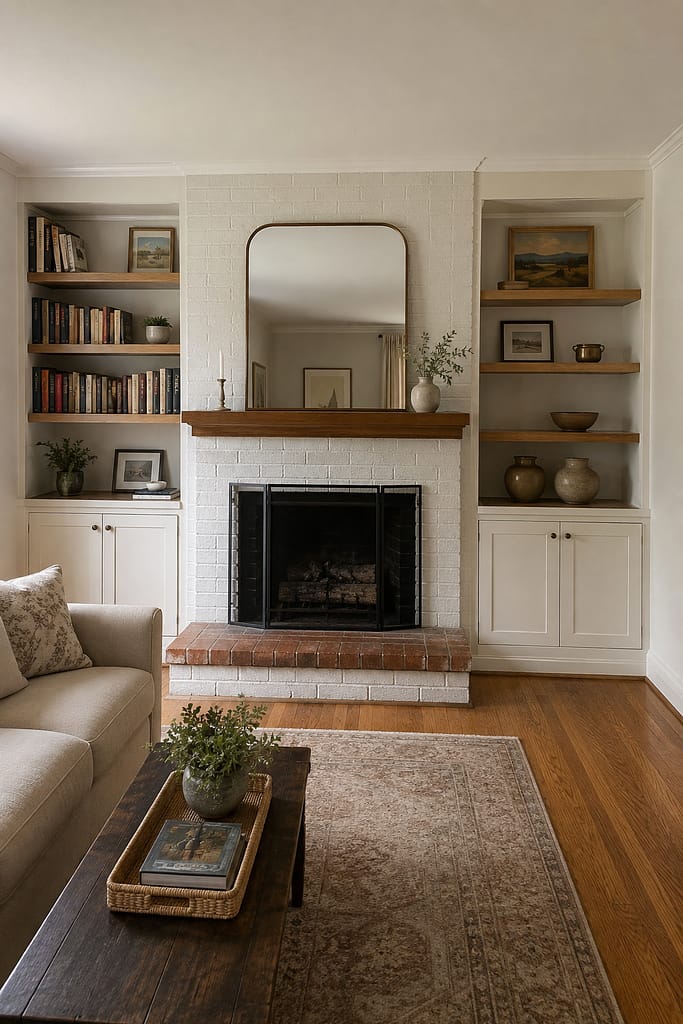
How to Design Built-In Shelves That Look Calm and Permanent
The strongest built in shelves living room ideas usually follow one framework: closed storage below + open shelves above + correct scale + restrained styling + architectural trim.
Start by deciding what the wall actually needs to store. If the room has toys, games, electronics, paperwork, cords, or extra blankets, those categories deserve cabinet doors or drawers before you start planning decorative shelves.
Then look at scale. An eight-foot room may only need low cabinets and a few broad shelves. A taller room can support floor-to-ceiling storage, but fewer, wider bays usually look calmer than a wall broken into dozens of small compartments.
Color changes the visual weight. Warm white and pale mushroom recede. Sage and navy add architecture. Charcoal makes a wall feel stronger and more contemporary. Natural oak or walnut can supply enough warmth that the shelves themselves need less decoration.
Finally, make the wall read as one built-in system. Consistent paint, side fillers, an integrated base, aligned shelf heights, and appropriate top trim matter more than filling every shelf.
The goal is storage that hides clutter, holds real books, displays a little art, and still leaves enough empty space to breathe.