

12 Winter Curtains Living Rooms Ideas for a Warmer and Cozier Space
Curtains are one of those things you barely notice until winter arrives.
Then suddenly that innocent-looking window feels like it’s personally responsible for half the cold in the room.
While curtains can’t fix poorly insulated windows, the right Winter Curtains Living Rooms Ideas can make a living room feel warmer, softer, and much cozier during the colder months.
And you don’t need enormous luxury drapes sweeping across a 14-foot ceiling.
We’re working with normal homes here.
Think:
Warm cream.
Mushroom taupe.
Deep burgundy.
Muted olive.
Camel.
Warm brown.
Soft woven textures.
Lined panels.
Layered window treatments.
The goal is to create visual warmth while improving privacy and reducing that cold-window feeling where appropriate.
Just remember that curtains should never interfere with heaters, radiators, vents, electrical equipment, or safe window operation. If a window is required for emergency egress, keep it fully accessible.
Ready to make the windows look considerably less January-ish?
Here are 12 Winter Curtains Living Rooms Ideas for a Warmer and Cozier Space.
1. Hang Warm Cream Curtains
Warm cream is probably the safest place to start.
It brightens a winter living room without looking stark.
Choose curtains with a substantial woven texture rather than extremely thin summer sheers.
Pair them with:
Warm greige walls.
Medium-walnut flooring.
A camel sofa.
Mushroom accents.
The entire room immediately feels softer.
Warm cream is especially useful in small living rooms because darker winter colors can sometimes make limited space feel even smaller.
And yes, cream is technically still beige’s relative.
But this one has better lighting.

2. Try Deep Burgundy Curtains
Want more drama?
Use burgundy.
Deep muted burgundy curtains look incredible in winter because they add warmth without needing seasonal patterns.
Keep the rest of the room lighter.
Use warm-cream walls.
Add a camel sofa.
Bring in medium walnut.
Use mushroom through the rug or throw.
The burgundy becomes the main visual feature.
This is especially good for a living room that feels a little flat during winter.
Two curtain panels.
Entire personality transplant.
Interior design can be suspiciously easy sometimes.

3. Use Mushroom Taupe Curtains
Mushroom is perfect when cream feels too light and burgundy feels too bold.
It’s warm.
Neutral.
Soft.
And extremely easy to combine with other winter colors.
Pair mushroom curtains with warm-cream walls and medium walnut.
Add muted olive or burgundy through a cushion.
The result feels cozy without becoming obviously seasonal.
Which means you can leave the curtains up in April without anyone asking questions.
Excellent return on decorating effort.

4. Layer Sheer Curtains With Heavier Panels
Layering gives you more flexibility.
Use light-filtering sheers closest to the window.
Add heavier curtain panels outside them.
During the day, open the heavier curtains and let the sheers provide some privacy while admitting daylight.
At night, close the outer panels.
Choose warm cream for the sheers.
Use mushroom, camel, muted olive, or burgundy outside.
Just remember that the actual thermal performance depends on the fabric, lining, fit, window condition, and installation.
Pretty curtains aren’t secretly insulation contractors.
But appropriate layered treatments can still make the room feel much more comfortable.

5. Choose Thermal-Lined Curtains
If your living room windows feel particularly cold, consider properly fitted thermal-lined curtains.
Look for curtains specifically designed for insulation or energy performance.
Follow the manufacturer’s installation instructions.
Fit matters.
Panels that barely cover the glass won’t perform like curtains extending beyond the window opening.
Choose warm cream, mushroom, or camel so the practical curtain still looks decorative.
Thermal curtains have improved considerably.
We’re no longer automatically choosing between “pretty” and “something apparently borrowed from a theater backstage area.”
Progress.

6. Use Muted Olive Curtains
Muted olive gives winter rooms a softer connection to nature.
It works especially well if you already have:
Warm cream.
Walnut.
Camel.
Mushroom.
Use olive curtain panels around a standard window.
Add one burgundy cushion for contrast.
Keep the rest simple.
The green feels seasonal without looking like Christmas because it’s earthy rather than bright.
Olive and burgundy together?
Still one of winter’s best color combinations.
I will continue campaigning for it.

7. Add Camel Brown Curtains
Camel creates a warmer, earthier window treatment.
Use medium camel-brown curtains against warm-cream walls.
Pair them with a cream sofa or camel chair.
Add mushroom and muted olive nearby.
This works beautifully in rustic, transitional, and cozy traditional living rooms.
Choose a fabric with visible weave rather than a shiny finish.
The texture is what makes the brown feel intentional.
Otherwise, you risk drifting into “conference room curtains from 2004.”
Very specific danger.
Very real.

8. Try Subtle Plaid Winter Curtains
Plaid can work beautifully in winter.
The key is restraint.
Choose a subtle pattern.
Try warm cream, mushroom, and muted brown.
Or cream with restrained burgundy lines.
Avoid bright red-and-green plaid if you want the curtains to feel appropriate after Christmas.
Use the pattern on the curtains.
Then keep the sofa and rug mostly solid.
Otherwise the room starts collecting patterns like they’re loyalty points.
One statement is enough.

9. Use Textured Woven Curtains
Color isn’t your only tool.
Texture can make neutral curtains feel much cozier.
Choose a warm-cream or mushroom woven fabric with visible texture.
Think linen-look or other substantial woven materials appropriate for curtain use.
The irregular surface catches winter daylight beautifully.
Pair textured curtains with smoother materials elsewhere.
A simple camel sofa.
Walnut table.
Plain cream rug.
That contrast prevents the room from feeling flat.
Texture is basically color’s quieter cousin.
And winter loves it.

10. Choose Floor-Length Curtains for a Small Living Room
Small living room?
Use vertical lines to your advantage.
Mount an appropriate curtain rod securely above the window according to the hardware instructions and wall construction.
Let the panels extend almost to the floor.
Keep the hem just above the flooring rather than creating a large fabric puddle.
Warm cream or mushroom works particularly well.
The longer visual line can make the window feel taller.
And unlike an oversized furniture purchase, it doesn’t consume another three feet of floor space.
Small-room victory.

11. Pair Curtains With Roman Shades
Layer curtains with a simple shade.
Use a warm woven-look Roman shade inside the window.
Add full-length warm-cream curtain panels outside.
The combination creates depth.
It also gives you more control over privacy and daylight.
Choose compatible products and install them according to manufacturer instructions.
If young children are present, prioritize cordless window coverings or products compliant with current window-covering safety requirements.
Loose window-covering cords are not decor.
They’re a safety issue.
Luckily, clean cordless shades also look better.
Win-win.

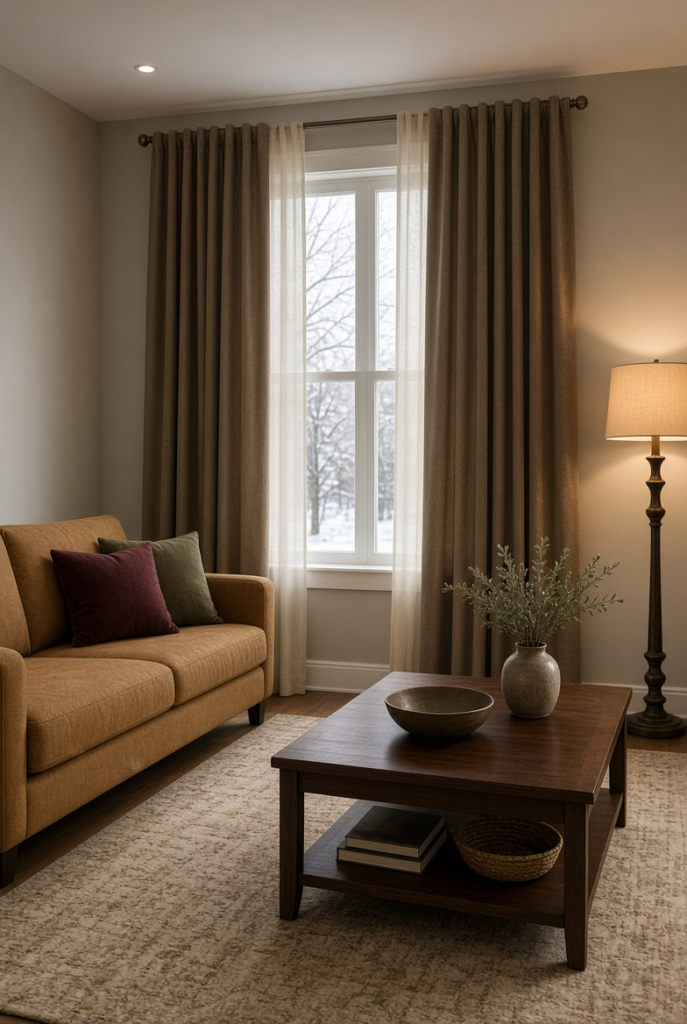
12. Create a Full Layered Winter Window
Want the coziest version?
Build the room around the window.
Use warm-cream sheers.
Add deep mushroom outer curtains.
Bring in a camel sofa.
Add one burgundy cushion.
Use a muted-olive accent.
Repeat medium walnut through the coffee table.
Finish with warm 3000K lighting.
The curtains become part of the whole winter palette rather than an isolated feature.
Keep the arrangement practical.
The window should still open normally.
The curtains should move easily.
And nothing should interfere with nearby heating or ventilation.
Cozy works best when the house still functions.
Annoying but true.
What Curtains Are Best for a Living Room in Winter?
It depends on what you want the curtains to do.
For visual warmth, consider:
Warm cream.
Mushroom.
Camel.
Burgundy.
Muted olive.
For more privacy and a heavier winter look, choose substantial woven panels.
For potential insulation benefits, look for curtains specifically designed and labeled for thermal performance.
For flexibility, layer sheers with heavier outer panels.
And remember that curtains alone won’t correct major drafts, damaged weatherstripping, or poorly performing windows.
If the room is genuinely uncomfortable, investigate the actual source of the heat loss too.
The curtain cannot carry the entire building envelope on its back.
Cozy Winter Curtains Living Rooms Ideas
Cozy curtains usually have one or more of three qualities:
Warm color.
Visible texture.
Substantial weight.
Try:
Mushroom woven curtains.
Cream lined panels.
Burgundy drapes.
Camel textured curtains.
Muted olive panels.
Layered cream sheers and heavier curtains.
Avoid making every textile in the room heavy.
If the curtains are visually substantial, keep the rug or sofa simpler.
Balance keeps cozy from becoming cave-like.
Winter Living Room Curtain Color Ideas
A reliable winter palette is:
Warm cream + mushroom + camel + medium walnut.
For more color, add:
Deep burgundy.
Or:
Muted olive.
For a moodier room:
Mushroom + burgundy + walnut + warm cream.
For something lighter:
Warm cream + camel + muted olive + pale mushroom.
You don’t need to match the curtains exactly to the sofa.
In fact, slight contrast usually looks better.
Burgundy Winter Curtains Living Rooms Ideas
Burgundy works best when the surrounding room is lighter.
Try burgundy curtains with:
Warm-cream walls.
Camel seating.
Mushroom textiles.
Walnut furniture.
Use burgundy again once elsewhere in the room.
Maybe one cushion.
That’s enough.
Repeating the color once makes the curtains feel intentional without turning the entire living room burgundy.
Cream Winter Curtains Living Rooms Ideas
Cream curtains are ideal for small or darker living rooms.
They reflect more available daylight than very dark fabrics.
Choose warm cream rather than icy white for a softer winter effect.
Add texture through the weave.
Pair cream curtains with walnut, camel, mushroom, and olive.
If you need more light control or thermal performance, look for lined options rather than automatically choosing a darker color.
Mushroom Winter Curtains Living Rooms Ideas
Mushroom is probably the easiest winter curtain color to live with year-round.
It’s warmer than gray.
Softer than dark brown.
And more forgiving than cream.
Pair it with:
Walnut.
Warm cream.
Camel.
Burgundy.
Muted olive.
It works in modern, rustic, traditional, farmhouse, and Scandinavian-inspired rooms.
Basically, mushroom is the coworker who somehow gets along with everyone.
Olive Winter Curtains Living Rooms Ideas
Muted olive works particularly well in rooms with wood.
Use it beside medium walnut or oak.
Add warm cream.
Bring in mushroom.
Use burgundy as a tiny accent.
Avoid very bright greens if your goal is a quieter post-Christmas winter room.
Earthy olive feels natural.
Bright green can start asking where the ornaments went.
Neutral Winter Curtains Living Rooms Ideas
Neutral doesn’t mean everything must be cream.
Mix:
Warm cream.
Mushroom.
Taupe.
Camel.
Warm gray.
Natural brown.
Use different textures to separate similar colors.
For example:
Mushroom curtains.
Cream rug.
Camel sofa.
Walnut table.
The room stays neutral without becoming one giant beige object.
An important distinction.
Rustic Winter Curtains Living Rooms Ideas
Use textured warm neutrals.
Try:
Camel.
Mushroom.
Warm cream.
Subtle plaid.
Pair the curtains with medium-toned wood furniture.
Add muted olive.
Use a burgundy accent.
Avoid excessively themed cabin patterns unless you genuinely want that look.
Rustic can be created through texture and material.
No moose silhouettes required.
Farmhouse Winter Curtains Living Rooms Ideas
Try warm-cream woven curtains.
Or a subtle cream-and-mushroom plaid.
Use medium-walnut or oak furniture.
Add matte-black hardware.
Keep patterns restrained.
Avoid overly decorative valances if you want a cleaner modern-farmhouse look.
Simple panels usually feel more current and are easier to transition between seasons.
Scandinavian Winter Curtains Living Rooms Ideas
Keep them light.
Use warm cream.
Pale mushroom.
Soft taupe.
Choose simple textured panels.
Let natural daylight through when privacy allows.
Pair with pale or medium wood.
Add one muted-olive accent.
Avoid excessive layering.
The goal is softness without visual heaviness.
Winter already provides enough darkness.
The room doesn’t need to volunteer more.
Modern Winter Curtains Living Rooms Ideas
Use clean full-length panels.
Try mushroom.
Warm cream.
Charcoal-taupe.
Or deep burgundy as a statement.
Keep curtain hardware simple.
Use matte black or understated metal where appropriate.
Avoid unnecessary decorative tiebacks and heavy trim.
Let the curtain’s color, texture, and proportion create the impact.
Winter Curtains for Small Living Rooms
Use lighter colors.
Warm cream and pale mushroom are especially useful.
Mount the rod securely at an appropriate height above the window.
Extend the curtain coverage beyond the glass where practical and compatible with the room.
Use floor-length panels.
Keep hems neat.
Avoid excessive fabric pooling.
And don’t choose extremely bulky curtains that consume precious floor area.
Small spaces benefit from clean vertical lines.
Should Winter Curtains Touch the Floor?
They can reach the floor visually without creating a large fabric puddle.
For practical everyday rooms, a hem ending just above the floor is often easier to maintain.
It collects less dust.
It’s less likely to interfere with cleaning.
And it reduces fabric bunching around floor-level heating or ventilation.
Exact curtain length depends on the window, rod position, floor, and style.
Measure before ordering.
“Approximately the right length” is how you end up introducing your curtains to a sewing machine at 11 p.m.
Can Curtains Make a Living Room Warmer?
Appropriate window coverings can help reduce heat transfer around windows, particularly when they’re designed for thermal performance and installed effectively.
But results vary.
Curtain material, lining, size, fit, window construction, drafts, climate, and how the curtains are used all matter.
Close appropriate curtains when useful for retaining indoor warmth.
Open them when beneficial sunlight can help warm the room.
But don’t let curtains block radiators, heaters, heat registers, or required ventilation.
For serious drafts or heat-loss problems, address the underlying window or building issue.
Decor has limits.
Physics remains stubborn.
How to Layer Curtains for Winter
Start with the inner layer.
Use sheers or a shade.
Then add heavier outer panels.
Choose colors that relate without matching perfectly.
For example:
Warm-cream sheers + mushroom curtains.
Warm-cream sheers + burgundy curtains.
Mushroom shade + cream curtains.
Install the hardware securely.
Make sure both layers move freely.
And keep the window’s locks, handles, and required opening functions accessible.
Layering should add flexibility.
Not make opening the window a 12-step procedure.
How to Make Winter Curtains Look Expensive
Use generous but appropriate fullness.
Choose substantial fabric.
Hang panels evenly.
Measure carefully.
Use a consistent length.
Choose simple hardware.
Stick to a controlled palette.
Avoid excessive decorative trim.
And steam or otherwise remove packaging creases according to the fabric’s care instructions.
Nothing exposes brand-new curtains faster than eight horizontal folds running across each panel.
Give them a minute to recover from the box.
How to Keep Heavy Winter Curtains From Making a Room Look Dark
Choose a lighter wall color.
Use warm cream or mushroom rather than extremely dark curtain fabric.
Open curtains fully during daylight when privacy allows.
Use warm layered lighting at night.
Add a cream rug.
Keep larger furniture medium rather than very dark.
You can also use heavier curtains only on the outer layer and retain lighter sheers underneath.
The goal is cozy.
Not permanent 4:37 p.m.
Winter Curtain Installation Tips
Measure the window before buying anything.
Then measure it again.
Consider:
Window width.
Window height.
Rod position.
Desired panel length.
Curtain fullness.
Wall construction.
Window hardware.
Nearby vents or heating equipment.
Use curtain rods and mounting hardware appropriate for the panel weight and mounting surface.
Use suitable anchors where required.
Follow manufacturer instructions.
Heavy curtains require appropriately supported hardware.
Don’t assume two tiny screws into drywall will enthusiastically support several kilograms of fabric forever.
Gravity is patient.
Winter Curtain Safety
Install curtain hardware securely and appropriately for the wall construction and curtain weight.
Check brackets periodically, especially with heavier panels.
Keep curtains away from:
Open flames.
Fireplaces.
Portable heaters.
Radiators where contact isn’t permitted.
Hot surfaces.
Cooking equipment.
Electrical equipment that requires ventilation.
Don’t drape fabric over heaters or vents.
Maintain required clearances around fireplaces and heating appliances according to manufacturer instructions.
Keep floor-length curtains from creating trip hazards.
Avoid excessive fabric pooling in walking areas.
Maintain clear access to window:
Locks.
Handles.
Latches.
Opening mechanisms.
If a window is required for emergency egress, the curtain arrangement must not prevent or unreasonably delay access and operation.
Don’t permanently cover necessary ventilation.
Be cautious with electrical cords near curtains.
Don’t run damaged cords behind or beneath fabric where overheating or damage could go unnoticed.
For homes with young children, window-covering cords require special attention.
Use cordless products where possible and follow current product safety guidance.
Keep cords inaccessible and never create accessible loops.
Secure curtain rods and accessories so children cannot easily pull heavy hardware down.
Consider pets too.
Long curtains can be climbed, pulled, scratched, or tangled.
And if you’re using curtains primarily because a room feels unusually cold, don’t ignore significant condensation, drafts, moisture damage, or other window problems.
Those may need actual repair.
A burgundy curtain is powerful.
But even burgundy has boundaries.
How to Transition Winter Curtains Into Spring
You may not need to change them at all.
Warm cream?
Keep it.
Mushroom?
Keep it.
Muted olive?
Absolutely.
If you’re using heavy burgundy curtains and want something lighter, swap them for warm cream or pale mushroom.
Remove the heavier outer layer from a layered setup if your climate and privacy needs allow.
Keep the sheers.
Change nearby pillows and throws.
The whole room can feel lighter without touching the major furniture.
That’s the advantage of curtains.
Big visual impact.
Relatively small intervention.
Final Thoughts
The best Winter Curtains Living Rooms Ideas for a Warmer and Cozier Space combine visual warmth with practical window coverage.
Try warm cream.
Go bold with burgundy.
Use mushroom taupe.
Layer sheers with heavier panels.
Consider thermal-lined curtains.
Bring in muted olive.
Try camel brown.
Use subtle plaid.
Add woven texture.
Create long vertical lines in a small room.
Pair curtains with a Roman shade.
Or build one complete layered winter window.
Focus on warm colors, substantial textures, correct measurements, secure installation, useful light control, and safe clearance from heating equipment.
Curtains won’t magically turn January into June.
But they can make sitting beside the window considerably more appealing.
And frankly, that’s enough responsibility for two pieces of fabric.
