

16 Elegant Shower Curtain Ideas for Small Bathrooms
In a compact bathroom, the shower curtain takes up far more visual space than most accessories. It may cover nearly an entire wall, which means changing it can alter the room more noticeably than swapping a bath mat, towels, or countertop decor. The best shower curtain ideas use that large surface deliberately, controlling color, texture, pattern, and proportion instead of treating the curtain as an afterthought.
A higher rod can draw attention upward. A quiet woven fabric can soften glossy tile. A carefully chosen stripe can make a low ceiling seem less obvious. Even an inexpensive white curtain can feel polished when the length, fullness, liner, and hardware are handled well.
The useful rule is to think of the shower curtain as a wall of fabric rather than a small bathroom accessory. In a five-by-eight-foot bathroom, that wall can make the space feel brighter, taller, calmer, more traditional, or noticeably busier.
Here are 16 elegant approaches that work with the proportions and practical limitations of real small bathrooms.
1. Hang a Floor-Skimming White Curtain Higher Than Expected
A plain white shower curtain becomes much more interesting when proportion does the decorating. Choose a substantial cotton, waffle-weave, or linen-look curtain rather than a thin, shiny fabric. Hang it higher than the typical rod position so the long vertical folds occupy most of the wall between the tub and ceiling.
This treatment is especially effective in a basic bathroom with white subway tile, pale walls, a compact vanity, and chrome or brushed-nickel fixtures. Because the curtain doesn’t introduce a strong color boundary, the eye notices its height instead. That helps a short room feel less visually chopped into horizontal sections.
You don’t necessarily need a ceiling-height installation. Raise the rod only as high as your curtain and liner can accommodate while still keeping water inside the tub. The decorative curtain can finish close to the floor, but it shouldn’t sit in damp folds against it.
Give the fabric enough width to form relaxed pleats when closed. Stretching a curtain completely flat across the tub tends to expose every inexpensive detail.
For a hotel-inspired finish, keep the rings simple and consistent with the faucet or existing bathroom hardware.

2. Warm Up Beige Tile With an Oatmeal Linen-Look Curtain
Older beige tile doesn’t need to be disguised with stark white. In fact, bright optical white can sometimes make warm tile look yellower by comparison. An oatmeal, flax, or light taupe linen-look shower curtain works with the existing warmth instead of fighting it.
Picture a rental bathroom with cream-beige tub tile, brushed-nickel hardware, off-white walls, and a medium-brown vanity. A softly textured oatmeal curtain gives those unrelated builder finishes a common neutral reference point. The room feels calmer because the largest textile isn’t creating another strong contrast.
This is one of the easiest renter-friendly bathroom ideas because nothing permanent needs to change. Keep the existing rod if necessary, replace mismatched plastic hooks with simple metal rings, and choose a curtain with enough weight to hang in defined folds.
Real linen can be beautiful, but a washable linen-look polyester or cotton blend is often easier around daily moisture. A decorative fabric curtain is not automatically a water barrier, so keep a waterproof shower liner on the tub side.
Avoid letting the curtain become overly brown. A light oatmeal shade usually works better than a muddy tan in a bathroom with limited daylight.

3. Use Narrow Vertical Stripes to Stretch a Low Ceiling
Vertical stripes are particularly useful when a shower rod sits low and the bathroom already feels horizontally compressed. Instead of choosing a bold cabana stripe, try narrow blue-gray, charcoal, or muted sage lines on an ivory ground.
The stripe gives the eye a reason to travel vertically. That effect becomes stronger when the rod is raised modestly and the curtain is long enough to create uninterrupted lines rather than stopping awkwardly halfway down the wall.
For a small bathroom, pattern scale matters. Narrow, evenly spaced stripes provide structure without becoming a giant graphic backdrop. They also pair comfortably with plain tile, which is why classic striped curtains work well in builder-grade bathrooms.
Keep surrounding accessories quieter. If the curtain is striped, solid towels and a simple bath mat are usually enough.
A stripe won’t magically make an eight-foot ceiling taller, but it can change where the eye focuses. Just check the curtain dimensions before moving a rod upward. A higher rod paired with a standard-length curtain that barely reaches the tub defeats both the visual effect and the curtain’s function.

4. Try an Extra-Long Dusty-Blue Curtain as the Main Color Moment
An extra long blue shower curtain can add real personality without making a small bathroom feel frantic. Dusty blue, faded denim, or muted slate-blue works especially well because the color is noticeable without having the visual weight of deep navy.
Imagine an otherwise simple bathroom with white subway tile, warm-white walls, a light-oak vanity, and brushed-nickel hardware. A long dusty-blue curtain becomes the main color field. Hung higher than average, it emphasizes height at the same time, so the color feels architectural rather than like a random accessory.
Look for fabric with a matte weave instead of a shiny surface. Slight variations in texture keep a large solid-colored curtain from looking flat. Use a white or translucent waterproof liner behind it.
A very long shower curtain still needs a deliberate endpoint. Measure from the proposed rod position before buying. Ideally, the decorative fabric should finish just above the floor rather than pooling beside the tub.
In a windowless bathroom, choose a softer blue and make sure the lighting is adequate. Very dark navy across an entire wall can visually close in a poorly lit room.

5. Bring In a Soft Botanical Print Without Overcrowding the Room
Botanical patterns don’t have to mean enormous tropical leaves. For a narrow bathroom, a restrained pattern of small olive branches, faded green leaves, or delicate blue-gray stems can provide detail while leaving plenty of background visible.
Choose a curtain with an ivory or warm-white base and a muted print. Against plain tile and a simple vanity, the pattern softens the hard surfaces of porcelain, mirror, metal, and ceramic without becoming the only thing you notice.
This is where scale deserves attention. A huge floral motif may look beautiful online when photographed in a spacious bathroom, but in a compact room you may stand only a few feet from the curtain. Smaller motifs are easier to read at that distance.
Keep the remaining small bathroom decor restrained. Pull one secondary color from the curtain for the hand towel or bath mat rather than matching every accessory.
If the bathroom already has busy patterned floor tile, simplify the curtain further. Two competing patterns covering large surfaces can make a tiny room feel visually restless.

6. Choose Hotel-Style White With a Subtle Woven Border
If an all-white curtain feels too plain but a pattern feels too busy, use texture and border detail instead. A crisp white curtain with a narrow woven stripe, dobby band, or subtle border near the bottom has enough tailoring to look intentional while remaining visually quiet.
This approach works especially well in a windowless apartment bathroom where preserving brightness matters. White fabric reflects more available light than a dark curtain, while the border gives the eye a finishing detail without breaking up the room.
The expensive-looking part isn’t necessarily the curtain itself. Clean hems, controlled fullness, matching rings, and a liner that isn’t visibly bunching underneath can make an affordable curtain look much more considered.
For the classic hotel effect, pair the curtain with chrome hardware, white towels, and perhaps one charcoal or navy hand towel for contrast.
Keep the hem off the floor. A crisp white curtain loses much of its appeal when the bottom edge stays damp or collects dust.

7. Give Classic Ticking Stripes a Cleaner, Updated Look
A ticking-stripe curtain sits comfortably between traditional and casual. Choose fine navy-and-ivory, faded black-and-cream, or blue-and-white stripes rather than thick contrasting bands. The narrow pattern has enough detail to soften plain walls without visually shrinking the room.
In a small bathroom with white tile and an older wood vanity, ticking stripes can also bridge different eras. The pattern feels familiar next to traditional cabinetry but simple enough beside newer chrome or brushed-nickel hardware.
Hang the curtain so the stripe runs in a long, clean vertical direction. Slight fullness is important: you want visible folds, but not so much fabric that the narrow tub opening becomes crowded.
Among classic shower curtains, ticking stripe is particularly forgiving because it doesn’t rely on trendy colors or oversized motifs. It also gives you several easy accent choices—navy towels for more contrast, natural wood for warmth, or white accessories for a quieter result.
Avoid piling on additional stripes in the bath mat, towels, and wall art. The curtain already provides the rhythm.

8. Use Two Panels for a Tailored, Traditional Shower Opening
Two panel shower curtains can make a standard tub feel more like an intentional architectural feature. Instead of one curtain gathering entirely at one end, two decorative panels can frame the opening from both sides when the shower isn’t being used.
Choose lightweight ivory or pale taupe fabric panels with enough body to hold relaxed folds. A narrow contrast border can make the arrangement feel even more tailored. Behind them, keep a functional waterproof liner that can close fully across the tub during a shower.
This answers an important practical question about curtain panels for shower curtain styling: the decorative panels aren’t necessarily responsible for containing the water. The liner is. Hang the liner toward the inside of the tub or threshold while the fabric remains outside.
When bathing, the decorative panels should be easy to pull toward the center if necessary without creating cumbersome piles of fabric. In a tiny bathroom, moderate fullness is better than dramatic drapery.
This treatment works especially well with traditional vanities, framed mirrors, and simple white tile, but it shouldn’t look like living-room curtains transplanted beside a bathtub.
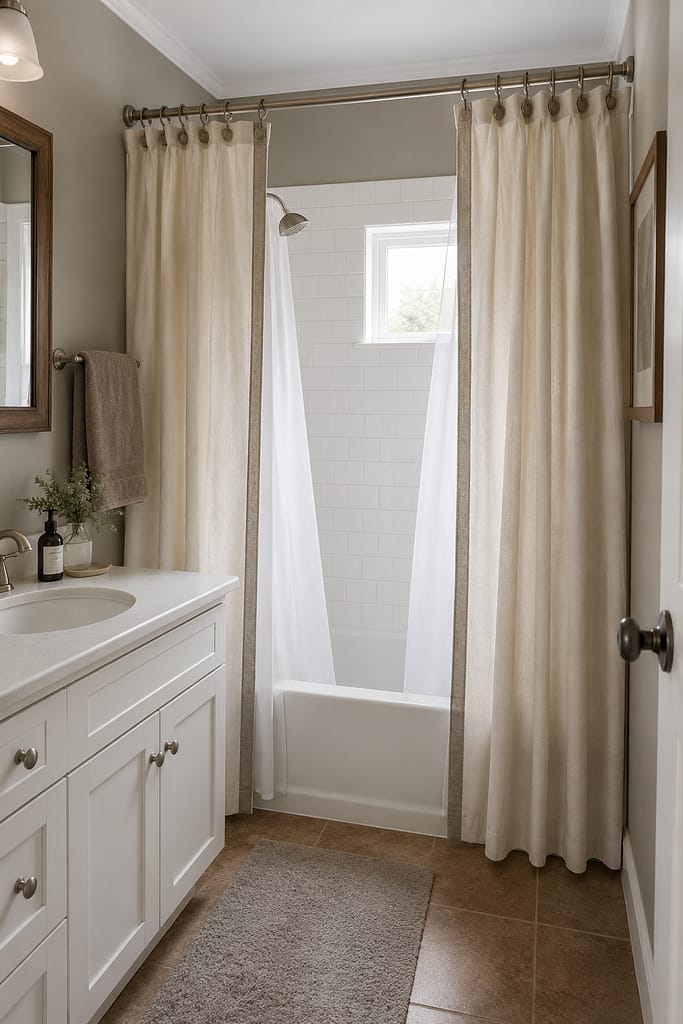
9. Add a Narrow Contrast Trim Instead of a Full Pattern
Sometimes a small bathroom needs definition, not another pattern. Start with an ivory, white, or pale gray curtain and choose one with a narrow navy, charcoal, olive, or brown border running vertically along the edges.
The trim outlines the curtain almost like a tailored textile panel. Because most of the surface remains light and plain, the bathroom keeps its visual breathing room. The darker line gives enough structure to connect the curtain to black mirror frames, dark vanity hardware, or a contrasting floor.
This is a particularly useful elegant shower curtain idea for bathrooms that already have patterned tile. Instead of asking the curtain to compete, the border repeats one color from the floor and leaves the rest quiet.
For the most convincing result, the trim should look integrated into the fabric rather than like a loose decorative ribbon. Hang the curtain in relaxed folds so the border remains reasonably straight.
If you use dark trim, repeat it only once or twice elsewhere. Too many small black accents scattered around a tiny room can look busier than one well-defined vertical edge.

10. Use a Small Vintage-Inspired Print in an Older Bathroom
An older bathroom doesn’t always benefit from being forced into a stark modern palette. If you have cream tile, a traditional vanity, or slightly dated chrome fixtures, a small vintage-inspired print can make those features feel more deliberate.
Look for a curtain with tiny block-print florals, restrained vines, or a repeating geometric motif on an ivory ground. Muted rust, faded blue, olive, or soft brown can work particularly well with warm tile.
Because the pattern repeats at a small scale, it can be viewed comfortably from close range. That’s important in a bathroom where the toilet or vanity may sit only a few feet from the tub.
Keep the curtain length tidy and the rod straightforward. The pattern already supplies plenty of character, so elaborate hooks or decorative tiebacks aren’t necessary.
This is also an affordable approach to a small bathroom makeover. Instead of replacing perfectly usable beige tile, select a textile that makes the existing color part of the palette. A cream liner is often less visually harsh than brilliant white behind a warm-toned decorative curtain.

11. Create a Softer Curtain-Style Look With a Hidden Liner
A curtain style shower curtain works best when the decorative fabric looks like a textile first and the waterproof layer stays visually secondary. Try a soft cream cotton-blend curtain with deep vertical folds and a simple concealed liner behind it.
This approach is especially effective in bathrooms dominated by hard materials. Tile, porcelain, mirrors, and metal can make a compact space feel somewhat clinical. A substantial textile introduces softness without taking up any floor space.
If you’re wondering how to hang a shower curtain liner with decorative fabric, the basic arrangement is straightforward: the water-resistant liner hangs toward the shower side and remains inside the tub while bathing; the decorative fabric faces the room. Depending on your hardware, both can share compatible rings or use a double shower-curtain rod.
The liner should be long enough to keep water contained but shouldn’t spill onto the bathroom floor. Weighted or magnetic hems can help some liners stay against a compatible tub.
Avoid overly heavy drapery fabrics that dry slowly. The goal is the appearance of tailored curtains without creating a moisture-management problem.

12. Let a Textured Solid Curtain Do the Work
Color isn’t the only way to make a curtain noticeable. A solid warm white, sage, dusty gray, or pale taupe curtain with waffle weave, matelassé-style texture, narrow ribbing, or subtle slub can provide depth without introducing another pattern.
Texture is especially helpful in a small bathroom where the floor already has movement or the vanity has strong wood grain. From the doorway, the curtain reads as a calm solid. Up close, the woven surface keeps it from feeling generic.
For a polished result, choose a fabric with enough weight to fall vertically instead of clinging to the liner. Use simple rings and moderate fullness.
A textured curtain is also forgiving for renters because it can improve a basic fiberglass or tiled tub surround without competing with finishes you didn’t choose.
Be careful with very thick fabric in a bathroom with poor ventilation. A heavy decorative textile that remains damp isn’t practical. A washable, medium-weight curtain with a separate liner gives you the visual texture without unnecessary bulk.

13. Mount the Curtain on a Ceiling Track in an Awkward Layout
Some compact bathrooms have an awkward tub position, an unusually low existing rod, or a configuration where a traditional wall-to-wall rod visually cuts through the room. A ceiling-mounted shower track can create a cleaner vertical line when the construction and mounting surface allow it.
Use a long, plain curtain—warm white, pale gray, or muted blue—and let the vertical folds begin close to the ceiling. In a small room, removing the obvious horizontal rod line can make the shower enclosure feel more integrated with the architecture.
This is not a universal renter solution. A ceiling track generally requires secure installation, and it shouldn’t be attached casually without understanding the ceiling material and manufacturer’s mounting requirements. Renters are usually better served by a tension rod unless modifications are permitted.
Function remains the priority. The curtain or liner still needs to overlap the shower threshold correctly and contain water. Don’t choose a floor-length decorative look that leaves the actual wet area unprotected.
Used in the right bathroom, though, a ceiling track can make a surprisingly ordinary tub surround look much more deliberate.

14. Soften Sliding Glass Shower Doors With an Exterior Curtain
Existing sliding doors can dominate a small bathroom, particularly when the frame is dated or visually heavy. In the right configuration, a shower curtain over sliding glass doors can soften their appearance without removing them.
The important distinction is that the existing glass remains the functional water barrier. The decorative curtain stays outside the enclosure, where it can introduce texture or color without needing to sit inside the tub.
For example, a long ivory linen-look curtain mounted on a separate rod above and slightly outside an older metal-framed enclosure can cover much of the glass when the shower isn’t being used. When needed, the curtain should slide aside easily so both glass doors still operate normally.
This can be useful for renters who can’t remove existing doors, but it depends heavily on the layout. Don’t install a curtain where it catches on the glass tracks, blocks handles, or makes entering the shower awkward.
A restrained solid fabric works better than elaborate drapery here. You’re visually softening a utilitarian surface, not building a second enclosure around it.

15. Use a Deeper Curtain Color in a Bright Small Bathroom
Small bathrooms don’t have to be pale. A deep slate, forest green, or softened navy curtain can look sophisticated when the surrounding room provides enough light and contrast.
The trick is understanding how much visual area the curtain occupies. In a bathroom with white tile, light walls, a white tub, and a bright window or strong layered lighting, one dark textile can give the room a clear focal point without making every surface feel heavy.
Choose a solid or extremely restrained pattern and keep the fabric matte. A dark shiny curtain can read more like a plastic barrier, while a woven finish absorbs light more softly.
Consider leaving the curtain partially open when the shower isn’t in use if doing so exposes light tile behind it. That prevents the darkest surface from always occupying the entire wall.
In a windowless bathroom with weak overhead lighting, this idea needs more caution. A floor-to-ceiling navy curtain may make an already dim space feel enclosed. In that situation, dusty blue or medium sage can provide color with less visual weight.

16. Combine Soft Blue and White for a Calm Coastal-Classic Finish
Blue and white can feel fresh without turning a bathroom into a themed coastal space. Choose a mostly white curtain with a faded blue block print, narrow blue border, or restrained medium-scale motif. Pair it with white tile, a pale wood or white vanity, and brushed-nickel or chrome fixtures.
This palette works particularly well in a small bathroom because the white background maintains visual lightness while the blue gives the large curtain surface enough definition to feel intentional.
Unlike a tiny allover print, a medium-scale blue motif needs some breathing room. Look for a design with generous white space between elements so the pattern doesn’t merge into visual noise when seen from a few feet away.
Hang the curtain at a flattering height, keep the hem dry, and use enough fullness for relaxed folds. A white liner behind the decorative fabric will disappear more easily than a contrasting one.
Among bathroom curtain styling options, this is a useful middle ground: more decorative than a plain white curtain, quieter than a dramatic floral, and adaptable to both classic and contemporary bathrooms.

Choosing the Right Shower Curtain for Your Small Bathroom
The most successful shower curtain ideas aren’t necessarily built around an expensive curtain. Start with five things: height, proportion, fabric, pattern scale, and a practical liner.
Look at the bathroom before shopping. Notice where the current rod divides the wall, how much distance there is between the tub and ceiling, whether the room gets daylight, and which existing finishes have to stay. Beige tile may call for warmer fabric rather than stark white. A low ceiling may benefit from vertical stripes or a higher curtain position. A windowless room may need a lighter color even if you love dramatic navy.
Then measure. An extra-long curtain looks intentional only when its length matches the rod position. The fabric should fall cleanly rather than puddling on a damp floor, and enough fullness should remain to create soft folds without crowding a narrow shower.
Finally, keep the decorative layer and water-control layer doing their respective jobs. A beautiful cotton or linen-look curtain can face the room while a properly positioned waterproof liner protects the tub area.
A small bathroom doesn’t need to pretend it’s enormous. Good proportions, useful textiles, restrained pattern, and thoughtful hardware can simply make it feel calmer, more comfortable, and more finished.