
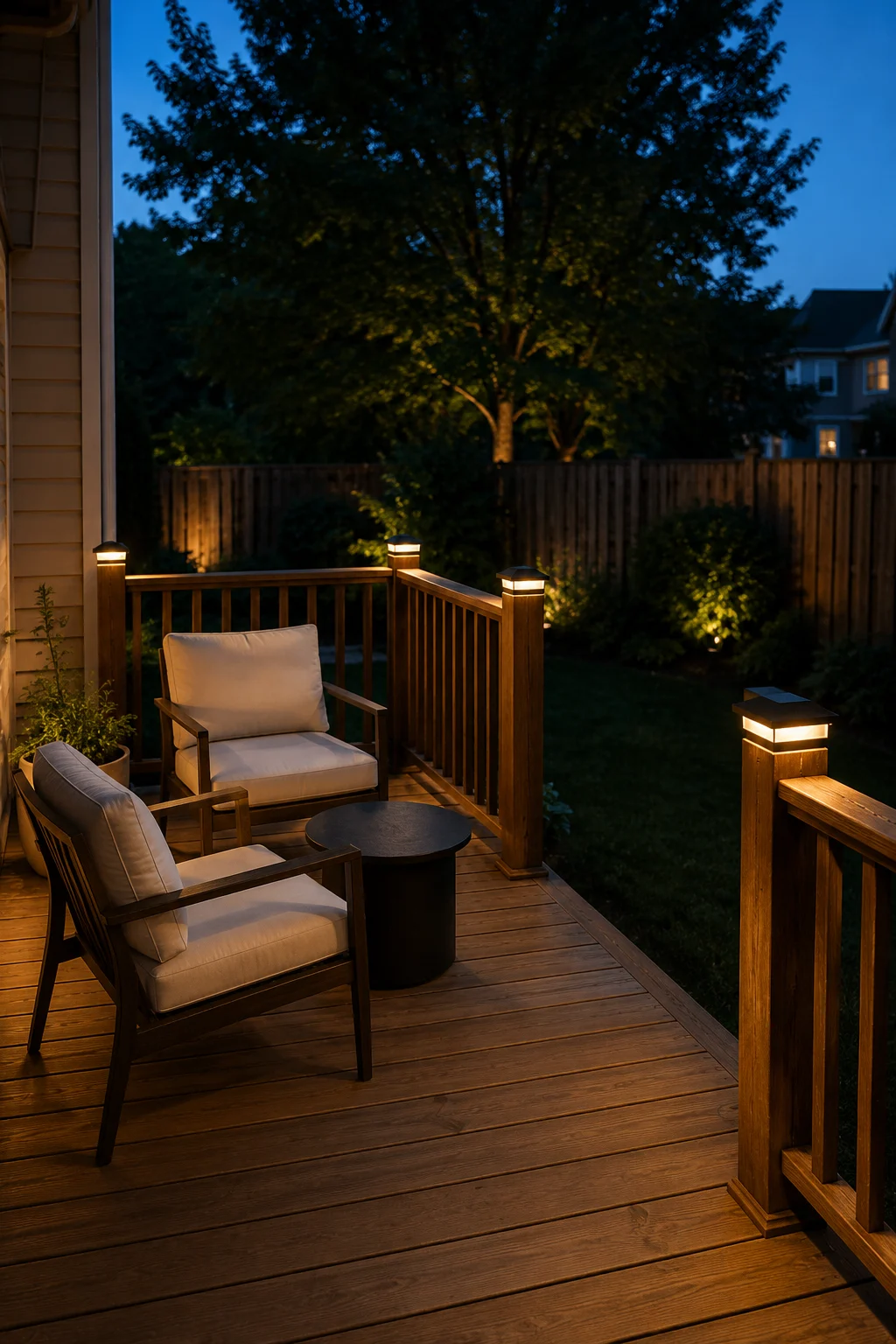
16 Wooden Patio & Backyard Lighting Ideas on a Budget
A backyard can look perfectly pleasant during the day and still feel oddly unfinished once the sun goes down. The best backyard lighting ideas aren’t about covering every fence post and railing with bulbs. They’re about placing a few warm light sources where they make the space easier and more inviting to use—near seating, along steps, beside a path, or against a wall that would otherwise disappear after dark.
For a small backyard or wooden patio, layering low, warm light usually works better than relying on one bright fixture. Think of it as three possible levels: ambient light for general visibility, task light where you sit or eat, and accent light for a planter, fence, stair edge, or architectural detail. A tiny patio doesn’t necessarily need all three in equal amounts.
Wood also responds especially well to warm light. Cedar, oak-toned decking, dark stain, rattan, terracotta, and cream outdoor cushions tend to look softer under warm-white bulbs than under harsh blue-white light.
The goal is simple: enough light to use the space comfortably, but not so much that your backyard starts to feel like a parking lot.
16 Wooden Patio & Backyard Lighting Ideas on a Budget
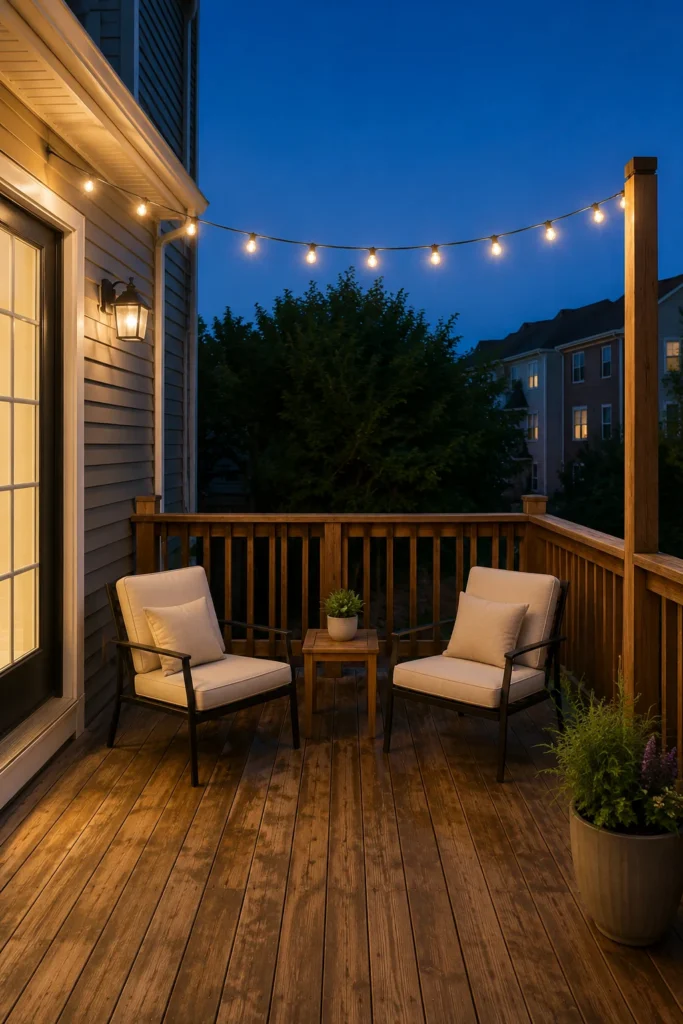
1. Run One Strand of Café Lights Over a Small Wooden Deck
A single strand of café-style lights can define a small deck without turning the ceiling overhead into a web of cords.
On a compact 8-by-10-foot cedar or pressure-treated deck, run one warm-white strand from the house to two secure posts at the outer corners, creating a shallow zigzag or gentle V rather than pulling the cord perfectly straight. Keep the bulbs well above normal sightlines so they create a soft ceiling of light instead of hanging directly in front of seated faces.
This works especially well on a wooden patio because the warm bulbs bring out the grain and golden tones of the boards. You don’t need multiple strands in a space this size. One clean run often looks more intentional than three overlapping ones.
For a budget setup, choose outdoor-rated plug-in lights and use appropriate outdoor clips or hooks instead of improvised fasteners. If you use an extension cord, it should also be rated for outdoor use and routed away from walking areas.
Keep the bulb brightness modest. A small deck needs atmosphere, not stadium lighting.
2. Mount String Lights Along the Fence Instead of Overhead
Not every yard has a convenient place to suspend lights above the seating area. In that case, use the fence as the lighting surface.
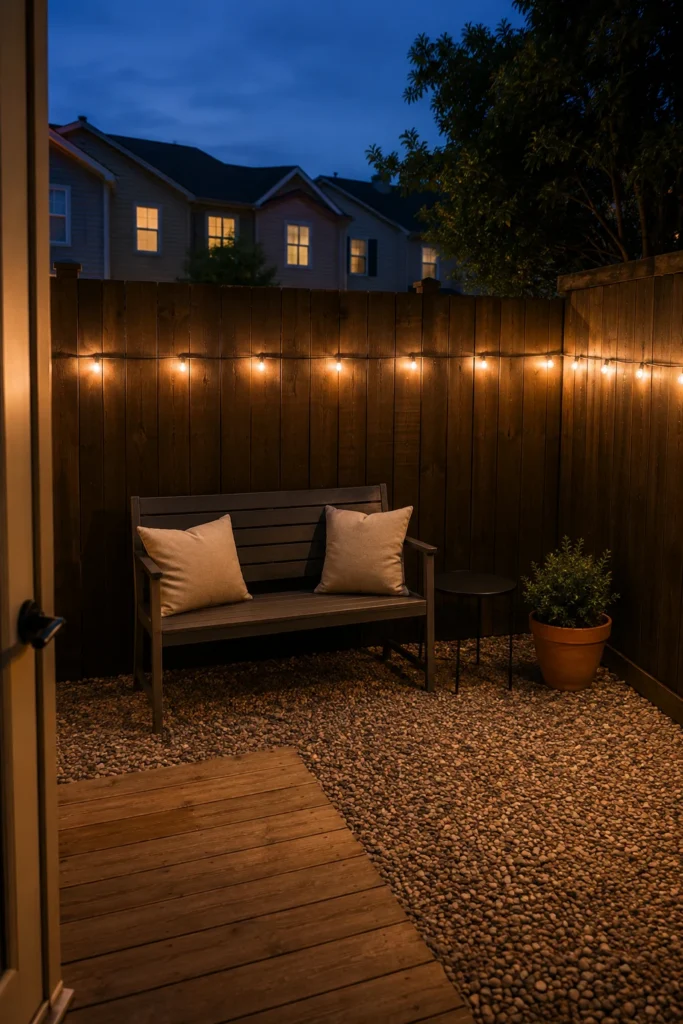
Run one warm-white string-light strand horizontally along the inside of a wood fence, ideally around shoulder height or slightly above, following one or two sides of a compact seating area. Let the bulbs sit close enough to the fence that they wash the boards with a little light instead of shining directly into your eyes.
This approach creates a softer boundary around a very small backyard and avoids adding poles or overhead supports. It also feels visually different from overhead café lights: instead of creating a ceiling, you’re giving the yard a warm perimeter.
On dark-stained fencing, the glow can provide useful contrast. On pale cedar, use lower-output bulbs so the wood doesn’t become overly bright.
The most affordable version uses one simple outdoor-rated strand on clips. Avoid snaking several strings around every fence panel. Too many bulbs can make a small backyard feel visually cluttered.
Also check where the light will point. A fence-mounted strand shouldn’t shine directly into a neighbor’s window.
3. Put a Rechargeable Lamp on the Outdoor Table
If the seating area is where you spend most of your time, one rechargeable table lamp can be more useful than installing several decorative lights around the yard.
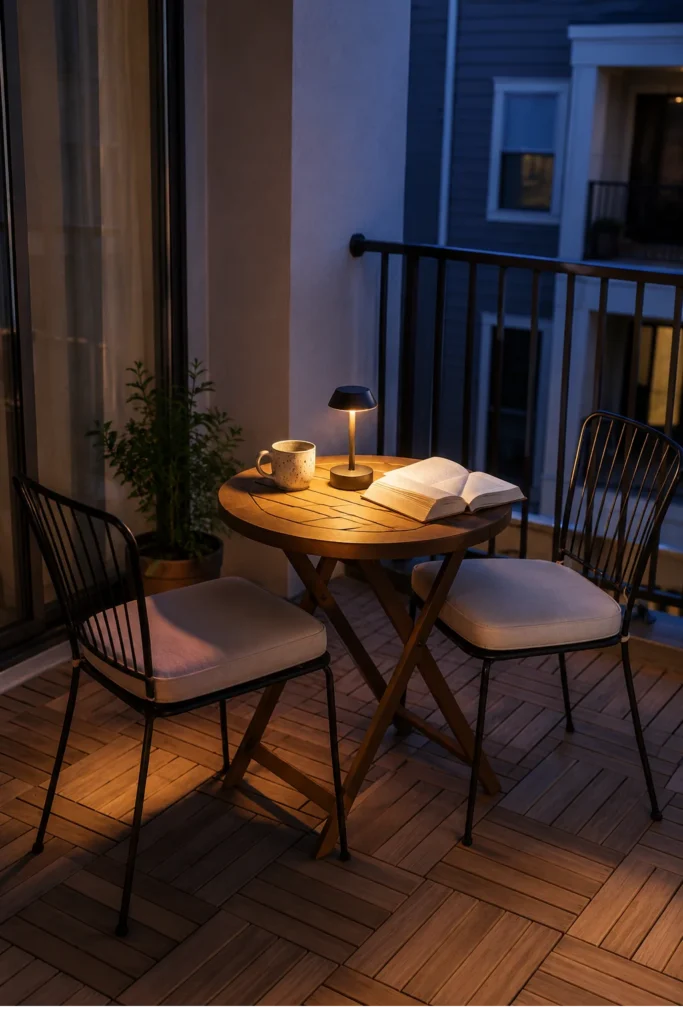
Place a compact warm-white lamp in the center of a small café table or at one end of a larger outdoor coffee table. A lamp around 10 to 14 inches high is usually enough to illuminate drinks, cards, or dinner without creating glare across the patio.
This is one of the easiest ways to handle small patio lighting in a rental because there are no cords and no permanent mounting. It also gives you proper task light right where you need it rather than wasting brightness on the fence or lawn.
On pale wood decking, choose a lower brightness level if the lamp is dimmable. Light-colored boards can reflect more illumination than you’d expect at close range. On darker decks, you may prefer a slightly brighter setting.
Rechargeable doesn’t mean maintenance-free. The lamp still has to be charged, stored if the manufacturer recommends it during severe weather, and brought indoors when you’re not using the patio for long periods.
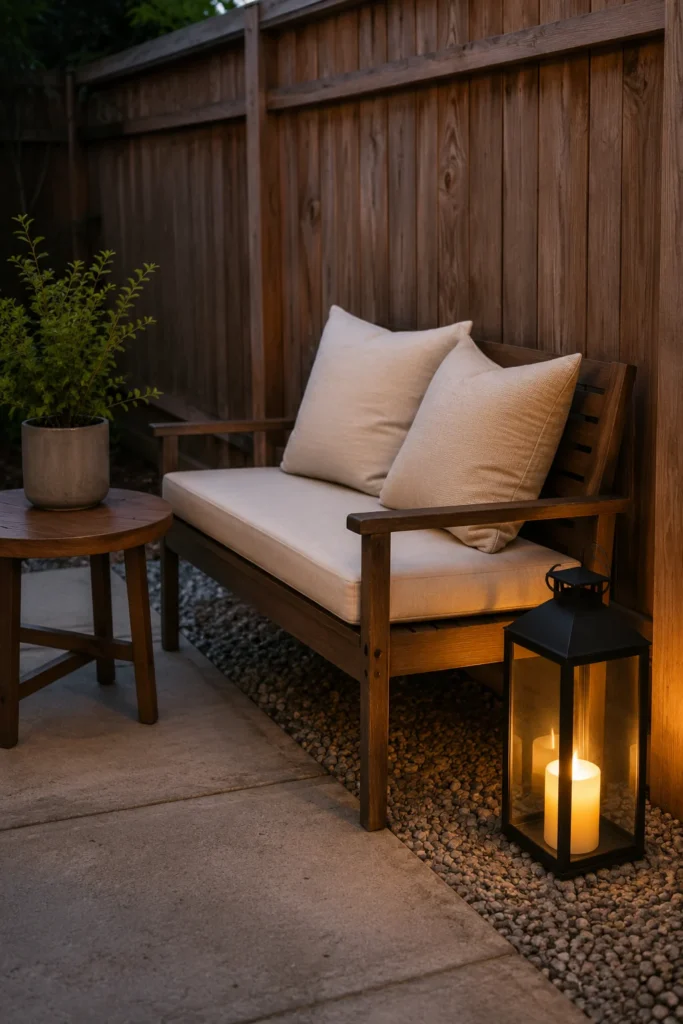
4. Place a Single Large Lantern Beside a Bench
One substantial lantern often looks better than several small ones scattered randomly around a patio.
Set a large outdoor lantern on the ground beside the outer end of a bench, not directly in front of the seating. A black metal or weathered bronze frame with a warm LED candle inside works particularly well next to a wood bench and neutral cushions.
The lantern visually anchors the bench after dark and creates one low pool of light without occupying valuable tabletop space. It’s especially useful for backyard lantern ideas where the goal is atmosphere rather than path illumination.
For a budget version, repurpose an outdoor-safe lantern you already own and add a battery-powered candle rather than buying a new fixture. LED candles also make more sense in windy areas or during dry conditions where an open flame would be impractical.
Keep the lantern out of the main footpath. A decorative object becomes irritating very quickly if everyone has to step around it.
If the bench sits against a fence, place the lantern slightly forward so the glow can spread rather than being completely trapped behind the seat.
5. Use Two Solar Lanterns to Mark Patio Steps
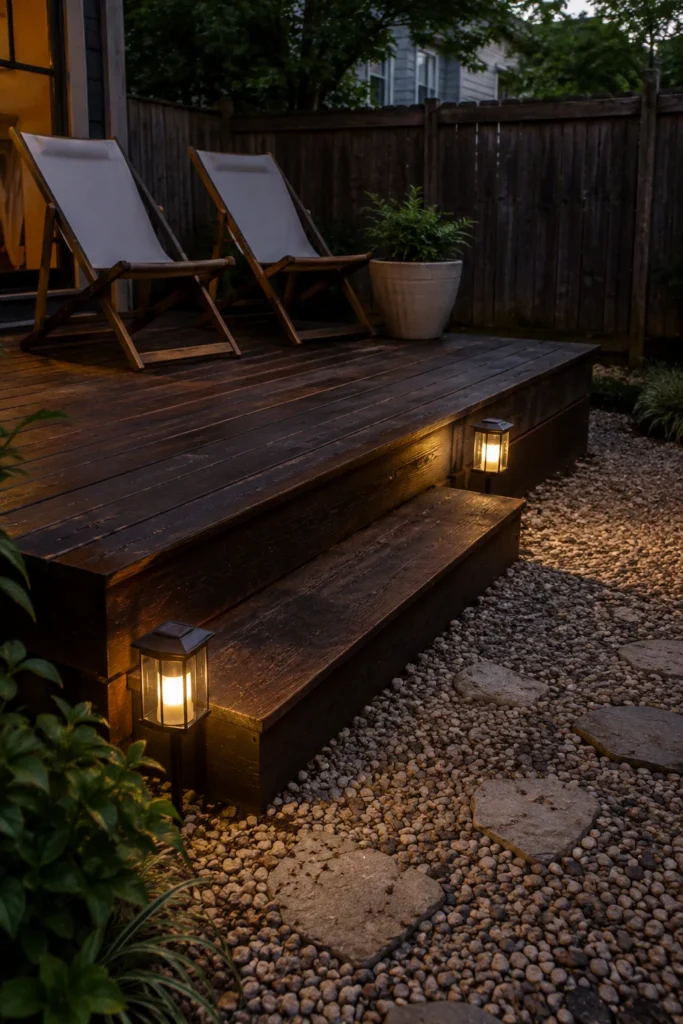
Lighting steps is more about usefulness than decoration, but it can still look intentional.
Place a pair of small solar lanterns or compact solar fixtures near the top and bottom of a short deck step rather than lining the entire stair edge with lights. The goal is to show where the level changes, not make every board glow.
On a dark-stained deck, the extra contrast can be especially helpful because the step edges tend to disappear faster at night. Warm-toned solar fixtures usually integrate more naturally with wood than cool blue-white models.
This is one of those solar backyard lighting ideas where placement matters more than quantity. Two well-positioned lights can do more than six randomly spaced ones.
Solar performance depends heavily on the amount of direct daylight the charging panel receives. If the steps sit in deep shade all day, solar may not be the best option.
Also keep the fixtures outside the actual walking zone. A light that helps someone see the step shouldn’t create a new tripping obstacle right beside it.
6. Add Low Solar Post Lights to a Wooden Railing
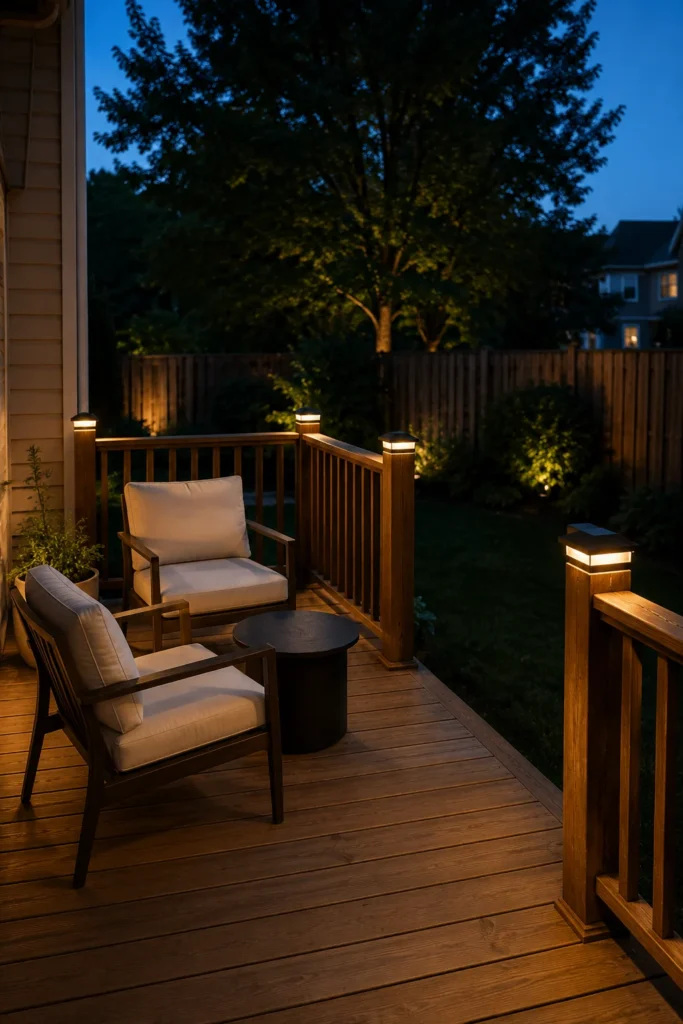
If your deck already has railing posts, use them rather than adding new poles or fixtures.
Install simple outdoor-rated solar post-cap lights on selected posts—perhaps every second or third post instead of every one. That spacing creates a steady visual rhythm without making the deck perimeter overly bright.
This idea works well for wooden deck lighting ideas because the light emphasizes the shape of the deck after sunset while leaving the seating area relatively calm. On warm cedar or medium-brown stain, small pools of amber or warm-white light can gently reveal the grain and handrail edges.
Budget-friendly post lights don’t always produce a lot of useful illumination, and that’s fine. Treat them as accent and edge lighting rather than the primary source for dining.
Choose models that fit the actual post dimensions instead of balancing an oversized light on a narrow cap.
Solar post lights also need decent sun exposure. If half the railing is shaded by the house all afternoon, you may get uneven brightness after dark.
For a low-maintenance setup, fewer fixtures are easier to clean, check, and replace when batteries eventually wear down.
7. Tuck Warm LED Lighting Under a Built-In Bench
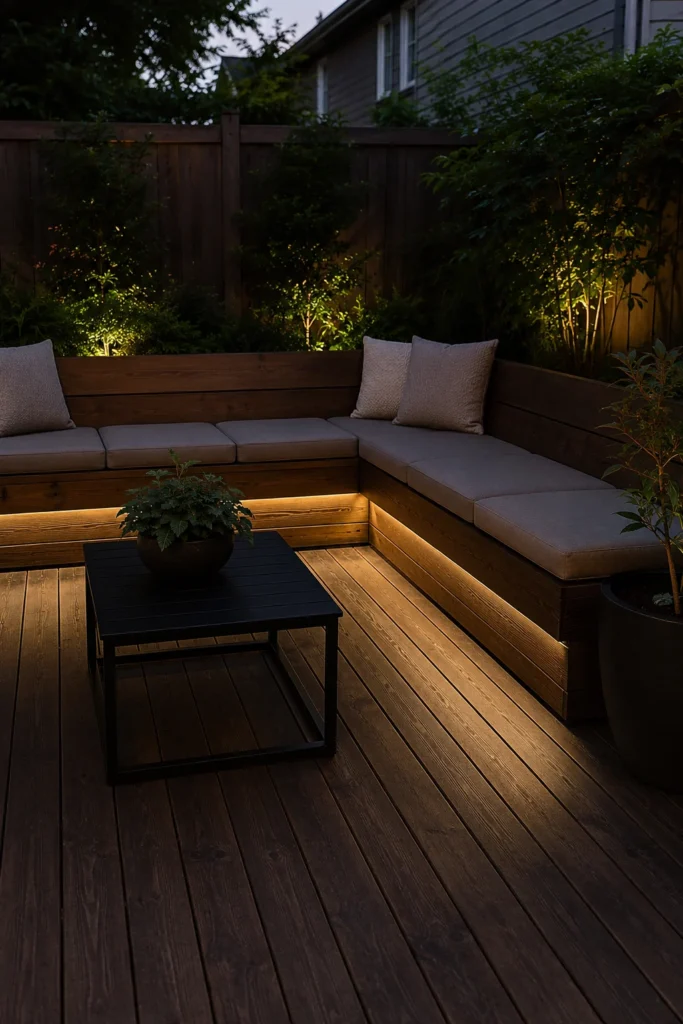
Under-bench lighting can look expensive even when the actual lighting is simple, as long as the source itself isn’t the first thing you notice.
On a wooden built-in bench, place an outdoor-rated warm LED strip or rope light beneath the front lip so it casts light down toward the deck rather than outward into seated faces. The goal is a soft glow underneath, not a visible glowing line.
This works especially well on a dark-stained deck because the light reveals the edge of the bench and gives the seating zone more depth. It also keeps the tabletop and walls visually quieter.
For a budget version, use one short outdoor-rated run rather than trying to outline every board and stair. If you’re using plug-in lighting, keep all connections appropriate for outdoor conditions and route cords where nobody will step across them.
Avoid very bright or cool-white strips. They can make even a cozy wood patio feel more like a retail display.
The lighting should support the bench, not turn it into the brightest object in the yard.
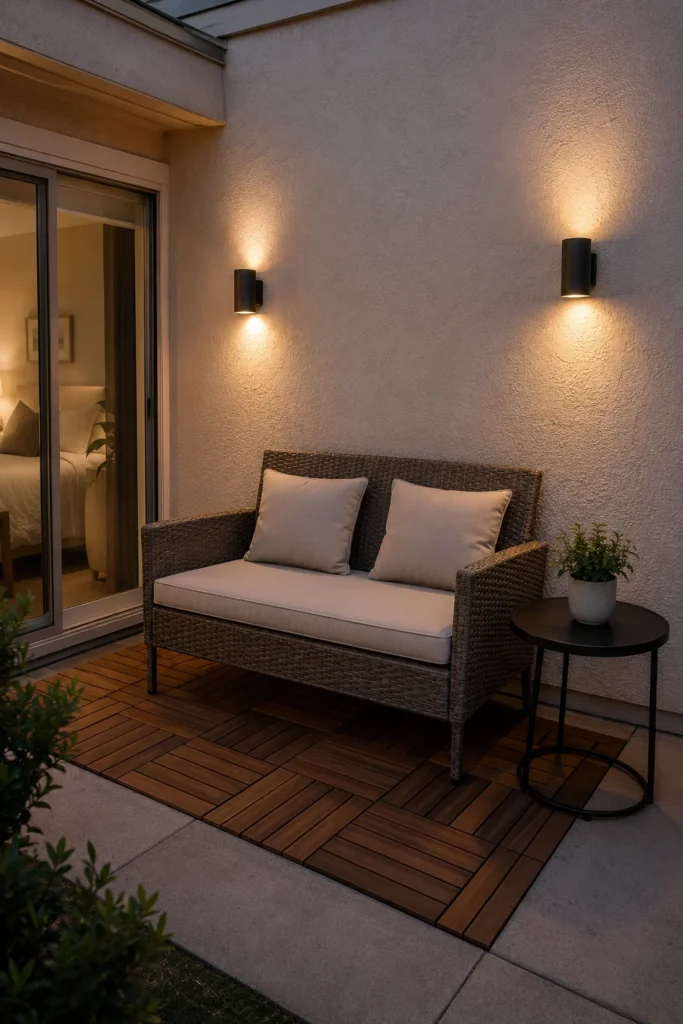
8. Use Battery-Powered Wall Lights on a Rental Patio
A rental patio can still have wall lighting without turning it into a wiring project.
Use one or two battery-powered outdoor wall lights mounted with a rental-appropriate method that follows the product instructions and building rules. Place them on the wall behind or beside the seating area rather than directly opposite seated faces.
A pair of small fixtures can provide enough general illumination for a compact patio while keeping the floor completely free of cords. This is particularly useful for apartment patios where outlets are limited.
Choose a simple warm-white light and keep the fixture scale modest. An enormous faux-industrial sconce can overwhelm a six-foot-wide patio.
The wall behind the light also affects the result. Pale stucco reflects more light, so you may need less brightness than you would against dark brick or siding.
Avoid assuming every adhesive mounting solution is suitable for exterior surfaces or weather. The exact fixture and wall material matter.
For renters, the real advantage is flexibility: you get usable ambient light without casually drilling into an exterior wall you don’t own.
9. Hang Lanterns From Two Shepherd Hooks Near a Garden Bench
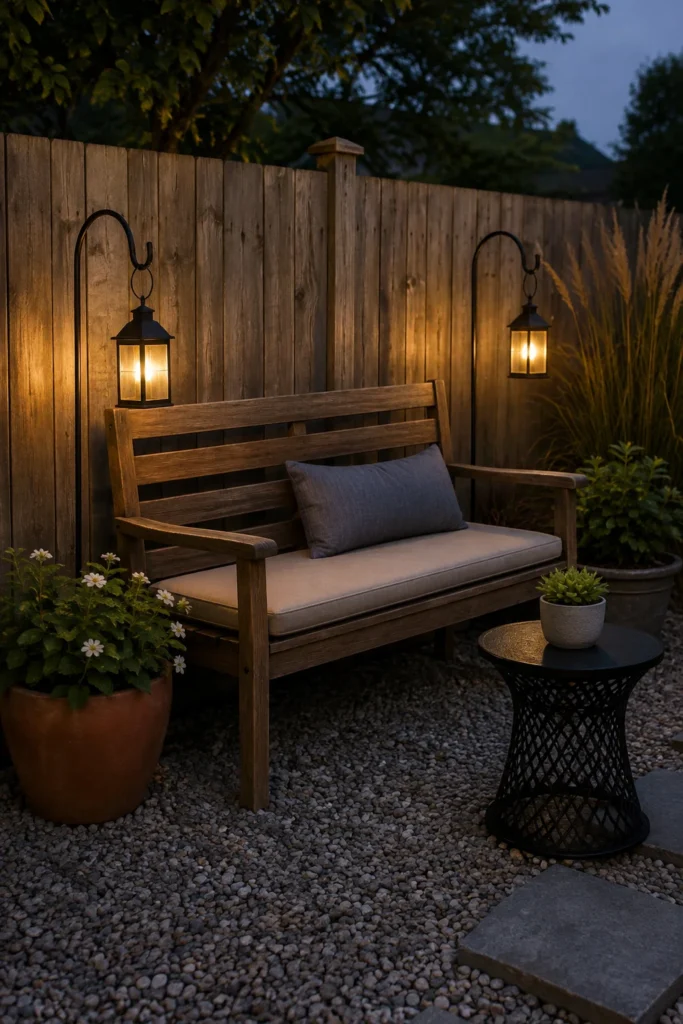
Shepherd hooks aren’t only for hanging flower baskets. Used sparingly, they can lift small lanterns off the ground and give a garden seating area a little height.
Place two hooks behind or slightly to either side of a simple wood bench. Hang one small solar or battery-powered lantern from each, keeping both high enough that they don’t swing into anyone’s head or shoulder.
The two lights define the bench as a destination without requiring a tree, pergola, or permanent wiring. This works well in a gravel garden corner or a very small fenced yard where you want to create an evening seating zone with minimal construction.
Use simple lantern shapes rather than overly decorative pieces if you’re trying to keep the look calm.
Wind is the practical issue here. Lanterns need enough weight and secure hanging points that they don’t whip around on breezy nights. In very exposed locations, ground-level fixtures may be a better choice.
Two lanterns are enough. Four or five hanging at different heights can make a tiny garden look busier than it needs to.
10. Add One Small Uplight to a Large Patio Plant
Accent lighting doesn’t have to involve a whole landscape lighting system.
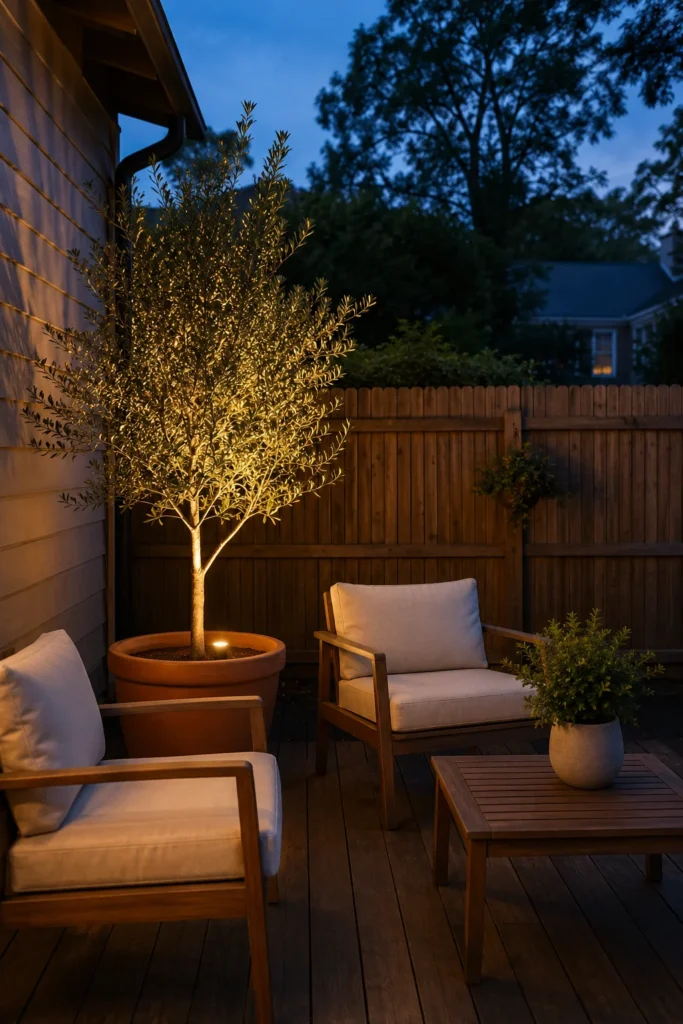
Place one compact outdoor uplight at the base of a larger patio plant, aiming it gently into the foliage rather than straight up into the sky. A small olive-like potted tree, ornamental shrub, or other appropriately scaled plant can become a quiet focal point after dark.
This works especially well near a wooden deck because the light creates depth beyond the seating area. Without it, the yard can flatten into one dark background once the sun sets.
Use this as an accent, not as your main light source. The seating area still needs a lamp, string lights, or another ambient source if you want to use the patio comfortably.
For a budget approach, one light on one good plant is more effective than trying to uplight every pot.
Be careful with brightness and aiming. A fixture pointed too steeply can create glare from certain seating angles or shine beyond your property.
If you’re using solar, make sure the charging panel receives enough daylight even if the light itself sits near the shaded plant.
11. Use Two Lanterns at the Edge of a Gravel Path
A small backyard path doesn’t need to look like an airport runway.
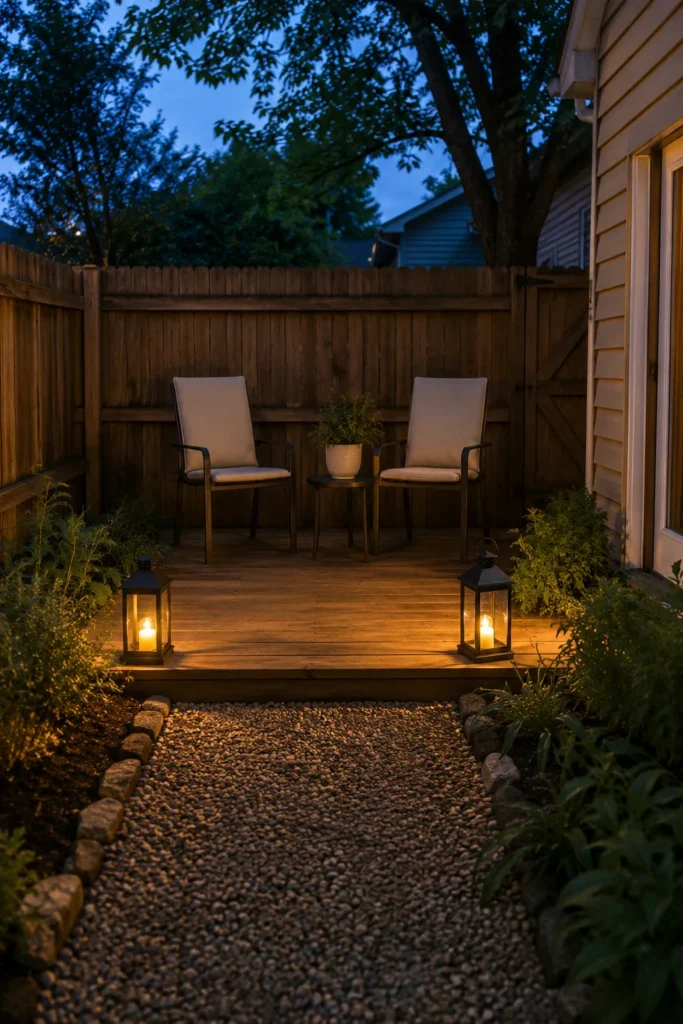
Instead of lining both sides with a dozen fixtures, place two lantern-style solar lights where the path changes direction or meets the patio. Those are the places where additional visibility actually matters.
This creates a visual transition from garden to seating area while keeping the yard darker and calmer elsewhere. It’s one of the more practical backyard lighting ideas because it combines accent and navigation in the same fixtures.
For a low-cost setup, choose two matching solar lanterns and repeat the same material already used elsewhere—black metal, for example, if your chairs are black.
Make sure the light doesn’t sit in the narrowest part of the path. If someone has to step around the lantern, it isn’t helping.
Solar works well here when the path gets decent daylight, but shaded side yards may produce weaker results. In that case, a battery-powered or wired outdoor-rated option may be more dependable.
Fewer fixtures also mean less maintenance and fewer things to trim around or clean.
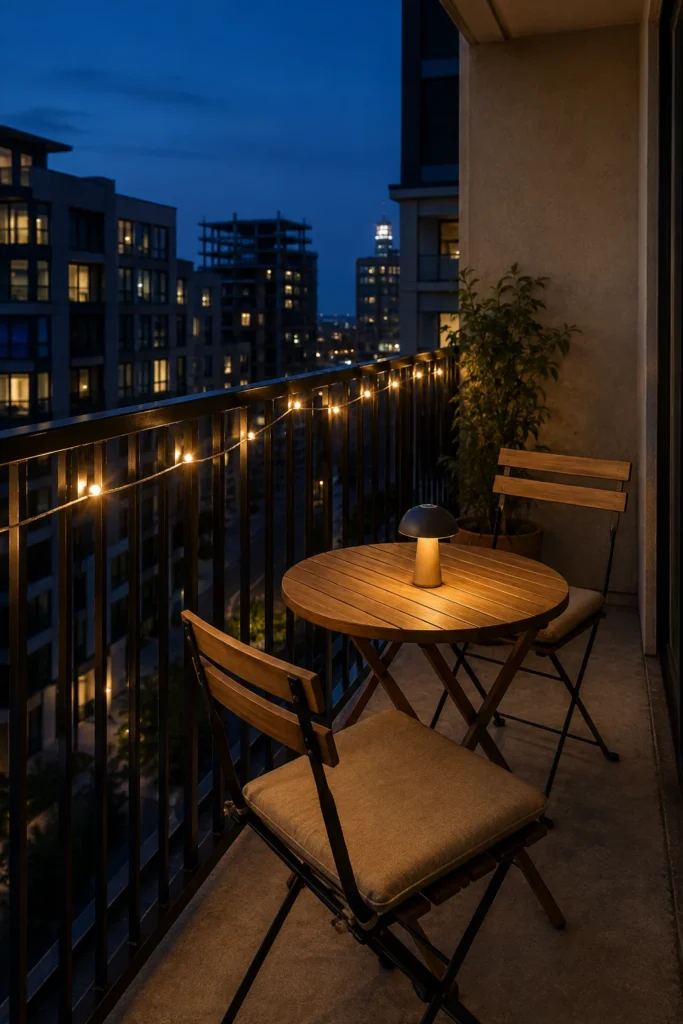
12. Clip Warm Micro Lights Along an Apartment Balcony Railing
For a narrow balcony, large hanging bulbs can feel oversized. A smaller railing-mounted light is often enough.
Use one restrained run of warm micro lights clipped neatly along the inside of the railing rather than wrapping the strand repeatedly around every baluster. The light should create a soft horizontal glow along the edge, not turn the railing into a bright decorative sculpture.
Pair the lights with two small chairs and a rechargeable table lamp if you need usable task lighting. The railing lights are better as atmosphere than as your only source.
This renter-friendly setup works best when the cord or battery pack can be secured neatly and protected according to the product instructions.
Don’t let loose wire loops hang into the walking area or outside the railing.
On upper-floor balconies, wind matters too. Secure clips are more important than creating a perfectly draped effect.
If the balcony is visible from neighboring apartments, choose a lower brightness setting. A cozy balcony shouldn’t become a glowing beacon in someone else’s window.
13. Put LED Candle Lanterns on a Small Outdoor Table
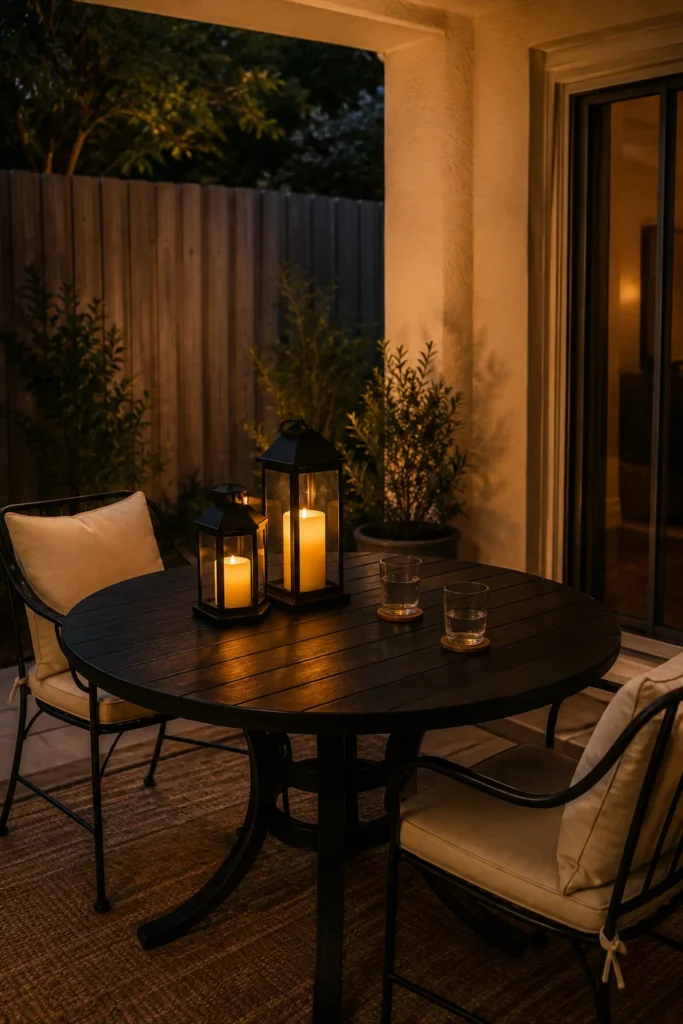
If you like the look of candlelight but don’t want open flames, group two small LED candle lanterns directly on the table.
Use different heights—perhaps one around eight inches and one around 11 inches—but keep both compact enough that they don’t dominate the tabletop. Set them toward one side so there’s still room for drinks or dinner.
This creates a more intimate pool of light than overhead fixtures and works particularly well on a small patio with a dark wood table. The warm LED glow reflects softly across the wood without becoming harsh.
This is another version of backyard lantern ideas, but the lanterns function as table lighting rather than floor decoration or path markers.
A pair is usually enough. A cluster of five can make a 30-inch table unusable.
Battery-powered LED candles also work better than real candles on breezy patios and covered apartment spaces where open flames may not be appropriate.
If the lanterns live outdoors, check whether the actual housings are rated for weather exposure rather than assuming decorative metal and glass can stay outside year-round.
14. Add a Small Light Under a Patio Umbrella
If your dining table already has an umbrella, use that existing structure instead of adding more posts or overhead wires.
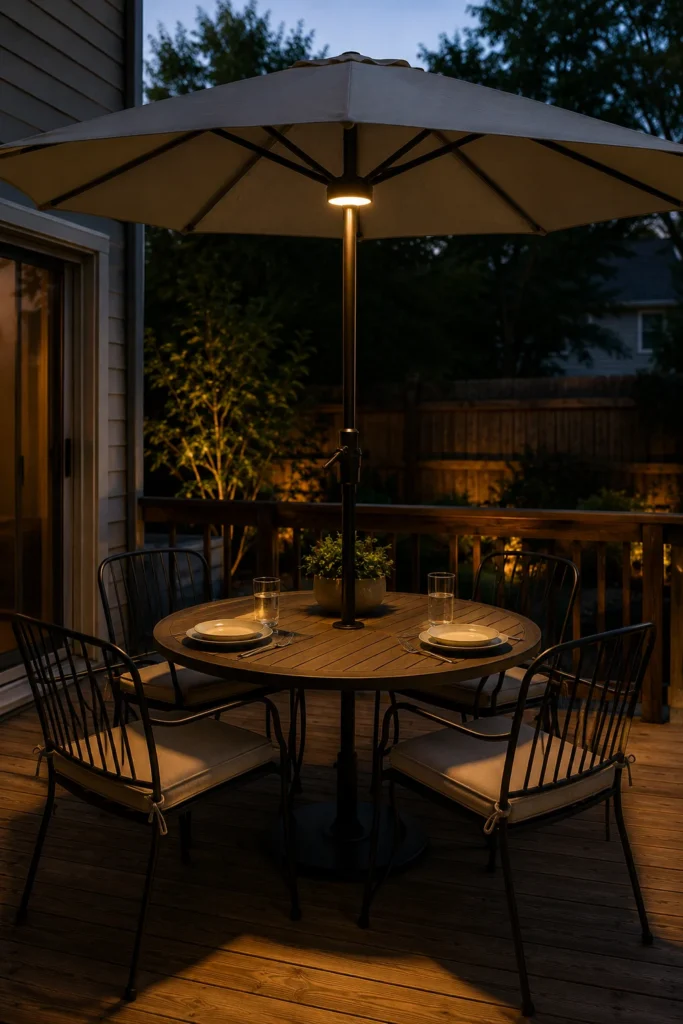
A compact battery-powered or rechargeable umbrella light mounted around or beneath the pole can provide useful task lighting over a small outdoor table. Keep the output warm and relatively low so the fixture lights the tabletop without making everyone underneath it feel exposed.
This arrangement works well for patios where dinner is the main evening activity. The umbrella blocks some overhead ambient light, so having a source beneath it can make the table much easier to use.
On a wooden deck, the downward light also creates a soft pool that stops at the table and chairs rather than flooding the whole yard.
Avoid installing anything that interferes with the umbrella’s opening and closing mechanism. The fixture also needs to be rated or suitable for the exposure it will receive.
If the umbrella has to be closed during wind, remove or secure the light according to its design.
One compact fixture is usually enough for a four-seat table.
15. Use a Timer Plug With One Main String-Light Run
Low-maintenance lighting doesn’t require lots of automated fixtures. Sometimes it just means making one useful light source easier to live with.
If your main patio lighting comes from one plug-in string-light strand, connect it to an outdoor-rated timer or compatible control so you don’t have to remember to switch it on and off every evening.
This is especially helpful on a small wooden deck where one café-light run already provides most of the ambient light you need. Add a rechargeable lamp only when you’re dining or reading outside.
The advantage is consistency. The patio feels welcoming at the time you actually use it, without six different solar fixtures switching on at slightly different brightness levels.
This approach fits naturally with backyard ideas low maintenance, but it isn’t zero-maintenance. Outdoor bulbs still need checking, cords need inspection, and weather exposure matters.
Keep the timer and connections appropriate for exterior use. Don’t improvise indoor power accessories outside.
And don’t leave lights running all night simply because they’re automated. Choose a schedule that matches how the space is genuinely used.
16. Layer One Ambient Source, One Task Light, and One Accent
If you’re unsure how to light up a backyard, this is the simplest arrangement to copy.
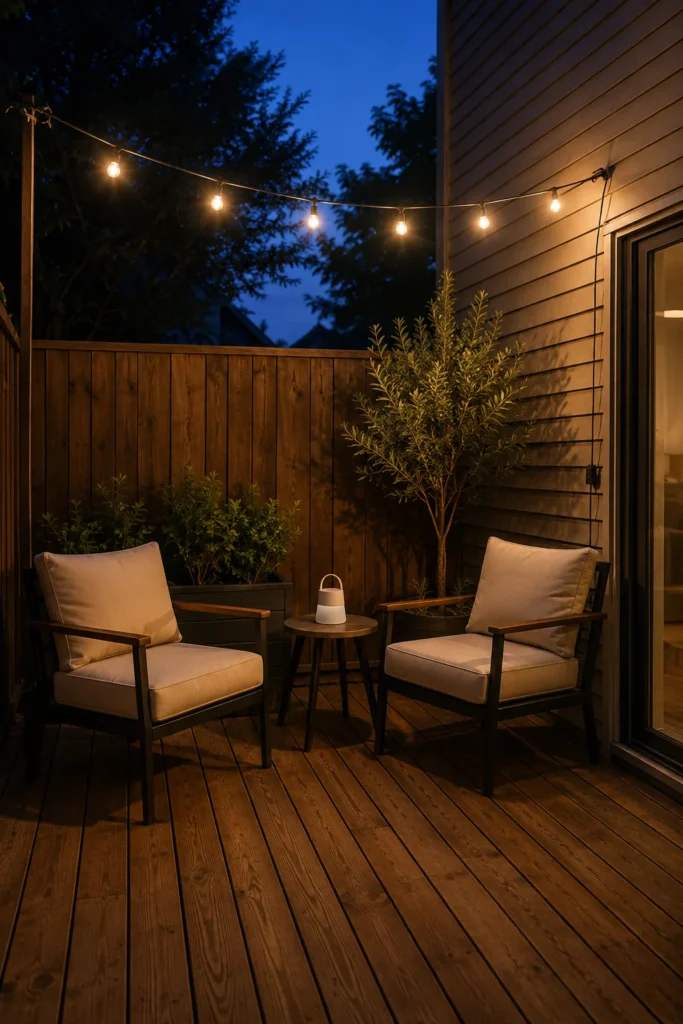
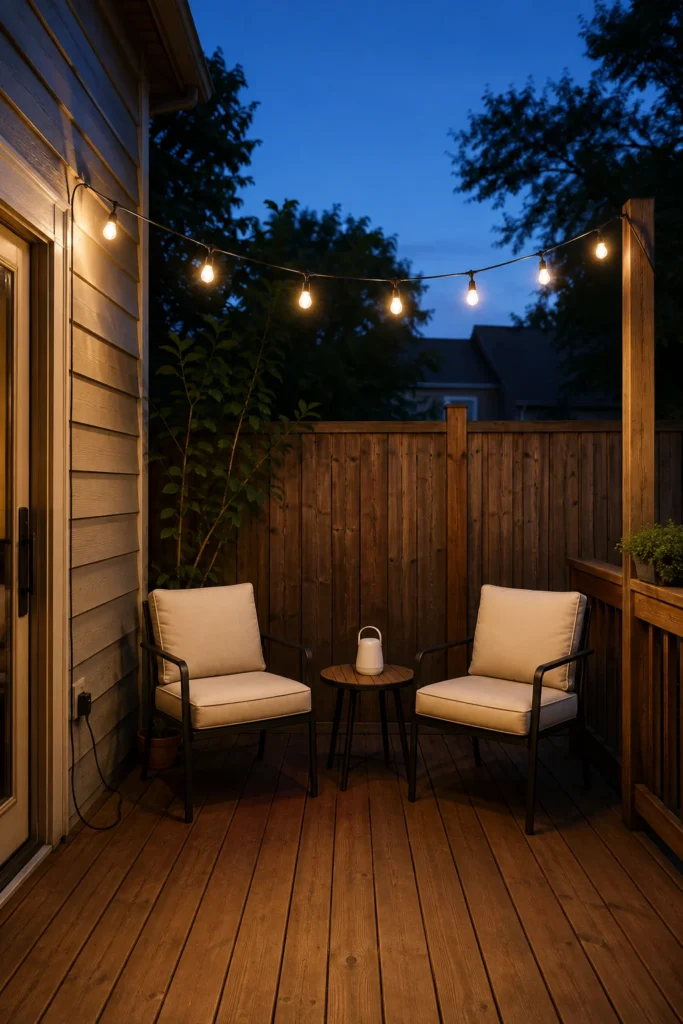
Start with one ambient source, such as a single café-light strand over a small deck. Add one task light—a rechargeable lamp on the table—and finish with one accent, such as a solar lantern beside the step or one uplight near a large planter.
That’s it.
On a compact patio, these three sources usually provide more visual depth than one extremely bright wall fixture. The café lights establish the space, the table lamp helps you actually use it, and the accent light creates one point of interest beyond the seating.
Keep all three in a similar warm-white range so they feel related. They don’t need to match exactly, but a cool blue path light beside warm café bulbs can look disconnected.
This setup also makes budgeting easier because you can build it gradually. Start with the ambient light, use the patio for a week, then decide whether you genuinely need the task or accent source.
Buying fewer lights after seeing where the dark spots actually are is often cheaper than trying to solve the entire backyard in one shopping trip.
A Simple Way to Plan Backyard Lighting Without Overspending
The most useful backyard lighting ideas aren’t necessarily the ones with the most fixtures. In a small yard or patio, a better starting point is one ambient source + one useful task light + one or two accents.
Your ambient source might be one good string-light run or a pair of modest wall lights. The task light belongs where you actually sit, eat, read, or play cards. Then add accent lighting only where it solves something specific: a dark step, a plant worth highlighting, the end of a pathway, or the edge of a deck.
Before buying anything, look at the yard after sunset. Notice where people walk, where you set drinks, where the stairs disappear, and which areas genuinely need light.
Then consider the practical parts—available outlets, cord routes, sun exposure for solar fixtures, local weather, nearby windows, storage, and how much maintenance you’re willing to do.
A small patio usually doesn’t need every fence, railing, planter, and stair illuminated. One clean string-light run, a rechargeable lamp near the seating, and a carefully placed lantern or path light can make the space feel warm and usable without spending more than necessary or creating another layer of outdoor clutter.
