
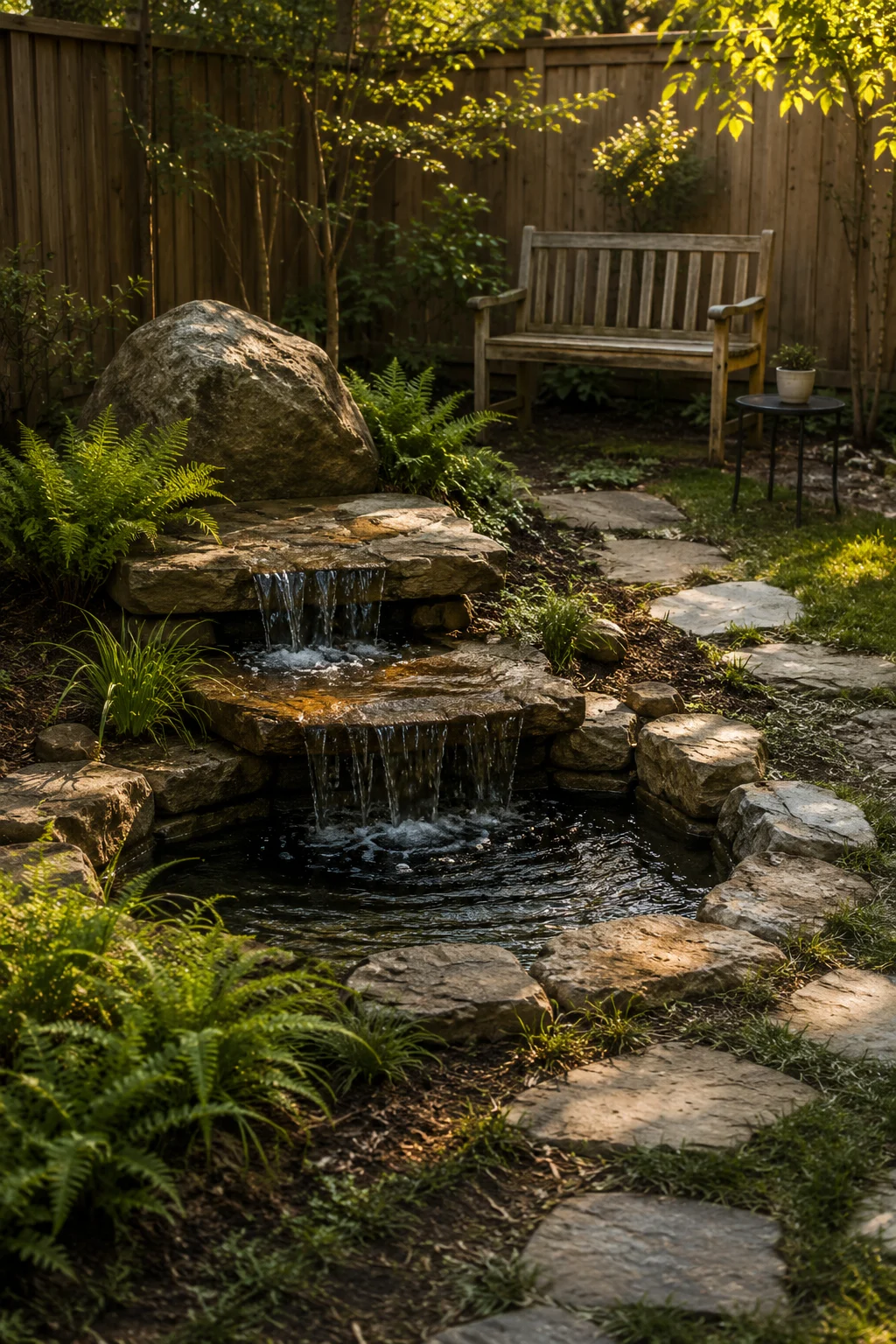
17 Backyard Pond & Waterfall Ideas With Natural Stone
The most convincing water features in the garden usually don’t look as though they were dropped into the yard as a finished object. They feel connected to the slope, planting, stone, and surrounding lawn—as if the water had a reason to be there.
That effect has less to do with building a huge pond and more to do with getting a few details right. Use stones in different sizes instead of creating a perfect ring. Partially bury larger rocks so they look settled into the soil. Let plants interrupt sections of the pond edge. Give water an obvious direction to travel, especially when you’re working with a waterfall or cascade.
One useful principle applies to almost every design here: the most convincing backyard water features look as though the stone and water were already part of the landscape.
That means working with the yard instead of fighting it. A slope can become the beginning of a stream. A shaded corner can hold a quiet pond. A narrow patio bed may have room for a bubbling stone even when a full pond would be impractical.
Here are 17 different ways to make natural stone and water work together in a real backyard.
17 Backyard Pond & Waterfall Ideas With Natural Stone
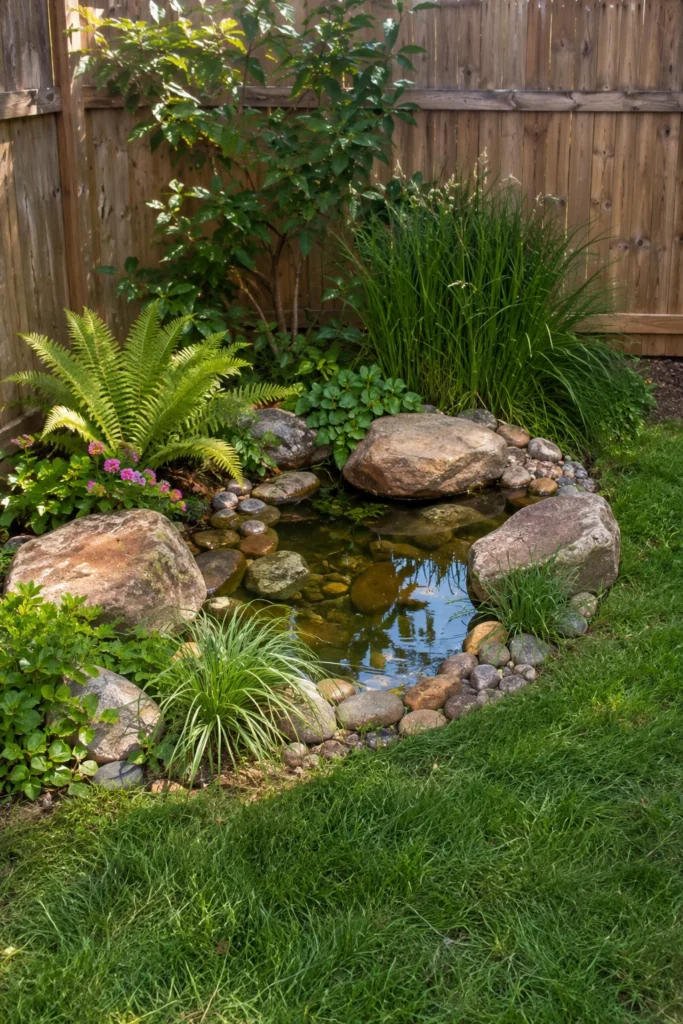
1. Build a Small Irregular Pond With Partially Buried Fieldstone
One of the quickest ways to make a small backyard pond look artificial is to outline the entire thing with identical rocks. A better approach is to shape the pond irregularly and let the stone disappear in places.
For a compact garden, a pond around 5 by 7 feet can be enough to create a strong focal point without taking over the yard. Use three or four larger fieldstones as anchors, partly burying them along different sections of the perimeter. Fill some of the gaps with medium stones and gravel, then let groundcover, sedges, or low moisture-loving plants soften other parts of the edge.
That mixture is what makes a natural stone garden pond feel connected to the landscape. Your eye sees a transition from lawn to planting to stone to water rather than a hard necklace of rocks.
Leave one section accessible for maintenance. Plants will spread, leaves will collect, and pumps or filters may occasionally need attention.
2. Add a Short Rock Waterfall to the Back of a Pond
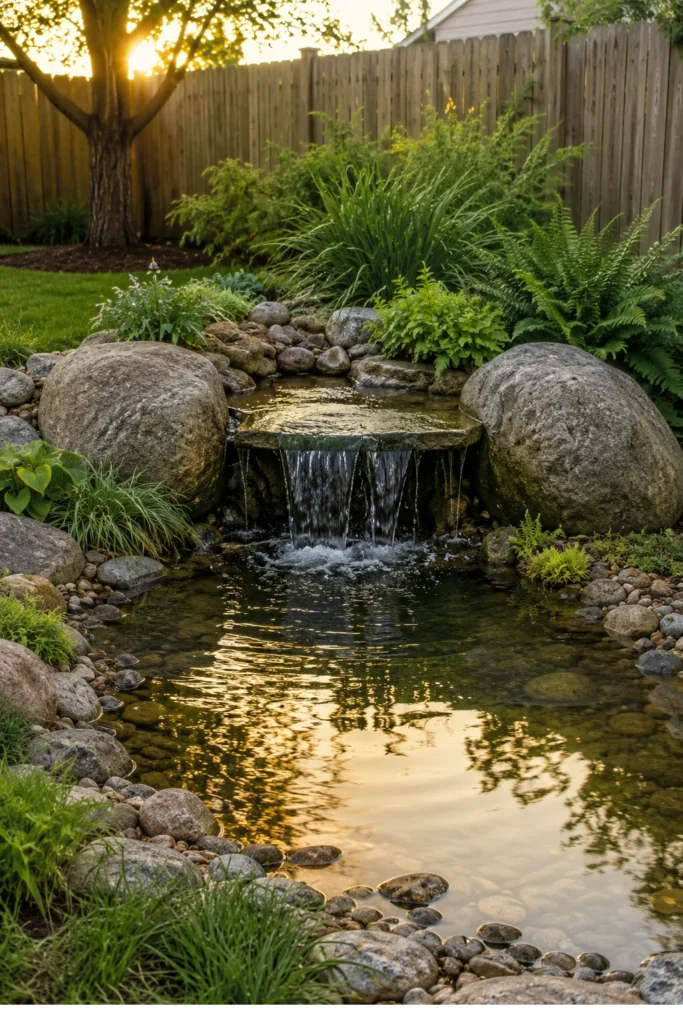
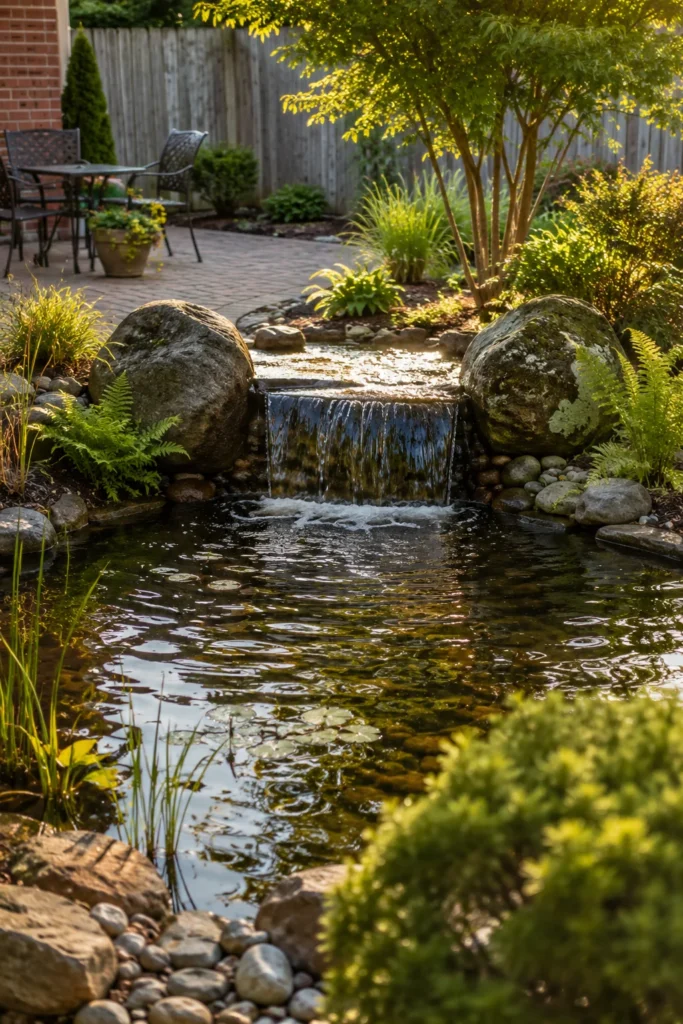
A backyard pond with a waterfall doesn’t need a dramatic drop. In a smaller yard, a short fall of around 12 to 18 inches often feels much more believable.
Place two substantial weathered boulders near the back of the pond and use a flatter ledgestone between them as the main spill stone. The water should appear to emerge from behind or between the larger rocks rather than from a visible pipe sitting on top.
Around the base, add smaller transition stones and plant ferns, ornamental grasses, or compact perennials into a few gaps. Don’t try to hide every inch of stone with plants; some exposed rock gives the waterfall enough structure.
The key is connecting the fall visually to the pond. A rock waterfall sitting five feet away with a narrow channel joining it can look like a separate decoration rather than part of the same system.
A wider, low spill tends to sound softer than a tall narrow stream, which matters if the feature sits near a bedroom or patio.
3. Create a Two-Drop Cascade With Flat Sandstone
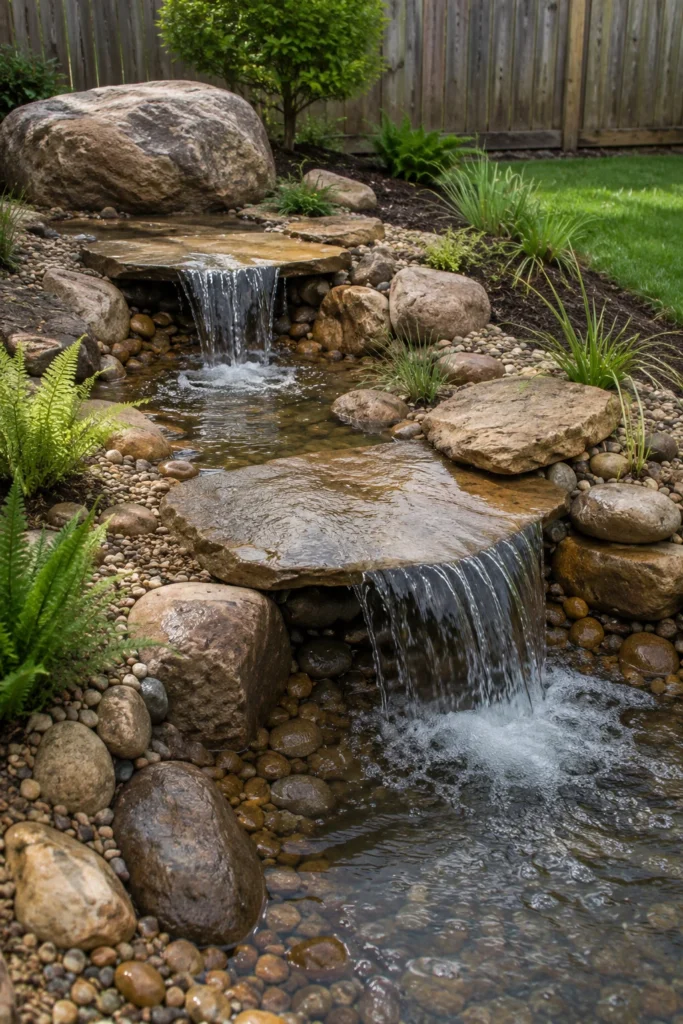
A cascade looks more natural in a compact yard when the water changes level gradually instead of falling several feet in one dramatic sheet.
Use two flat sandstone spill stones to create a pair of short drops, perhaps six to ten inches each. Offset them slightly rather than stacking them in a perfectly straight staircase. Frame the upper section with one larger anchor rock and use smaller stone and gravel along the sides.
The water should widen slightly over each stone before narrowing again into the next pool. That changing width makes the movement feel more like a small natural creek.
This kind of garden cascade works well behind a small pond or as part of a shallow stream bed. It also gives you more opportunities to tuck plants into the edges without making the whole feature look overgrown.
Don’t underestimate the amount of stone a believable cascade needs. If the spill stones are large but everything beside them is tiny gravel, the transition can feel abrupt. Use a clear hierarchy of large, medium, and small pieces.
4. Use a Pondless Waterfall in a Tight Garden Corner
If you like moving water but don’t want to give up several feet of yard to open pond surface, a pondless waterfall is worth considering.
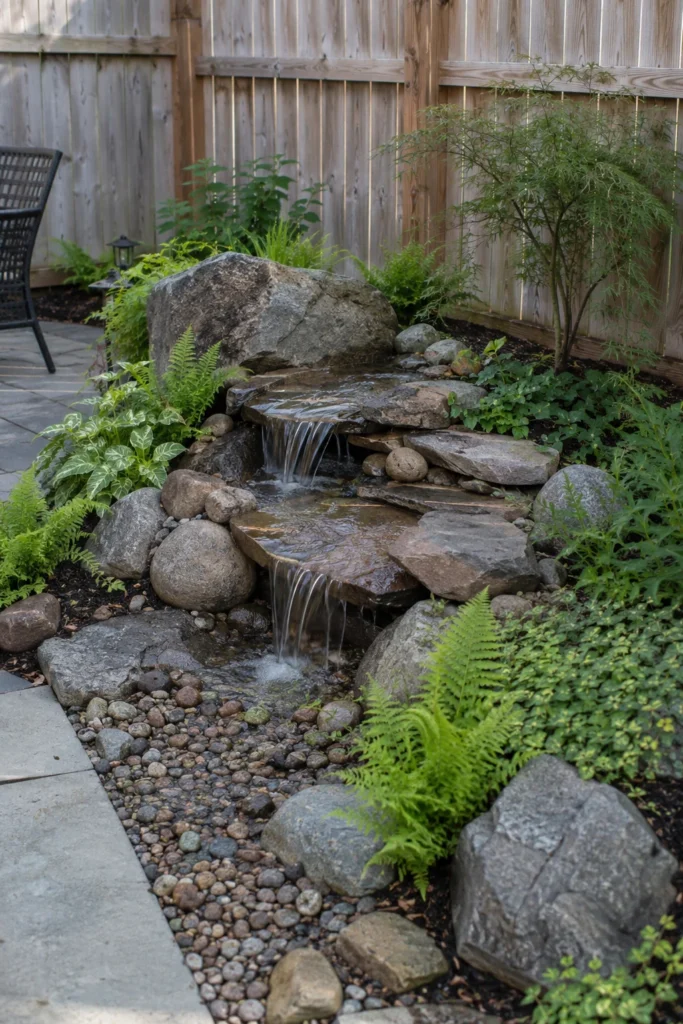
In a compact corner, create a short stream of two or three small drops that disappears into a hidden gravel-covered basin. Use one or two weathered boulders near the top, then transition into flatter creek stone and smaller river rock toward the bottom.
The absence of an open pond makes this easier to fit beside a fence, near a patio, or into a narrow garden bed. It’s also useful for households where open water around children or pets isn’t desirable.
The design still needs enough width to look natural. A waterfall squeezed into a six-inch-wide channel can start to resemble water running down a pile of rocks.
A pondless feature isn’t maintenance-free. The pump and basin still need access, and debris can collect among the gravel. Keep at least one area reachable without dismantling the entire stone arrangement.
5. Design a Calm Lily Pond With Only a Gentle Trickle
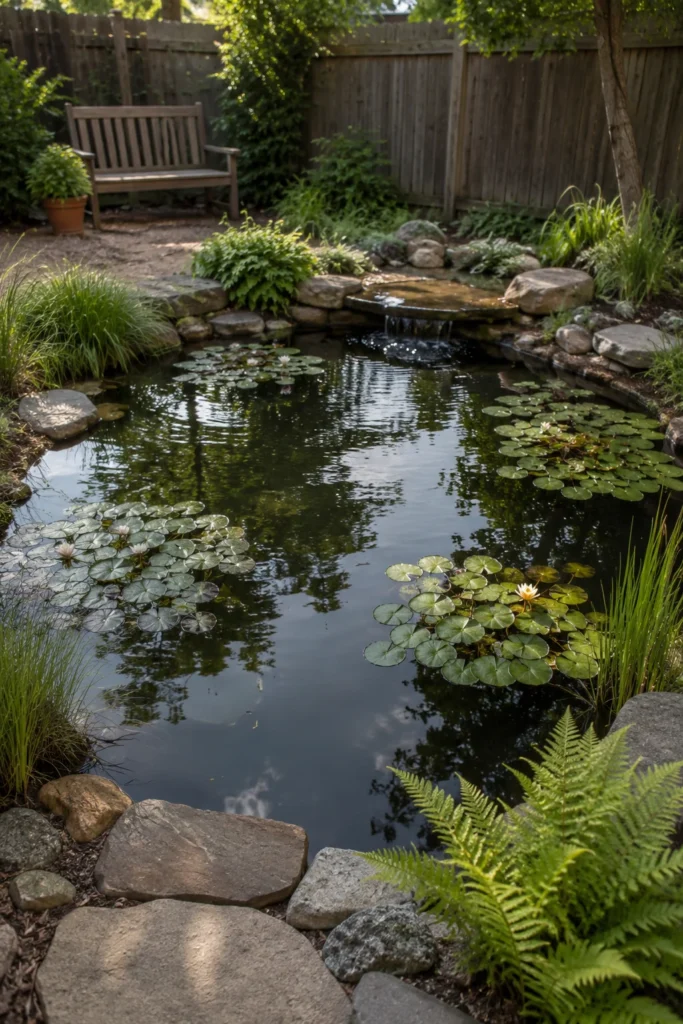
A beautiful pond with lilies needs a different approach from a loud waterfall feature. If the surface is constantly churning, you lose much of the reflection and calm that make lily ponds appealing.
Use an irregular pond with a generous open center and natural stone concentrated mostly around selected edges. Flat fieldstone or weathered sandstone works well for a few larger anchor points, while gravel and planting can soften the rest.
Add water lilies or other suitable floating foliage, but don’t try to cover the entire surface. Leave enough open water to reflect the sky, fence, and nearby greenery.
At one end, a very low trickle over a flat stone can provide some circulation without turning the pond into a waterfall showcase. The sound should be subtle.
This layout suits a garden corner where the pond itself is the focal point. A simple bench placed several feet away is enough.
Remember that aquatic plants grow. A pond that looks sparse in the first season may become much fuller later, so resist packing every planting pocket on day one.
6. Turn a Sloped Yard Into a Three-Step Water Cascade
A sloped backyard can be awkward for furniture, but that same grade can be useful for water.
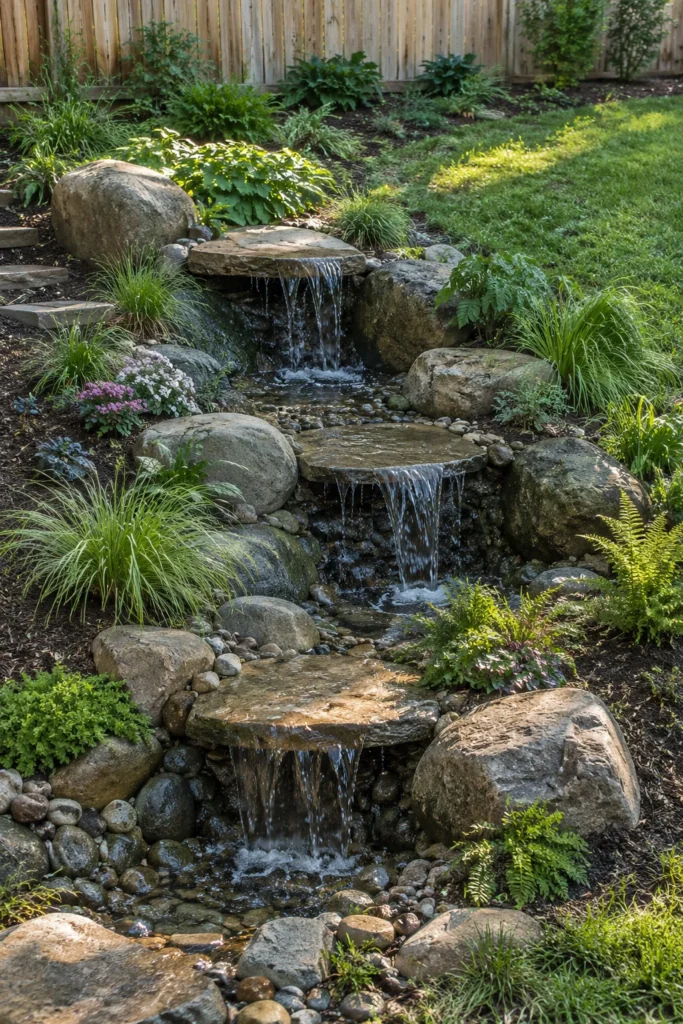
Instead of flattening the entire area, work with the slope to create three short drops separated by shallow pockets of moving water. Use larger boulders sparingly to stabilize the visual structure, then use flatter ledgestone or sandstone where the water actually spills.
Each level should feel slightly different rather than forming three identical steps. One drop might be broader and quieter, while the next is narrower and more noticeable.
This is one of the strongest garden ideas for a sloped yard because the grade gives the water an obvious reason to move downhill. Planting can then follow the same direction, with grasses, groundcovers, and moisture-loving perennials tucked between the stone.
Large boulders, drainage changes, and structural slope work can quickly move beyond a casual DIY project. If the site needs retaining work or heavy stone placement, professional help may be worth it.
7. Run a Narrow Garden Stream Along a Side Yard
A narrow side garden doesn’t have much room for a pond, but it can sometimes support a slim stream-like feature.
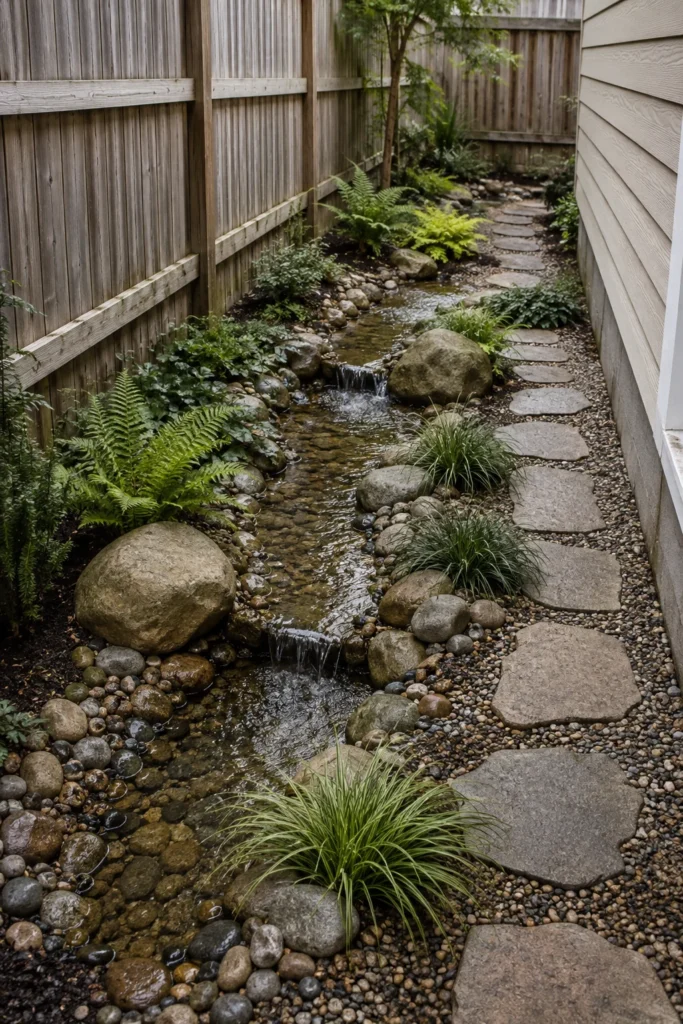
Keep the watercourse relatively narrow—perhaps 18 to 30 inches across—and let it curve gently rather than running as a ruler-straight trench. Use creek stone and rounded river rock along the sides with only a few larger anchor stones where the stream changes direction.
One or two miniature drops can add movement without making the feature too busy.
The best part of this arrangement is the sense of depth it creates. A narrow strip of yard can feel longer when the eye follows moving water through planting toward a destination at the far end.
Use groundcovers and grasses to blur some sections of the edge. If every inch of the liner is covered by an identical row of rock, the stream will still feel constructed.
Maintenance access matters in a side yard. Leave enough space beside the feature to reach pumps, remove leaves, and walk through without stepping on wet stones.
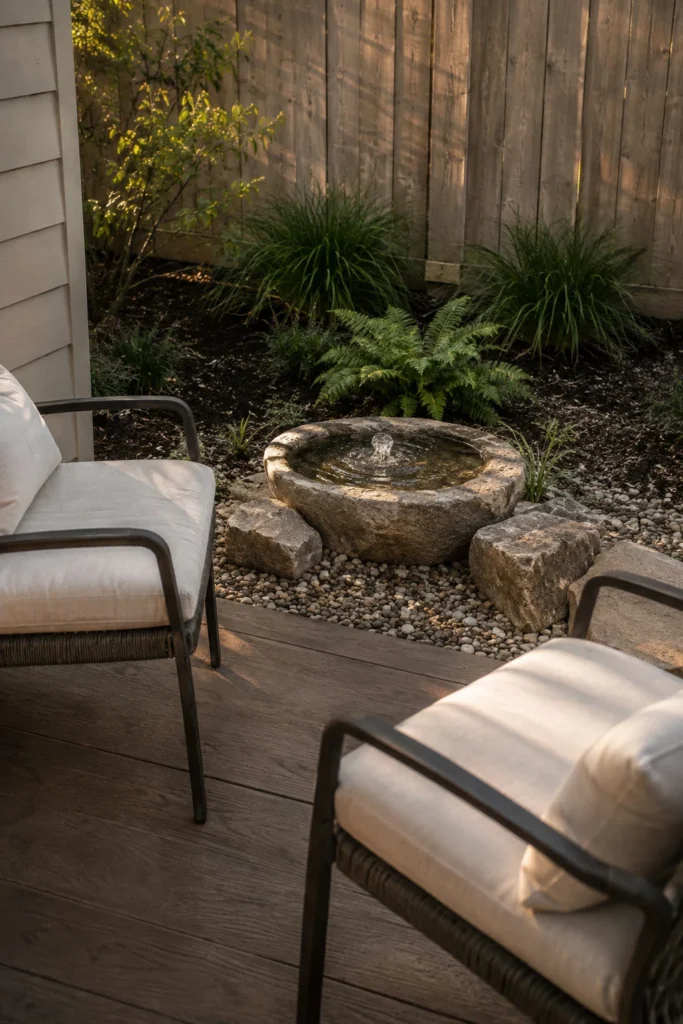
8. Place a Low Stone Basin Beside a Patio
A water feature next to seating needs to be close enough to enjoy but not so close that spray constantly lands on cushions or paving.
For a modest patio, use a broad low stone basin around 24 to 30 inches wide with a simple recirculating bubbler in the center. Surround the base with gravel and two or three medium stones so the basin doesn’t look like it was simply set on top of the patio edge.
This type of patio water feature is especially useful when a full pond would require too much floor or garden space. The sound remains concentrated near the chairs, and the water movement can be kept gentle.
Avoid a high fountain jet. A low bubbling surface is quieter, splashes less, and usually looks more connected to natural stone.
Position the basin just beyond the main walking route. Wet stone can become slippery, and you don’t want anyone brushing past the feature every time they sit down.
Electrical equipment used around water should be appropriate for outdoor water-feature use, with installation handled safely.
9. Make a Bubbling Boulder the Focus of a Small Garden Bed
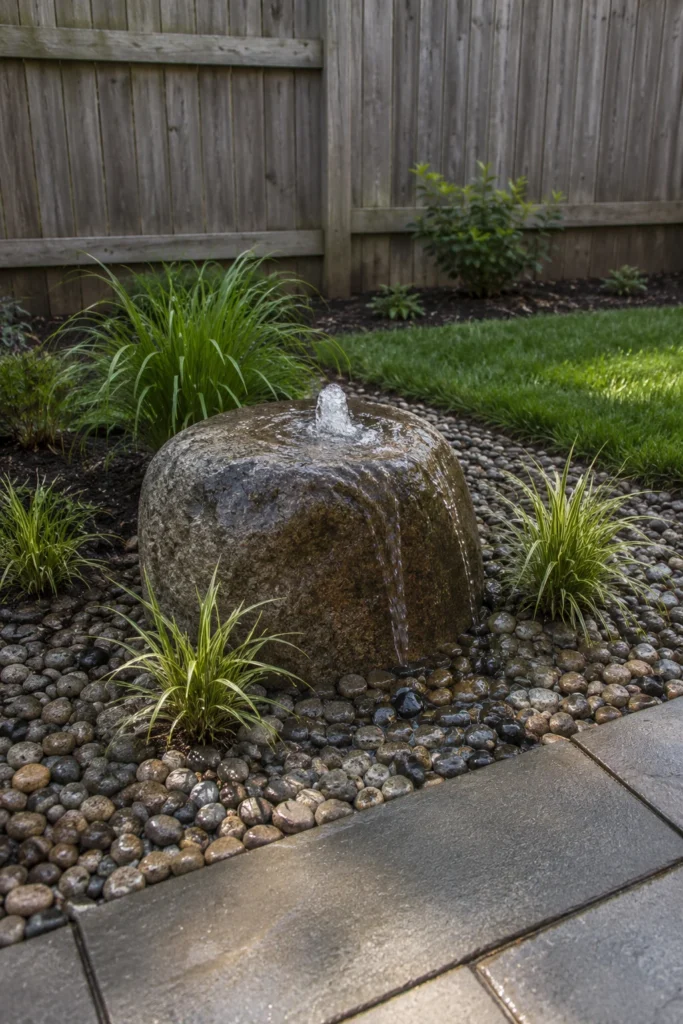
If you want water movement without building a pond or visible waterfall, a single bubbling boulder can be enough.
Choose one naturally weathered stone with an interesting surface rather than a perfectly round manufactured-looking rock. Set it partially into a bed of river stone and gravel so the base disappears into the ground. Water should emerge gently from the top and run down the existing contours of the rock before returning to a concealed basin.
This is one of the more approachable small outdoor water features because the visual composition is simple: one anchor stone, smaller gravel, and restrained planting.
Use plants around only part of the feature. A low ornamental grass, a few sedges, or groundcover can soften the transition without hiding the boulder.
The biggest scale mistake is choosing a rock that overwhelms the bed. In a tiny courtyard, one knee-high or slightly larger boulder can look substantial enough.
Moving and stabilizing heavy stone may still require help. Natural-looking does not mean casually balancing a large rock over a basin.
10. Build a Corner Pond With a Compact Rock Waterfall
Garden corners often suit ponds because two surrounding edges can visually shelter the feature without forcing it into the center of the lawn.
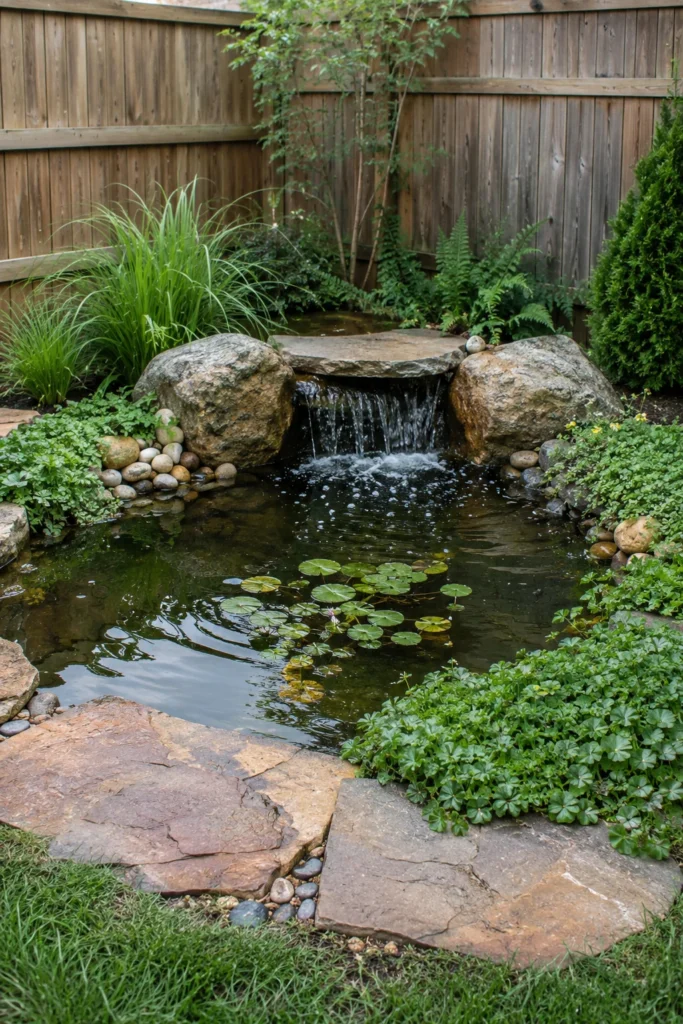
Shape a compact 5-by-6-foot pond into the corner and place the waterfall at the back, where planting can conceal the upper mechanics. Use two medium anchor boulders and one flat spill stone to create a low drop of around 12 inches.
Let the pond edge remain irregular. One side might have exposed flagstone where you can kneel for maintenance, while the other side disappears beneath sedges and creeping plants.
This version of a backyard pond with rock waterfall feels especially natural when the water seems to come from the planted corner rather than from a freestanding rock pile.
Don’t make the waterfall wider than the pond can visually support. A huge wall of water entering a five-foot pond usually looks out of scale.
If the corner sits directly beneath a heavily shedding tree, expect more debris and maintenance during certain seasons.
11. Use a Low Two-Drop Waterfall Beside a Garden Bench
Water features can support a relaxing outdoor space without becoming the entire yard.
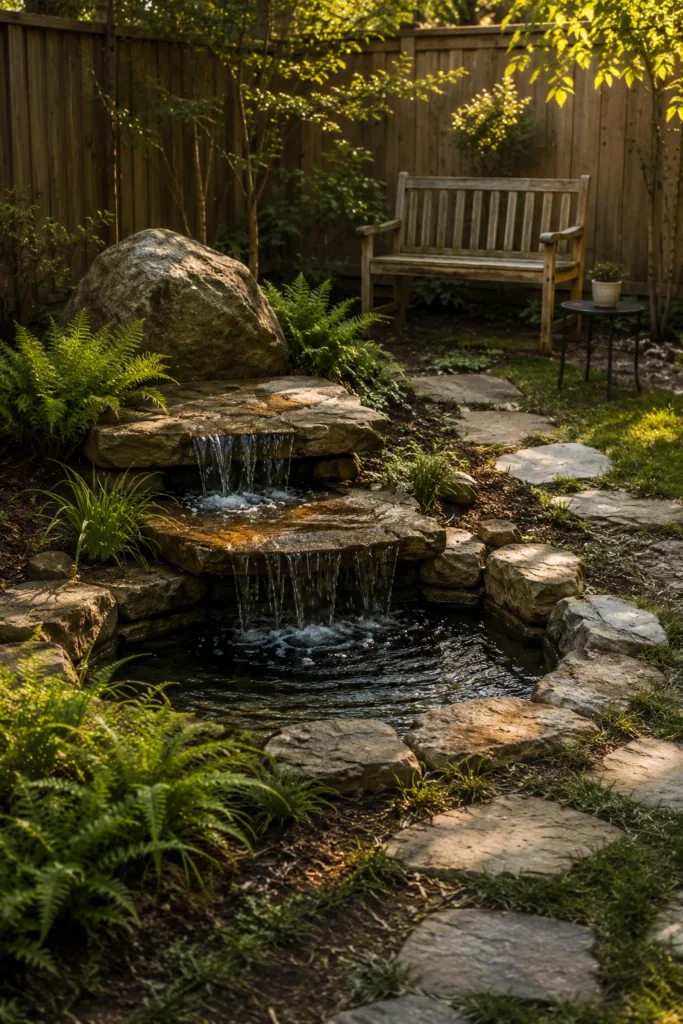
Place a short two-drop cascade several feet from a simple bench, using flat ledgestone for the spill points and one larger boulder at the rear. Let the water move into a small gravel-edged basin or compact pond rather than building a tall feature.
The placement matters. Close enough, you’ll hear the water while seated. Too close, and a stronger waterfall may become louder than expected, especially in a quiet yard.
This kind of setup works well if you’re trying to mask some distant traffic noise without creating an aggressive rushing sound. Two broad shallow drops often produce a fuller but softer effect than one narrow vertical fall.
Keep the furniture sparse. One bench and perhaps a small side table are enough. The landscape water feature should remain the main visual element.
Make sure the path to the bench stays dry and slip-resistant, particularly if spray or overflow could reach nearby stepping stones.
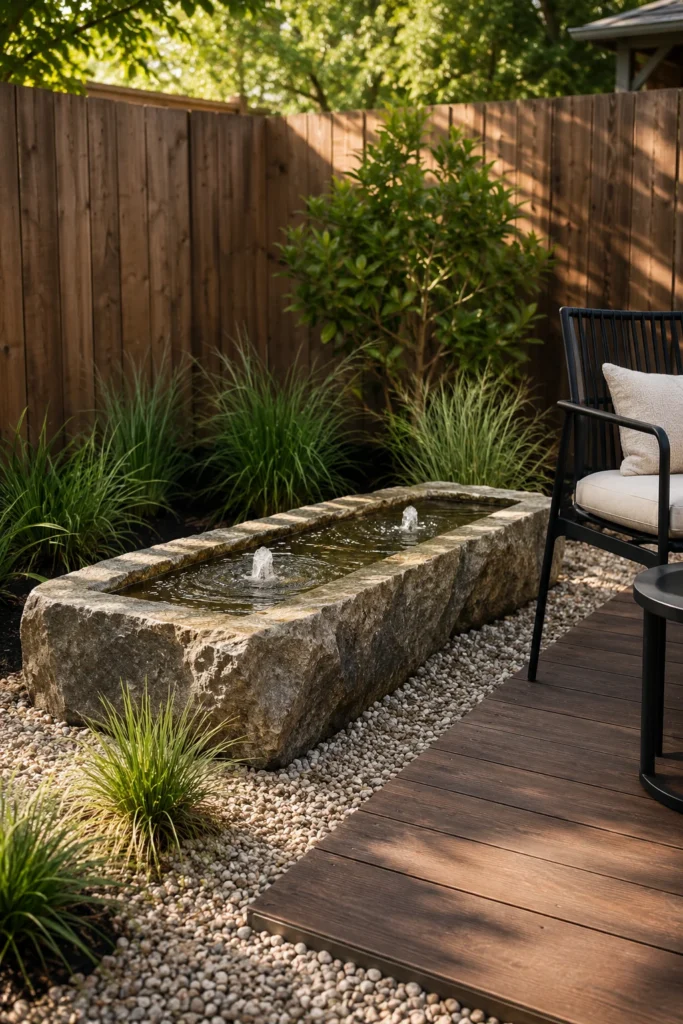
12. Create a Modern Rustic Stone Trough Fountain
Natural stone doesn’t have to mean a wild-looking pond.
For a cleaner garden, use a long low stone trough or rectangular basin set into gravel beside a patio or clipped planting bed. A narrow spill or two gentle bubbling points can provide movement while the strong rectangular shape keeps the feature more architectural.
Balance that geometry with irregular gravel and a few soft plants rather than surrounding the trough with perfectly aligned decor.
This works particularly well in a modern rustic backyard where wood decking, black metal furniture, and natural stone already appear elsewhere.
The water should stay low. A big vertical fountain would fight the simplicity of the basin and create unnecessary splash.
This kind of feature is often easier to fit into a small yard than a full pond, but the basin still needs routine cleaning and water-level checks. An exposed stone trough can collect leaves, dust, and pollen just like any other outdoor water feature.
Place it where you can reach it without squeezing behind shrubs.
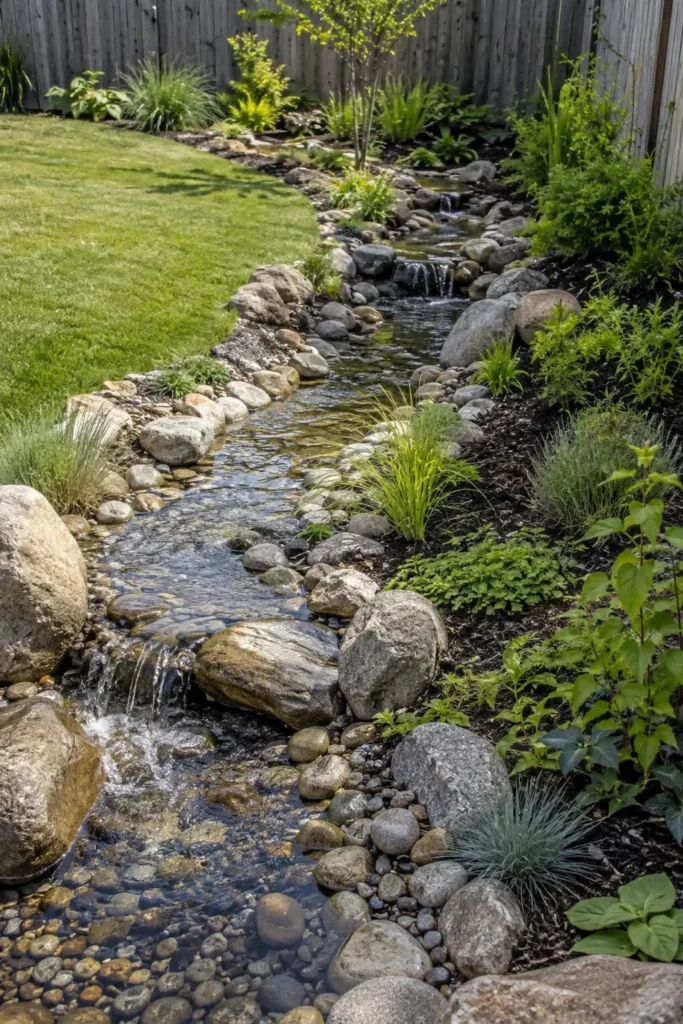
13. Let a Natural Creek-Style Feature Cross a Larger Planting Bed
If you have a little more room, a creek-style feature can feel less formal than a traditional pond.
Create a gently curving channel through a broad planting bed, using rounded creek stone and gravel along the bottom with larger boulders only at turns and small drops. The stream can widen into shallow pockets before narrowing again.
The key is variation. A completely uniform channel looks like a drainage ditch. A believable creek has places where water speeds up, places where it slows, and sections where plants lean close to the edge.
Use taller ornamental grasses and compact shrubs farther back, with groundcovers and sedges nearer the water. The planting should look layered rather than creating a solid green wall.
A feature like this can be more involved than it appears. Maintaining grade, managing water loss, and moving larger stones may justify professional help.
Also consider where the stream will be viewed from. If most of it disappears behind plants from the patio, the design loses much of its value.
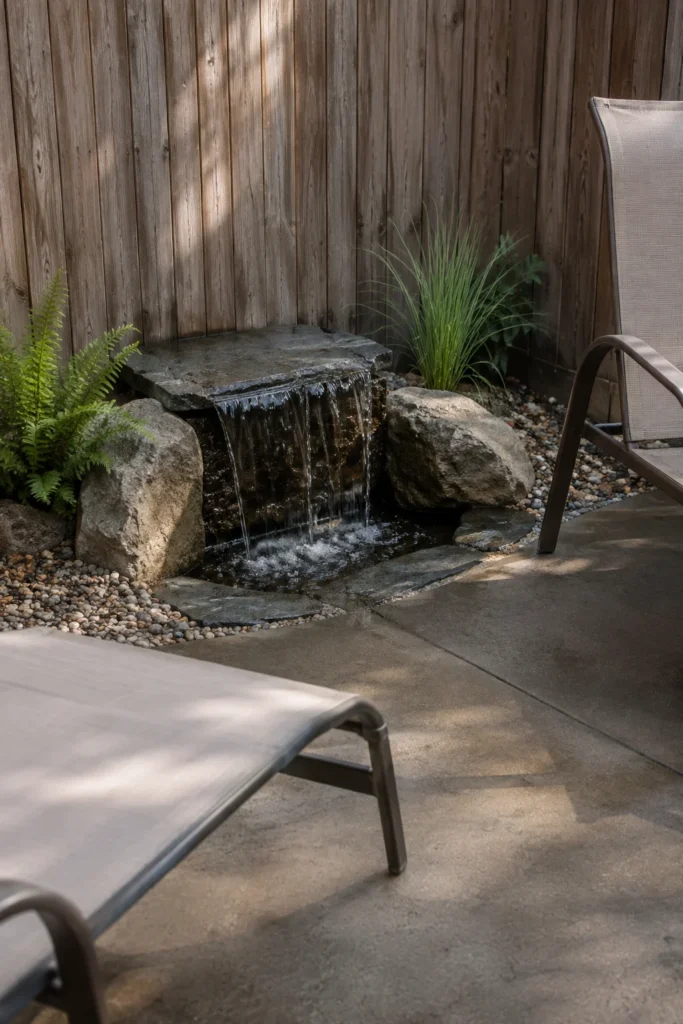
14. Add a Mini Recirculating Waterfall to a Patio Corner
A tiny garden doesn’t need a miniature version of a mountain waterfall.
Instead, use a compact recirculating feature with one broad spill stone, one small lower basin, and just enough surrounding gravel to make it feel settled. The full feature might occupy only a 3-by-4-foot corner beside a patio.
Use flat slate or sandstone for the main drop and one medium irregular rock on each side. Plant one grass or fern nearby rather than cramming the entire corner with greenery.
This restrained approach makes a small waterfall water feature look intentional rather than toy-like.
Keep the drop around six to eight inches. That produces visible movement without creating excessive sound or splash in a tight seating area.
For a DIY-inspired version, compact prefabricated or lined basins can be softened with carefully chosen stone, but don’t assume the mechanical components can simply be buried and forgotten. Pumps still need maintenance access.
If the feature sits beside outdoor chairs, test the splash before finalizing the placement.
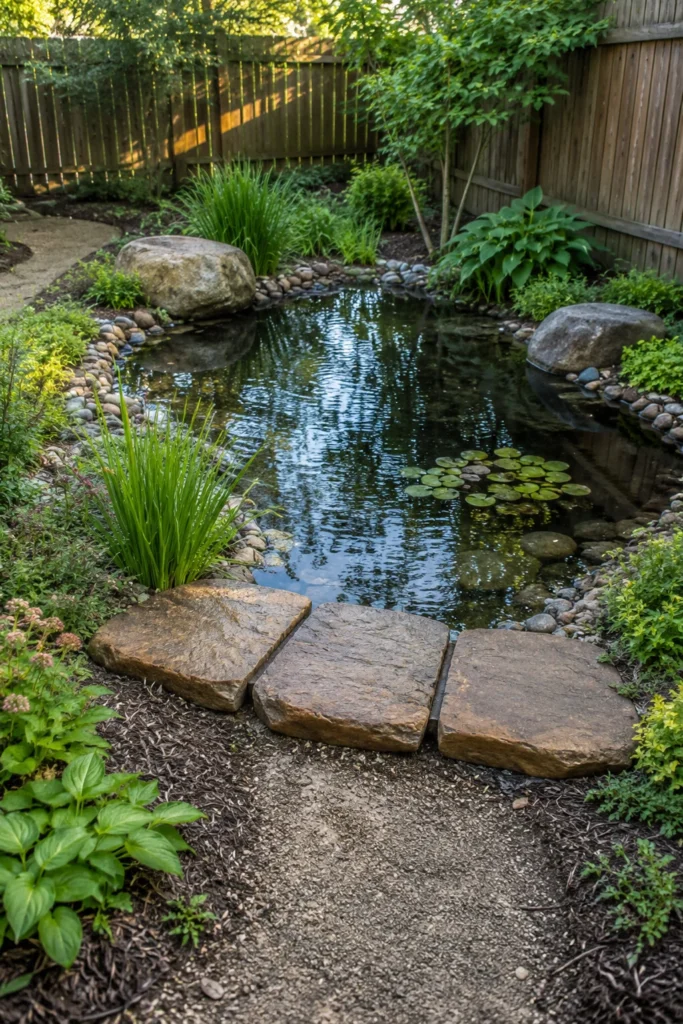
15. Build a Stepping-Stone Edge Along One Side of a Pond
A pond edge doesn’t have to be purely decorative. One section can also function as access.
Use two or three broad flat flagstones along the near edge of an irregular pond, set low and securely enough to create a practical place to stand while checking plants or skimming debris. Let the other sides of the pond remain softer, with gravel, larger anchor rocks, and planting.
That contrast keeps the edge from looking overly designed.
The flagstones also create a visual connection between the garden path and water. They can make a backyard pond with natural stones feel integrated into the way you move through the space rather than simply being something you look at from afar.
Don’t create stepping stones that encourage people to cross deep water unless the design is specifically engineered for that. Here, the stones function as an edge and maintenance platform.
Choose surfaces with enough texture for outdoor use, and expect stone near water to become slippery at times. Keep the accessible section open rather than burying it beneath trailing plants.
16. Create a Wider Single-Drop Waterfall for Fuller Sound
If sound is part of the reason you want a waterfall, width can matter as much as height.
A single broad spill stone around 24 to 36 inches wide can create a fuller, more noticeable sheet of water without requiring a tall structure. Keep the vertical drop modest—around 12 to 18 inches in many residential settings—and use large anchor stones at the sides to make the spill look supported by the landscape.
This works well where a pond sits near a patio and you want the water to be audible without building a tower of boulders.
The water should appear to gather naturally behind the spill stone rather than arriving through a narrow visible channel. Smaller rocks and planting can disguise the transition.
Wider movement may be more noticeable acoustically, so consider neighbors and nearby windows before increasing flow simply for drama.
The proportions also need to match the pond. A three-foot-wide waterfall entering a tiny three-foot pond will usually feel forced.
17. Combine a Small Pondless Cascade With Lush Greenery
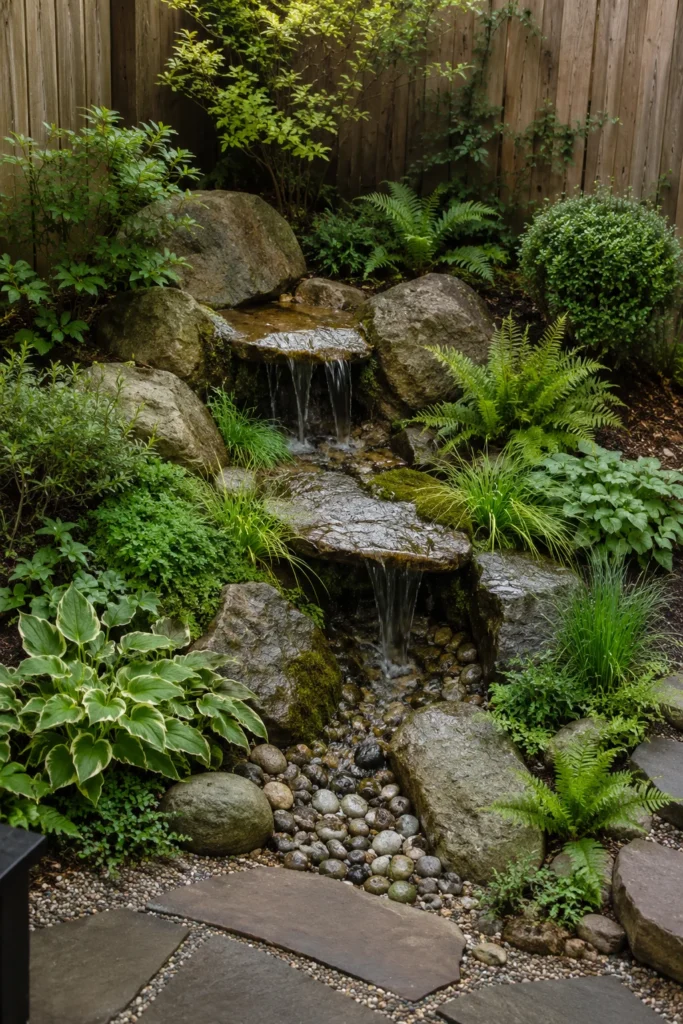
For a garden that feels lush without requiring a large open pond, combine a short pondless cascade with layered planting.
Use two low water drops through weathered stone, ending in a gravel-covered hidden basin. Place a couple of larger stones near the upper section, then use smaller river rock toward the lower end.
Around it, build a lush greenery backyard design using varied plant shapes rather than simply stuffing the entire area with foliage. Fern-like leaves, sedges, groundcovers, and a compact shrub or two can create depth while still leaving sections of stone visible.
The water should seem to disappear into the planting instead of ending at a conspicuous mechanical basin.
This design works particularly well in a shaded or partially shaded garden corner, but plant choices should still match the conditions in your own region.
Don’t pack plants too tightly at installation. They need room to mature, and maintenance becomes frustrating if you can’t reach the basin or pump.
A few visible stones and a little gravel are important breathing spaces. Without them, the water can vanish visually into a mass of foliage.
A Simple Framework for Natural-Looking Water Features
The most successful water features in the garden usually come down to a few decisions made well: one clear water movement + a few anchor stones + softened edges + planting + enough open space to see the water.
You don’t need a towering waterfall or dozens of expensive boulders. In many residential yards, a smaller feature looks more convincing because its scale makes sense. Use a few larger stones to establish structure, medium rocks to transition between them, and gravel or planting to soften the remaining gaps.
Let the existing landscape help make the decision, too. Look at the slope, drainage, sun and shade, mature trees, nearby seating, views from inside the house, and the route you’ll need for future maintenance.
Ponds, pumps, filters, plants, and moving water all need attention eventually. Leaves collect. Water levels change. Algae can appear. Stone near water gets wet. Keeping the design accessible is just as important as making it beautiful.
The goal isn’t to recreate a resort waterfall in a suburban yard. It’s to make the water, stone, and planting feel as though they belong to the same landscape—and to give yourself a garden feature you’ll actually enjoy living with.
