

18 Small Playroom Ideas for Toy Storage and Toddler Play Spaces
The strongest small playroom ideas usually begin with the part of the room that isn’t storage: the floor. In a compact play space, the biggest mistake is often lining every wall with bins, shelves, tables, chairs, and activity stations before deciding where children will actually build, sit, spread out, and move toys around.
A more useful rule is to protect the floor space first, then build storage around the edges.
That may mean one low storage wall instead of four separate toy units. It may mean a book ledge instead of a full bookcase, one activity table instead of several themed zones, or a rotation bin in a closet rather than displaying every toy at once.
Small playrooms also work better when cleanup is simple. Toddlers can understand broad categories much more easily than a complicated system of tiny labeled containers. Open storage is useful for favorites; closed storage is better for puzzles, art supplies, and sets with lots of pieces.
The goal is a room that still looks calm when playtime ends but leaves enough open space for the actual playing to happen.
18 Small Playroom Ideas for Toy Storage and Toddler Play Spaces
1. Build One Low Toy Storage Wall and Leave the Center Open
A low oak storage wall and one open rug can make a six-by-eight-foot playroom feel calmer than four separate toy stations. Run one short, sturdy storage unit along the longest wall and use a mix of open cubbies and three or four broad baskets.
Keep frequently used toys visible: blocks, a few vehicles, and one basket of soft toys. Put puzzles, multi-piece sets, and rotation toys behind doors or in another storage area.
The center of the room should remain mostly empty except for a washable rug. That gives toddlers space to build, sit side by side, and move toys around without constantly bumping into furniture.
This small playroom layout works because storage stays on the perimeter instead of eating into the play zone.
Fewer, larger bins are usually easier to maintain than many tiny ones. A “vehicles” basket and a “blocks” basket are more realistic than sorting every toy into narrow categories.
Low furniture should still be stable and secured where appropriate.

2. Turn a Small Alcove Into a Book-and-Floor-Cushion Play Nook
A narrow alcove doesn’t need much furniture to become a useful playroom nook. Install two or three short front-facing book ledges on one wall, place one floor cushion below them, and keep a small basket of soft toys nearby.
Use warm white walls with a muted dusty-blue or sage arch painted behind the reading area. The color visually defines the nook without adding another piece of furniture.
This works especially well in a hallway corner, bedroom alcove, or the side of a family room. Books use wall space rather than floor space, and the cushion can be moved when children want more room.
Keep the displayed book selection small and rotate extras elsewhere. Too many front-facing books can make a tiny wall feel unexpectedly busy.
The cushion also needs a storage home when the nook is used for something else. A nearby basket or bench can handle that.
Use secure, shallow ledges and keep hard wall-mounted items away from where children are likely to climb or roughhouse.

3. Create a Living Room Play Corner With Closed Storage
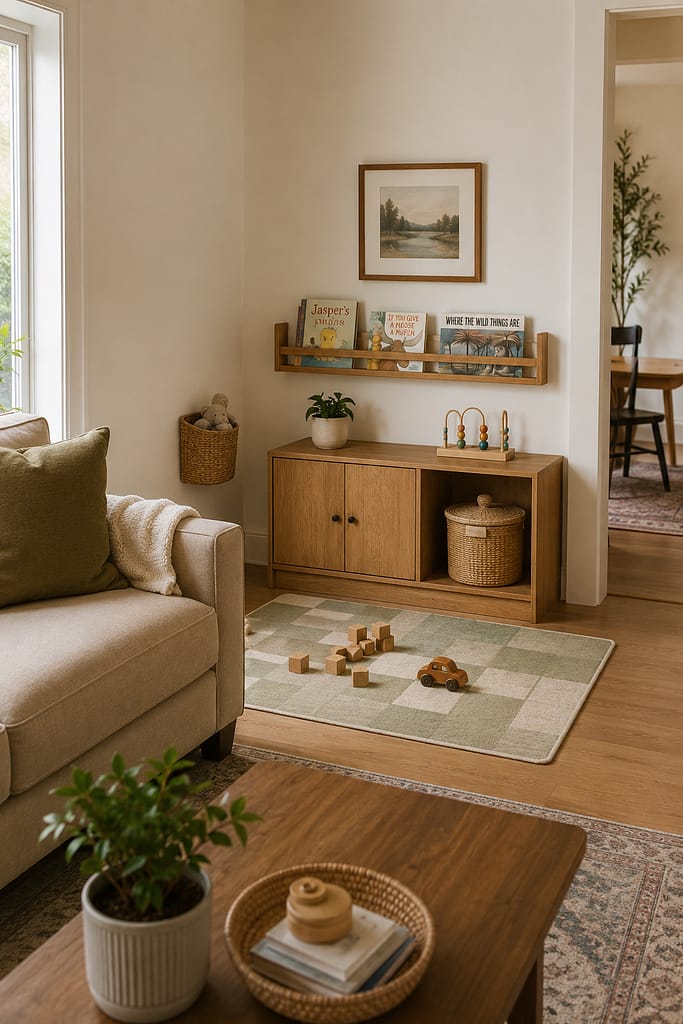
If the play zone shares a living room, the storage has to look calm after the last toy is put away. Use a low cabinet that matches the adult furniture—warm oak, painted beige, or soft gray—rather than brightly colored playroom storage.
Place the cabinet along one side wall, then use one washable rug to define the children’s area. Add a lidded basket for soft toys and one short book ledge above the cabinet.
This works because the play area is visually connected to the rest of the room instead of looking like a separate daycare corner dropped beside the sofa.
Keep only a few toys accessible at once. The cabinet can hide puzzles, pretend-play pieces, and extra rotation toys.
For kids’ play areas in living rooms with small-space toy storage, cleanup speed matters. If every toy requires a specific tiny container, the system will be hard to maintain at the end of the day.
Make sure the cabinet is stable and doesn’t interfere with the main walking route between seating and doorways.
4. Use One Storage Wall in a Narrow Playroom
A narrow playroom becomes difficult to use when storage is placed on both long walls. Instead, put most of the toy storage on one side and leave the opposite wall visually light.
In a seven-by-nine-foot room, use a low two- or three-section cabinet along one wall, a washable runner-style rug in the center, and a short book basket or ledge at the far end.
The open wall can hold one simple mural, painted arch, or framed child artwork without adding more furniture.
This compact playroom layout creates a clear route through the room and lets children spread blocks, cars, or puzzles across the central floor.
Use closed doors for multi-piece toys and one or two open baskets for daily favorites.
Avoid adding a full-size table unless the child uses it frequently enough to justify the footprint. In a room this narrow, a portable tray or small corner table may be more flexible.
The more furniture you distribute across both sides, the more the room starts to feel like a corridor of storage rather than a place to play.

5. Add One Small Toddler Activity Table in the Corner
A toddler table earns its footprint when it supports several activities: drawing, puzzles, play dough, simple crafts, or snack-like pretend play. In a small room, push it into one corner rather than centering it.
Use a compact round or square table with two child-size chairs. Store art or activity supplies in one shallow closed drawer or adult-managed cabinet nearby.
The rest of the room can stay open with low storage along one wall and a rug for floor play.
This works because the table becomes one clearly defined toddler activity area rather than another piece of furniture floating in the middle.
Keep the number of tabletop supplies limited. A cup of crayons and one paper tray may be enough for supervised use; extra supplies can stay closed away.
Large tables dominate tiny rooms quickly. If two children rarely use the table together, a smaller surface with one or two chairs may be more practical.
Washable finishes matter more than decorative styling in this zone.

6. Use a Window Seat as a Reading Nook and Toy Storage Zone
A window seat can handle both seating and storage without taking up another wall. In a small playroom, use a low bench beneath the window with drawers or lift-up storage below, then add one or two washable seat cushions.
Place a book basket beside the bench or use two short ledges on the adjacent wall rather than adding a large bookcase.
This is one of the stronger playroom seating ideas because the seat occupies an architectural edge that might otherwise go unused.
Use the hidden storage for extra books, blankets, puzzles, or rotation toys. Keep everyday toys elsewhere so the bench isn’t constantly being opened.
The window area should stay visually simple. One cushion, one small pillow, and a few books are enough.
If the window seat interferes with heating, vents, window operation, or safe access, the idea may not be appropriate. And as with any built-in-looking furniture, stability matters more than the Pinterest effect.

7. Put Toy Storage Under a Small Bench
In a tiny playroom, seating should do more than one job. A low bench with open or closed storage underneath can provide a place for an adult to sit briefly while also handling bulky toys or dress-up items.
Place the bench against a wall near the edge of the play area, not in the middle. Use two large baskets underneath instead of several small bins.
This works because the bench keeps the floor plan simple and consolidates seating and storage into one footprint.
A washable cushion can make it more comfortable, but skip decorative pillow piles that have to be moved every time the bench is used.
For playroom organization in a small space, the baskets should hold broad categories—stuffed animals and pretend-play accessories, for example.
An open bench can become messy if baskets are constantly overflowing. If the contents are visually chaotic, a bench with drawers or cabinet doors may be more useful.
The bench should be stable enough for the intended seating use and positioned so it doesn’t narrow the main route through the room.

8. Use Cube Storage Selectively Instead of Filling Every Wall
Cube units can be useful, but they quickly become visual clutter when every cubby is open and full. In a small playroom, use one short cube unit and mix open and concealed storage.
For example, keep two cubbies open for blocks and vehicles, use two fabric bins for loose toy categories, and leave the top mostly clear except for one larger toy or lamp.
This gives toddlers enough visible choices without turning the wall into a grid of dozens of objects.
The unit should stay low and stable. In a six-by-eight-foot room, a horizontal cube arrangement usually preserves more visual openness than a tall vertical tower.
This setup also makes toy rotation easier. Keep only the current favorites in the visible cubbies and store the rest elsewhere.
The problem with tiny bins is sorting fatigue. If cleanup requires matching every object to a hyper-specific container, the system is unlikely to stay tidy.
Use broad, understandable categories instead.

9. Use Closed Cabinets for Visually Messy Toys
Some toy categories never look calm in open storage. Puzzles, magnetic sets, art supplies, doll accessories, and pretend-food collections can create a lot of visual noise even when they’re technically organized.
Use a low cabinet with doors for those categories and keep only a small number of favorites on open shelves.
This is especially effective in a small kids’ playroom or shared family space where the room needs to look calmer after playtime.
Inside the cabinet, broad bins or shallow drawers can separate categories without adding visual clutter to the room.
Keep the cabinet color quiet—warm white, beige, sage, or natural wood—and use simple hardware.
A completely closed room isn’t necessary. One book ledge and one basket of blocks can stay visible so children still have easy access to everyday play.
The balance is useful: display what children use often; hide what creates visual noise.
Heavy storage furniture should be stable and secured where appropriate, especially when doors and drawers are at child height.

10. Add a Rolling Cart for a Flexible Art Zone
A rolling cart can work well in a small play space when the table or art zone changes location. Keep the cart narrow and use it for supervised art supplies rather than as a permanent tower of miscellaneous toys.
Place it beside a compact activity table during drawing or painting, then roll it against a wall when floor space is needed.
This is useful for small-space playroom design because one mobile piece can replace several fixed storage stations.
Use the upper shelf for current materials, with less-accessible or adult-managed items stored higher or elsewhere depending on the child’s age. Keep the lower shelf simple—paper, large coloring books, or washable smocks.
The cart needs a clear parking spot. A mobile organizer that constantly sits in the middle of the room defeats the purpose.
Also avoid turning every shelf into an overflowing supply zone. Art materials can quickly become more visually demanding than toys.
Choose a stable cart with smooth movement and child-appropriate use.

11. Turn the Space Under the Stairs Into a Play Nook
An under-stair alcove can become a useful play nook without building a miniature playhouse. Keep the architecture visible and use the low ceiling to define a reading or pretend-play area.
Add one floor cushion, a low book basket, and a small shelf for two or three favorite toys. Paint the back wall a muted color or simple arch to visually mark the nook.
The surrounding family room can hold the bulk of toy storage in a low cabinet.
This works because the under-stair area becomes one focused activity zone rather than another place filled with furniture.
Avoid enclosing the nook with doors or decorative structures unless there is a real functional reason. In a small home, open sightlines can make supervision and cleanup easier.
Low headroom means the space is better suited to sitting and reading than to active climbing or rough play.
Lighting should be simple and safely installed, without reachable cords or hot fixtures.

12. Create a Floor-Cushion Reading Corner Without Adding a Chair
A full-size chair takes up more floor space than many tiny playrooms can spare. Instead, create a reading corner with one or two floor cushions and low book storage.
Use two short book ledges or one shallow bookcase on the wall, then keep the cushions tucked into the corner when they’re not in use.
This gives children a distinct reading zone without sacrificing the open center of the room.
For very small playroom ideas, movable seating is especially useful because the cushions can become part of floor play or be stored away entirely.
Keep the books displayed to a manageable number. A small rotation of favorites is easier to browse and visually calmer than a wall packed with covers.
The cushions need a home when play becomes more active. A storage bench, large basket, or corner stack works.
Avoid decorative canopies, hanging strings, or cords just to make the nook look cozy. Texture, warm light, and a soft rug usually do enough.

13. Make a Small Art Station With Wall-Mounted Storage
A compact art station can fit in a small playroom if the supplies stay shallow and controlled. Use a small toddler table against the wall and mount one or two secure shallow shelves above adult reach for materials that need supervision.
Keep only the current paper, chunky crayons, and washable activity supplies available at table level.
This setup works because the table is pushed to the perimeter and the wall handles part of the storage.
One shallow drawer under the table or nearby can store paper, stickers, or large safe craft materials.
If the room is extremely small, the table can double as a puzzle and snack-style play surface rather than becoming an art-only station.
The biggest reality check is supply volume. Art materials tend to multiply. Without editing, a compact station quickly becomes an entire wall of containers.
For a toddler-focused room, keep age-inappropriate or messy supplies out of unrestricted reach and use storage that remains stable and secure.

14. Create a Dress-Up Zone With One Hook Rail and Basket
Dress-up play doesn’t need a wardrobe rack that occupies half the room. Use one short wall-mounted hook rail and one large basket for costumes, soft hats, and pretend-play accessories.
Place the zone near the edge of the room or beside a low closed cabinet. A small child-safe mirror can be added where appropriate, securely mounted and made from suitable material.
This works because the dress-up area stays vertical and compact while still making pretend play easy to access.
Use only a few hanging items at once and rotate the rest. A long row of costumes can become visual clutter surprisingly quickly.
The large basket handles soft accessories without requiring many tiny containers.
This is one of the more practical small play space ideas because it creates a recognizable activity zone with very little furniture.
Keep hooks and hanging items positioned safely so they don’t interfere with doors or become climbing aids.

15. Build a Soft-Play Corner With a Clear Boundary
A soft-play area can work in a small room when it stays simple. Use one corner of the rug for two or three foam shapes, a soft floor mat, and perhaps one low basket of balls or plush toys appropriate to the child’s age.
The rest of the room should stay open for building, reading, or pretend play.
This works because the soft-play zone has a defined footprint instead of expanding into the entire room.
Keep storage low and nearby so the pieces can be put away when not needed. If the room is very small, use stackable foam shapes rather than large permanent structures.
Avoid adding climbing walls, slides, or tall equipment just because the room is labeled a playroom. Those features can dominate small family spaces and may not suit every age or home.
The floor mat should sit flat and not interfere with the main route through the room.
This kind of indoor kids’ play setup works best when one activity zone doesn’t crowd out all the others.

16. Use a Simple Multi-Zone Dayhome Layout
A small dayhome setup or home child-care room works best when the zones are obvious but not overbuilt. In an 8-by-10-foot space, put low toy storage along one wall, a compact activity table in one corner, and a small reading area in another.
The center floor should remain open for group play. Use one durable washable rug rather than several small mats dividing the room into too many sections.
Broad categories help cleanup: blocks, vehicles, pretend play, books, and art supplies. Keep visually messy or adult-managed materials behind doors or in drawers.
Flexible seating is more useful than fixed furniture. Two small chairs at the table and one floor cushion in the reading corner may be enough.
This layout feels more residential than classroom-like because the materials stay simple—warm wood, cream, sage, or dusty blue.
A small care space doesn’t need every activity available simultaneously. Rotating materials can keep the room more manageable.

17. Use a Toy Rotation Closet to Reduce What Stays Visible
One of the cheapest ways to improve small playroom organization is to remove toys rather than add more storage furniture.
Keep a limited selection of toys in low accessible storage and place rotation bins on an adult-managed closet shelf or another storage area. Swap categories periodically based on what the children are currently using.
This can make a six-by-eight-foot room feel dramatically calmer because fewer objects compete for floor and shelf space.
Use the open storage for current favorites and keep extra puzzles, vehicle sets, pretend-play pieces, and seasonal toys out of sight.
The goal isn’t to create a complicated rotation schedule. A few broad backup bins are enough.
This works especially well when open cubbies tend to become stuffed with every toy the household owns.
Closet storage still needs to remain practical. Don’t stack heavy bins where they are difficult or unsafe to access, and don’t fill the playroom closet so completely that coats or household storage become unusable.

18. Create a Shared Sibling Play Space With Separate Zones but Shared Storage
A shared playroom doesn’t need duplicate storage for every child. Use one common low storage wall and divide the room through activity rather than ownership.
For example, put books and a floor cushion in one corner, a small table for puzzles or drawing in another, and leave the center rug open for blocks and pretend play.
Use broad shared toy categories in baskets and closed cabinets. If each child has a few special items, one personal basket apiece is enough.
This works because the room stays visually simple while still giving children more than one place to play side by side.
In a 7-by-10-foot room, keep the table tight to a wall and avoid adding separate child-size armchairs. Floor seating and a small bench are easier to move.
A shared room can become cluttered quickly if every activity has a dedicated piece of furniture. Keep the setup flexible.
The best small playroom ideas usually leave enough empty floor for the activity that wasn’t planned in advance.

How to Keep a Small Playroom Organized Without Filling It With Storage
The most useful small playroom ideas follow a simple framework: open floor space + low accessible storage + broad toy categories + one or two activity zones + easy cleanup.
Start by watching how the space is actually used. Notice where children sit, which toys spread across the floor, where books naturally collect, and what gets abandoned during cleanup. That information is more useful than adding another cabinet simply because an empty wall exists.
Keep daily favorites accessible and hide the categories that create the most visual noise. A few vehicles, blocks, books, and soft toys can stay open; puzzles, craft supplies, extra sets, and rotation toys often work better behind doors or elsewhere.
Use fewer, larger bins with categories children can realistically understand. Avoid making the storage system more complicated than the play itself.
If the room shares a living area, prioritize furniture and baskets that look calm when everything is put away.
Most importantly, don’t let storage replace the reason the room exists. A playroom should still have enough open floor for children to build, move, sit together, imagine, and spread out temporarily.