
20 Small Kitchen Storage Ideas That Make Every Inch Count
A small kitchen can feel surprisingly crowded when cabinets are packed, countertops are covered with appliances, and finding a baking sheet requires rearranging half your cookware.
Fortunately, better kitchen storage doesn’t always require new cabinets or a major renovation. The right organizers, shelving, and storage habits can help you use existing space more effectively.
The trick is identifying what’s causing the clutter before buying another set of baskets. A deep cabinet needs a different solution from a narrow gap beside the refrigerator, and an overcrowded countertop may benefit more from reorganizing than adding another shelf.
These 20 small kitchen storage ideas cover practical ways to organize cabinets, drawers, walls, and everyday essentials while keeping your kitchen comfortable to use.
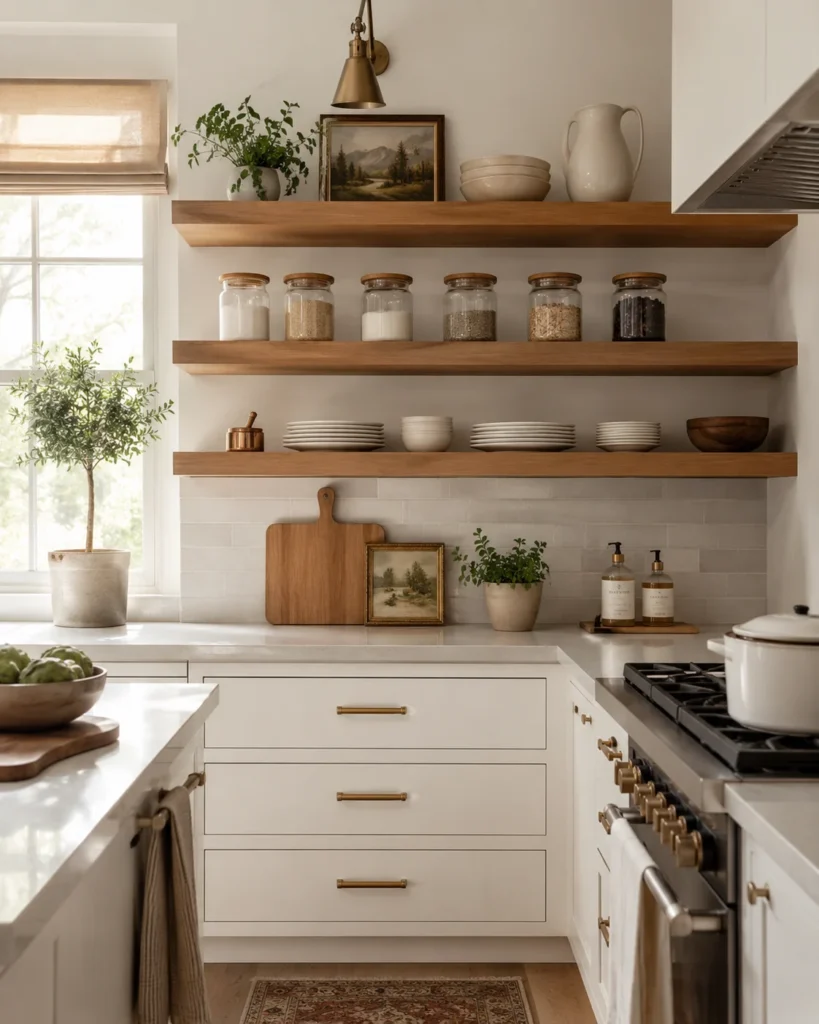
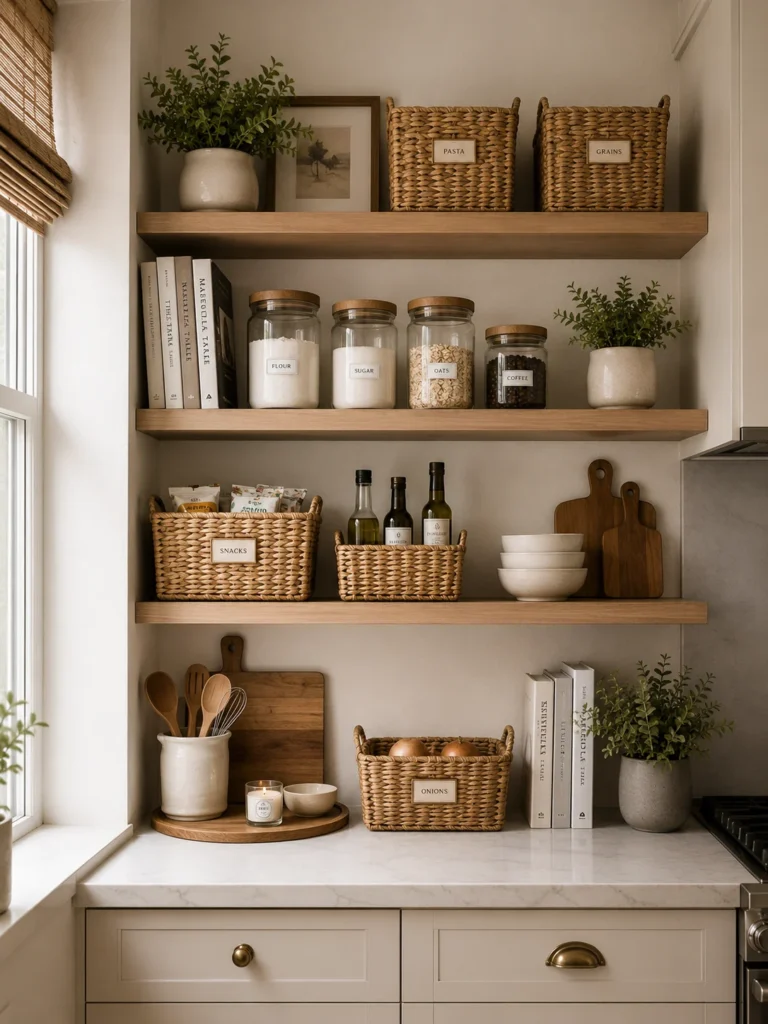
1. Install Floating Shelves Above Countertops
Floating shelves can turn unused wall space into accessible storage for dishes, mugs, and frequently used kitchen essentials. They’re especially useful when you have an empty wall above a countertop or beside existing cabinets.
Choose shelves that complement your kitchen’s finishes. Natural wood adds warmth to white cabinetry, while painted shelves can blend into the walls for a simpler appearance.
Before installation, decide what you’ll store. Everyday mugs and lightweight bowls have different support requirements from stacks of heavy dinner plates. Select shelving and mounting hardware designed for the intended load and wall construction.
Leave enough space beneath the shelves for the appliances and activities that already occupy the countertop. An attractive shelf becomes inconvenient if you have to move the coffee maker every time you use it.
Keep the display practical by grouping similar items and leaving a little open space. Floating shelves work best when they make essentials easier to reach rather than becoming another place to accumulate clutter.
2. Use Clear Pantry Containers
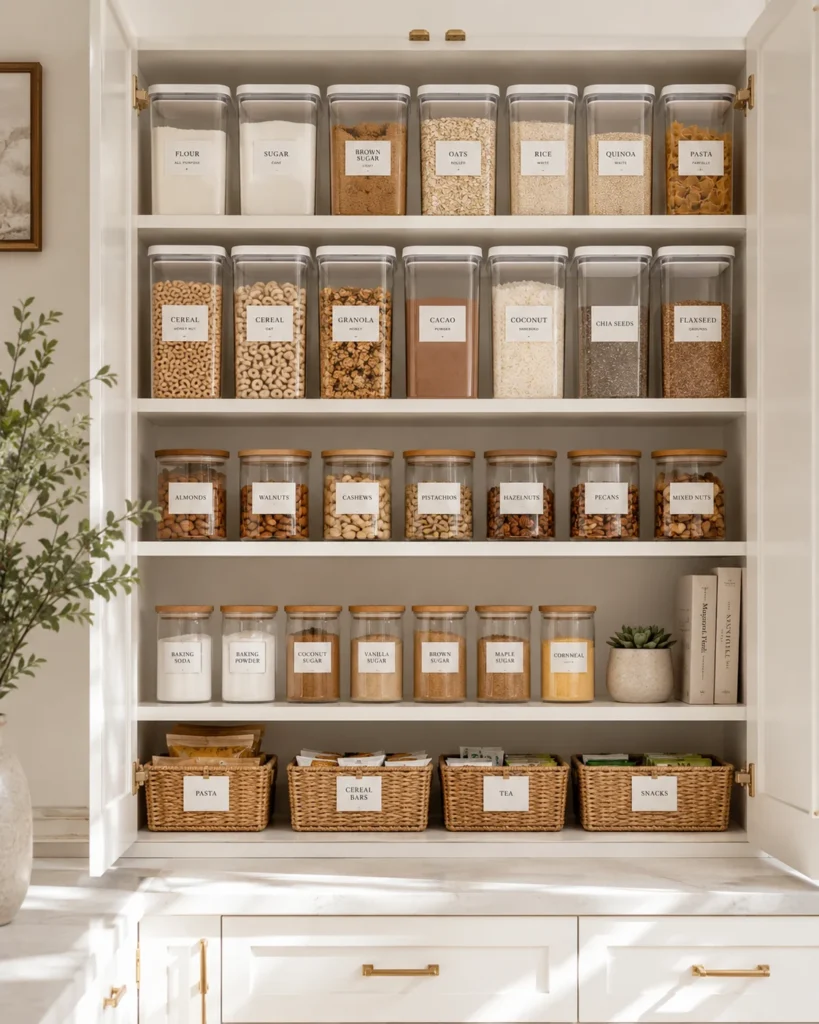
Clear pantry containers help organize dry ingredients that arrive in awkwardly shaped boxes and bags. Their regular shapes can make cabinets easier to arrange, especially when shelves contain several different food packages.
Choose containers according to the ingredients you actually buy. Tall containers may suit pasta or cereal, while smaller ones work for oats, rice, sugar, and baking supplies.
Measure the shelves before purchasing a matching set. Containers should fit with enough clearance to lift them out and open their lids comfortably.
Label each container with its contents and retain important information from the original packaging, including allergens, preparation instructions, and best-before dates. Avoid mixing new ingredients with older supplies without checking their condition.
Clear containers are most useful when they simplify your routine. If transferring every grocery item creates extra work, start with the ingredients whose original packaging causes the most frustration.
3. Add Pull-Out Cabinet Drawers
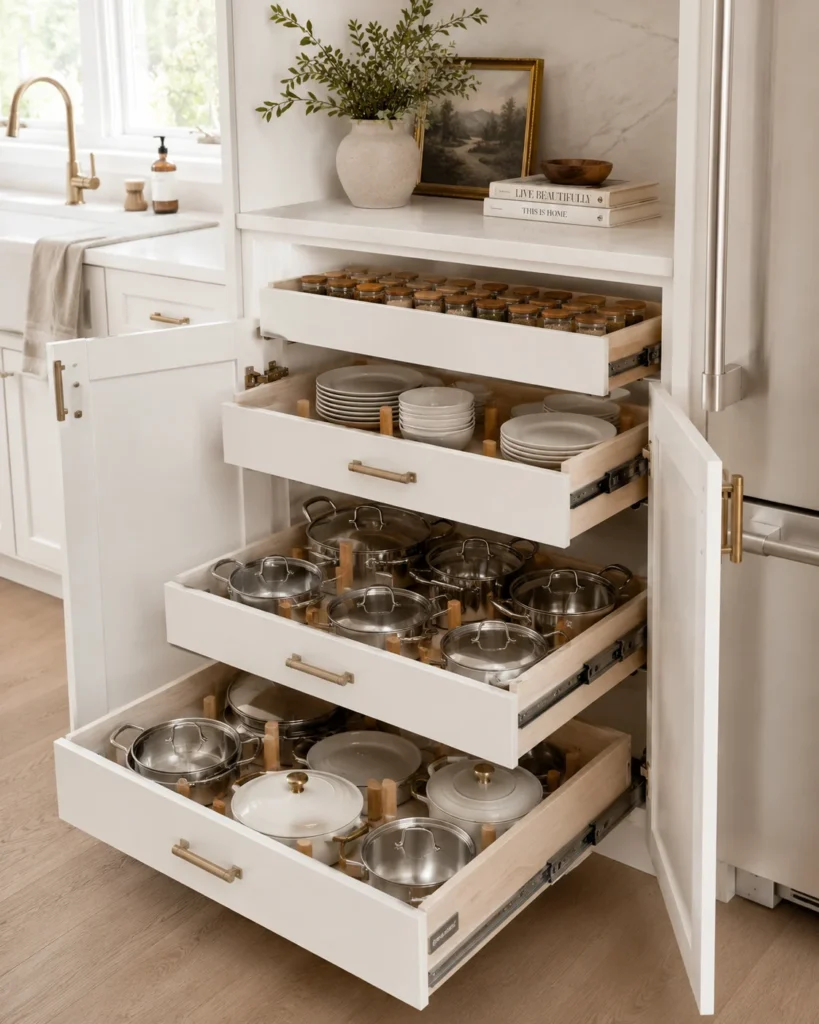
Deep lower cabinets often have plenty of space but poor accessibility. Items placed at the back can become difficult to reach without moving everything in front.
Pull-out drawers or sliding shelves bring cabinet contents forward, making cookware, mixing bowls, and pantry supplies easier to see.
Start by measuring the cabinet’s interior width, depth, and height. Account for hinges, door openings, plumbing, and any interior framing that could interfere with the sliding mechanism.
Choose an organizer suited to the weight of the items you intend to store. Heavy cookware needs sturdier hardware than lightweight food containers.
A pull-out shelf can be particularly helpful beneath a countertop, where bending and reaching into a deep cabinet becomes inconvenient. Keep frequently used items near the front and arrange heavier pieces where they’re comfortable to lift.
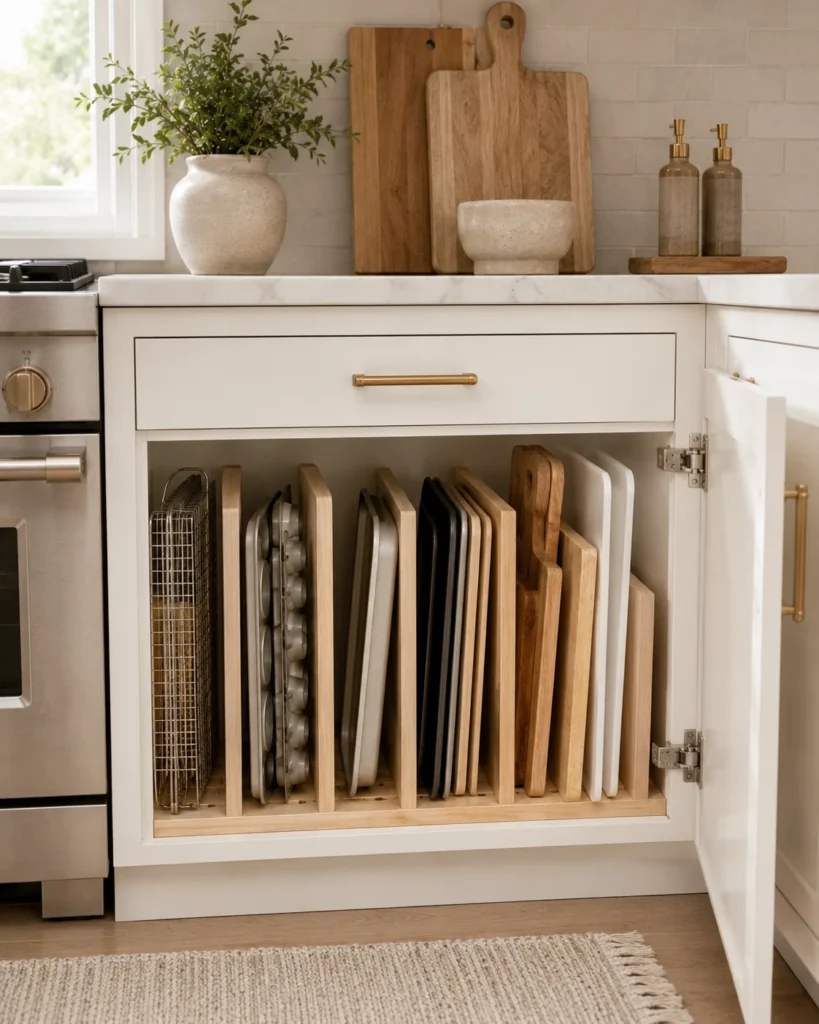
4. Store Items Vertically
Baking sheets, cutting boards, cooling racks, and serving trays are often easier to organize upright than in horizontal stacks.
A vertical organizer divides these flat items into individual slots, allowing you to remove one without lifting everything above it.
Choose a freestanding rack or adjustable divider that fits inside your cabinet. Check the height of your largest baking sheet and the thickness of your cutting boards before selecting the organizer.
Group similar items together, keeping everyday boards and trays in the most accessible positions.
Avoid forcing oversized cookware into narrow compartments. The organizer should hold items securely without bending, scratching finishes, or making removal difficult.
Vertical storage is especially useful in lower cabinets where stacked trays tend to slide around and become difficult to separate.
5. Create a Mini Pantry Wall
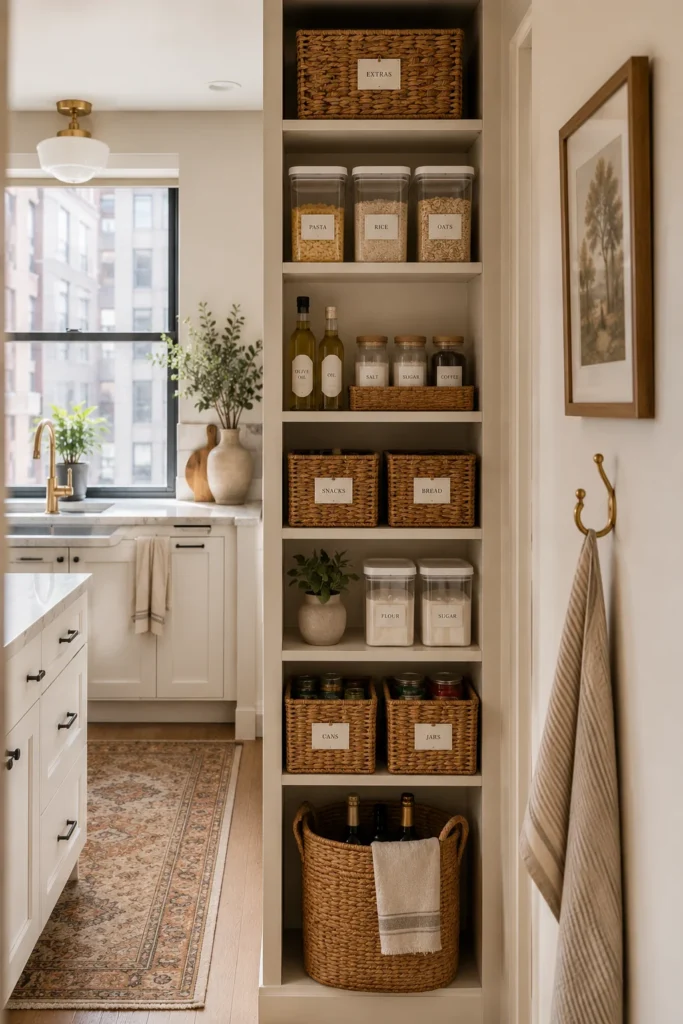
A narrow wall can become a compact pantry when your kitchen doesn’t have a dedicated food-storage cabinet.
Install appropriately supported shelves for dry goods, small baskets, and pantry containers. An empty section beside the refrigerator or near the kitchen entrance may provide a suitable location.
Choose shelf depth according to the available space and the items you want to store. Shallow shelves can work well for cans and jars, while larger baskets need more depth.
Arrange frequently used ingredients at a comfortable height and place occasional supplies higher or lower. Use baskets to contain packets and small items that would otherwise look scattered.
Before installing shelves, consider nearby doors, appliances, and walking routes. A mini pantry should make food easier to access without creating a narrow passage.
Keep the arrangement organized by category so the open shelves remain useful rather than becoming an extension of an overcrowded cabinet.
6. Use the Inside of Cabinet Doors
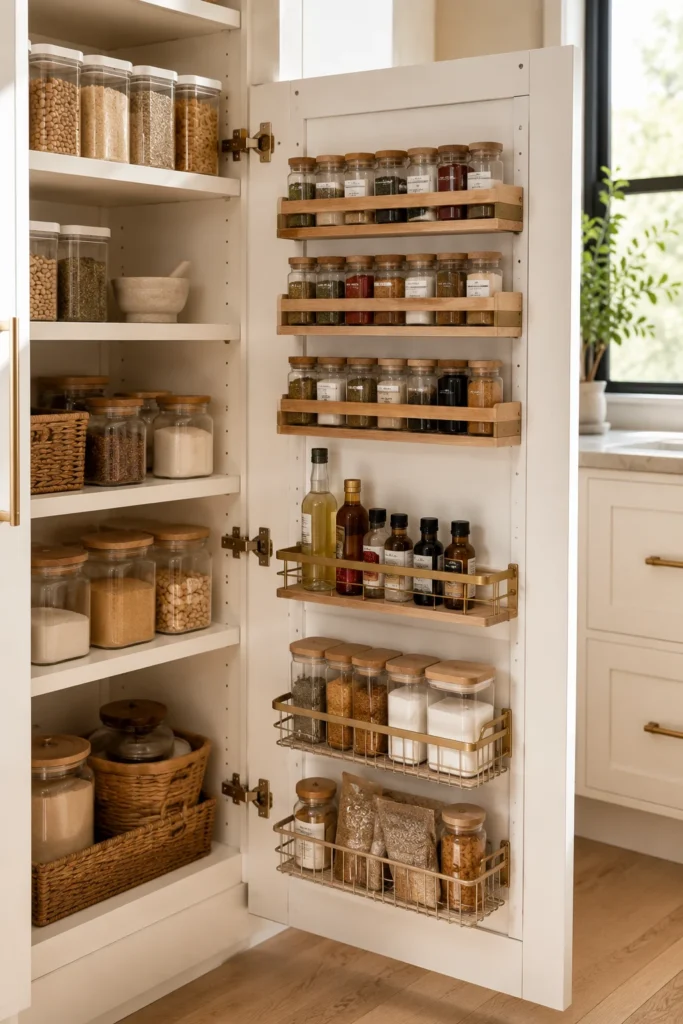
Cabinet doors can provide extra storage for small kitchen accessories that are difficult to organize on ordinary shelves.
Slim organizers can hold measuring spoons, food wraps, lightweight pot lids, or selected spices. Over-the-door designs are particularly convenient when you want a removable solution.
Check the space between the door and the contents of the cabinet before purchasing anything. An organizer that fits the door itself may still prevent it from closing properly.
Choose the mounting method according to the cabinet material and the weight of the stored items. Lightweight doors and thin panels may not be suitable for heavy organizers.
This approach works best for relatively flat, lightweight objects. Keep heavier bottles, glass containers, and bulky cookware on properly supported shelves.
A simple door organizer can free drawer space without requiring you to reorganize the entire kitchen.
7. Add a Rolling Kitchen Cart
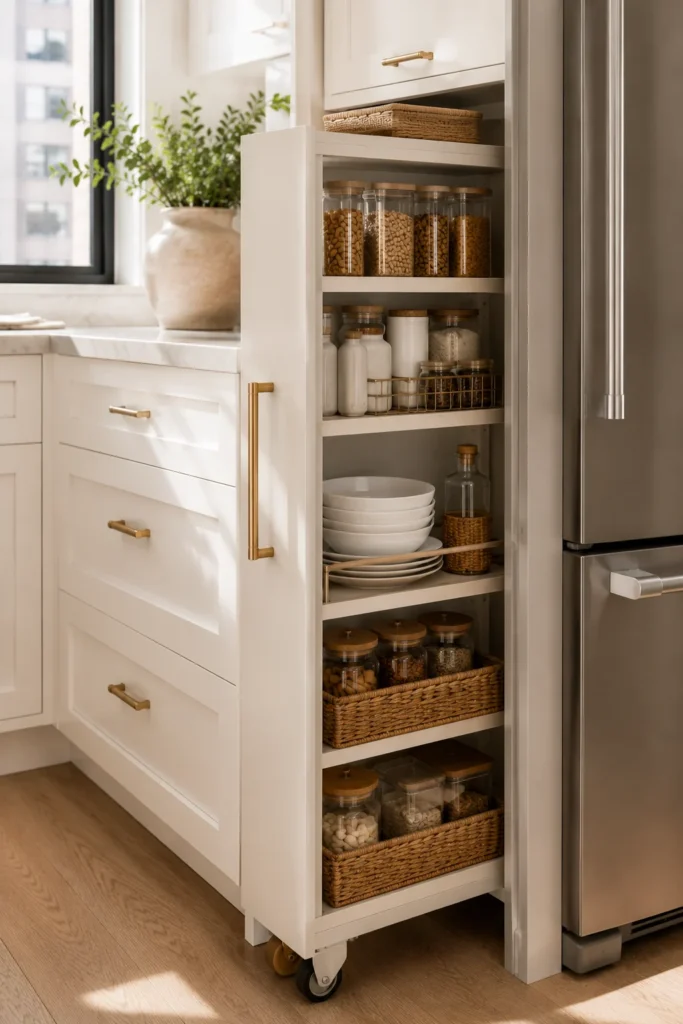
A rolling cart provides flexible storage that can move where it’s needed. It can hold pantry supplies, towels, utensils, or other everyday essentials without becoming a permanent cabinet.
Slim carts are particularly useful in small kitchens with limited floor space. Choose one that fits a suitable storage location and can be moved without scraping adjacent cabinets.
Look for stable construction, shelves with raised edges, and locking wheels if the cart will be used while stationary.
Arrange heavier items on lower shelves and lighter supplies above. Keep the cart organized by purpose so it doesn’t become a collection of unrelated kitchen items.
A rolling cart can also provide a temporary place for preparation supplies, although its suitability as a work surface depends on the product’s stability and intended use.
Choose a cart because it solves a specific storage problem, not simply because an unused gap happens to exist.
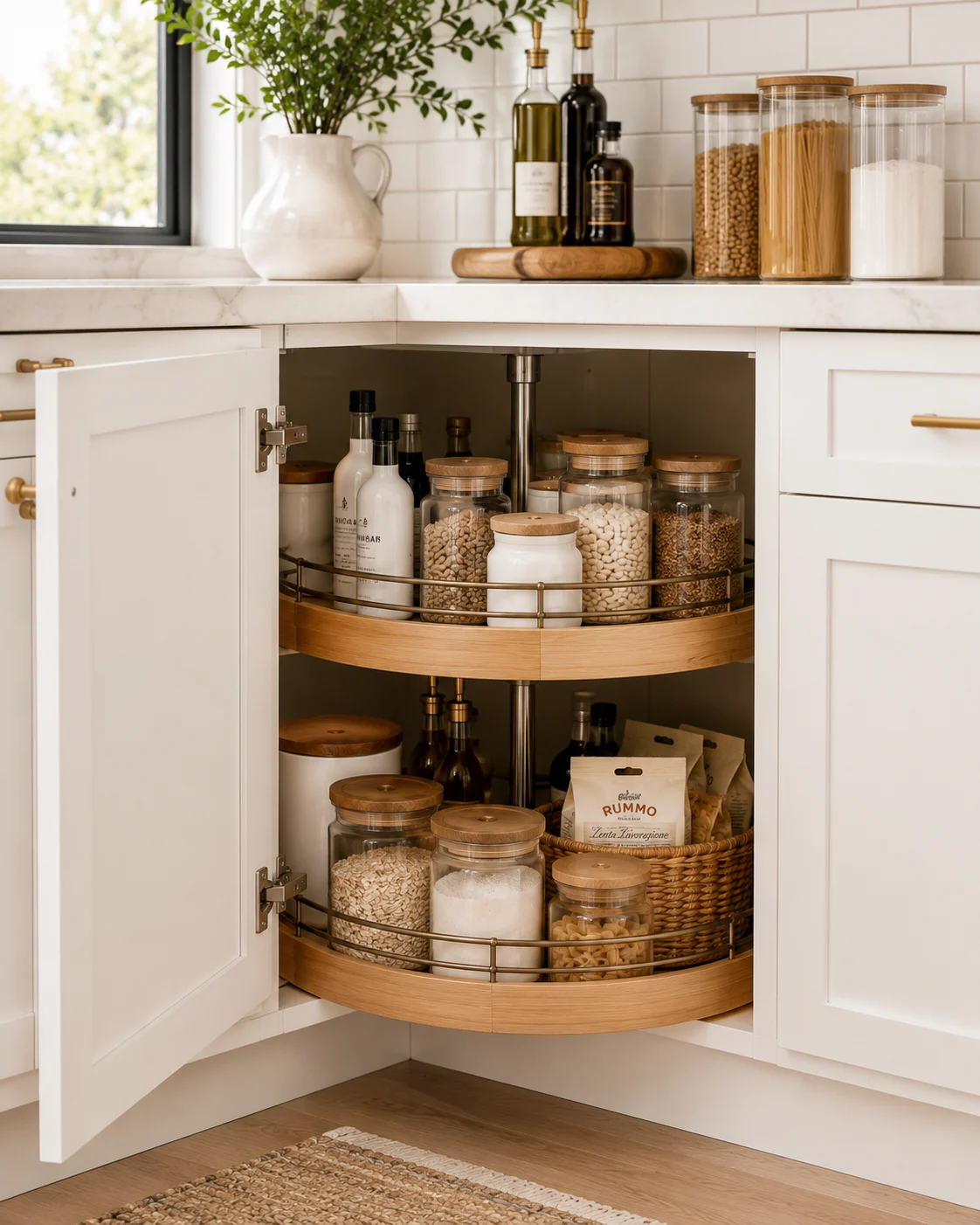
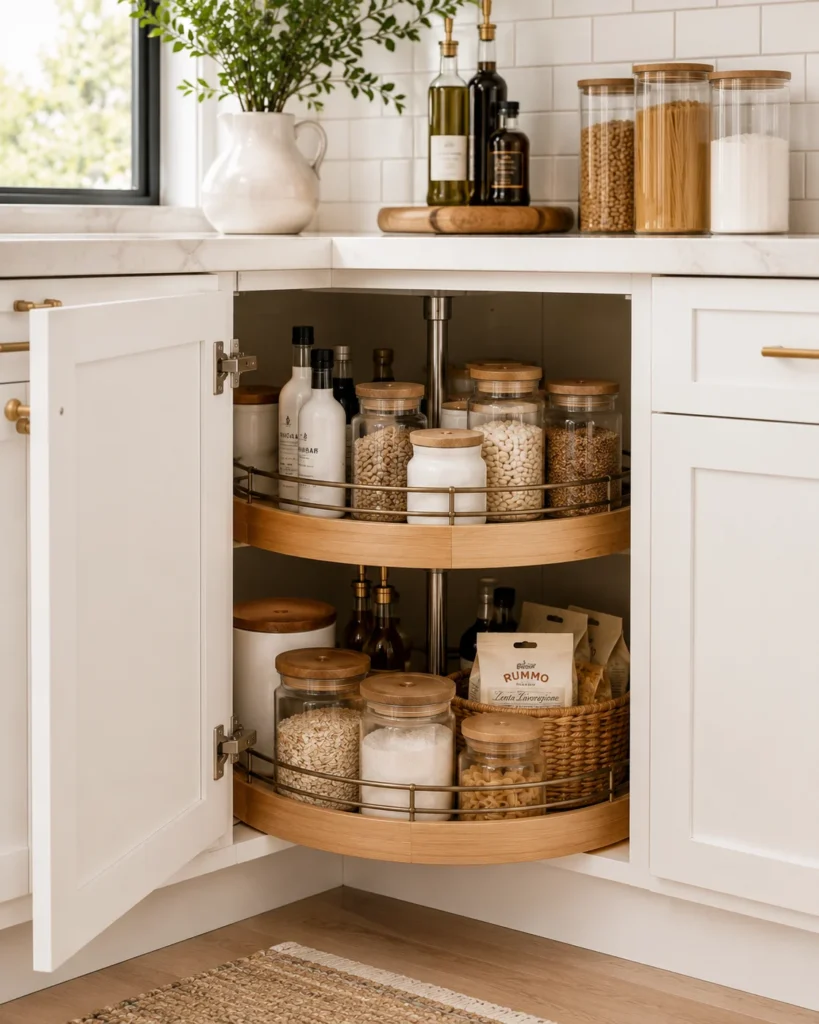
8. Maximize Corner Cabinets
Corner cabinets can offer generous storage, but their unusual shape often makes items difficult to reach.
A rotating organizer, lazy Susan, or purpose-built pull-out system can bring stored items toward the cabinet opening.
Before choosing a product, measure the actual opening as well as the interior. Cabinet doors, hinges, and the shape of the corner can affect which organizers will fit.
Rotating shelves are useful for pantry ingredients, bowls, and selected cookware. More elaborate pull-out systems may suit deeper corners where ordinary shelves leave large areas difficult to access.
Place heavier items on lower, properly supported levels and avoid arranging tall bottles where they may strike the cabinet frame during rotation.
The best corner organizer is one you can operate comfortably without unloading surrounding items first.
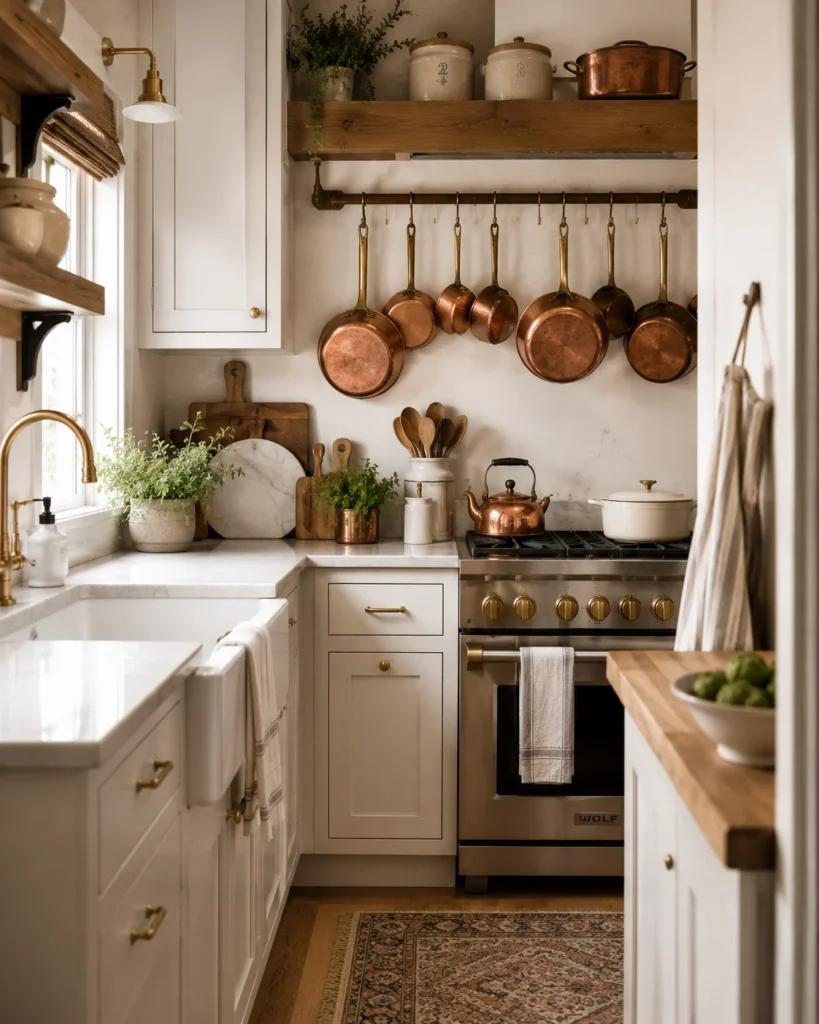
9. Hang Pots and Pans
A wall-mounted pot rack can free valuable cabinet space while keeping frequently used cookware accessible.
Choose a sturdy rail or rack that fits an available section of wall. Simple metal designs work well in contemporary kitchens, while darker finishes can complement rustic or traditional cabinetry.
Arrange pans according to how often they’re used and consider the length of their handles. Hanging cookware should remain easy to remove without knocking into adjacent items.
Select mounting hardware appropriate for the wall and the combined weight of the cookware. Heavy pans require secure support rather than lightweight decorative hooks.
Avoid positioning racks where cookware interferes with cooking, walking, cabinet doors, or cleaning.
If wall space is limited, a compact rack holding only your most frequently used pans may be more practical than displaying the entire collection.
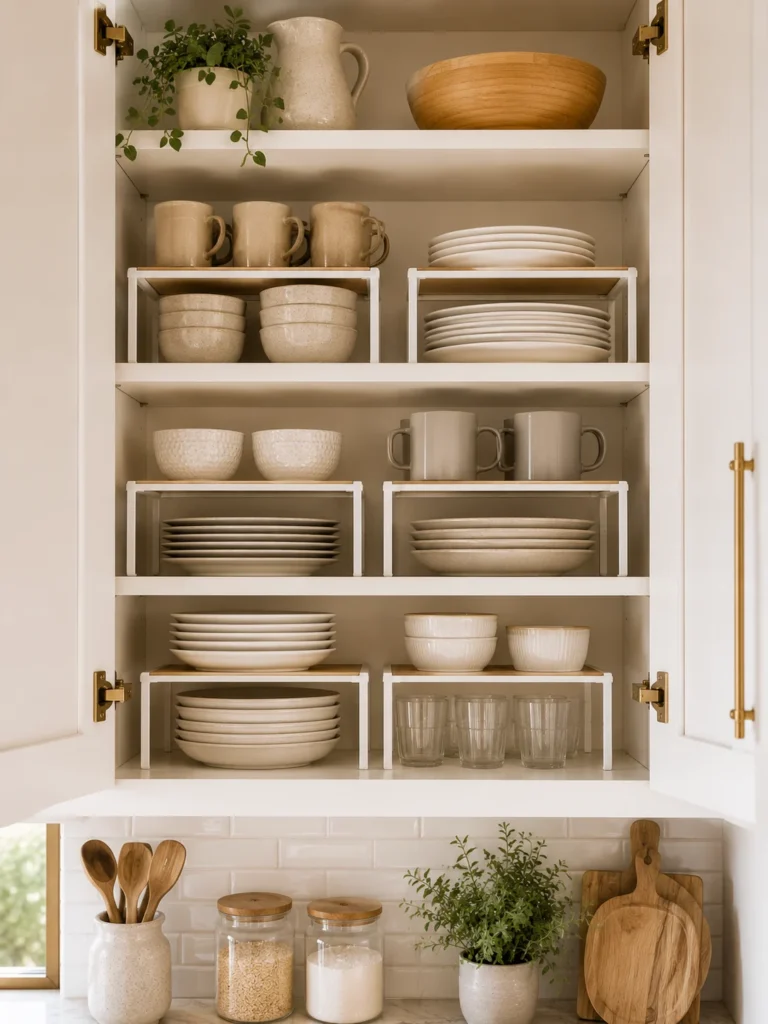
10. Use Stackable Shelf Risers
Shelf risers help make use of vertical space inside cabinets that contain relatively short items.
A sturdy riser can separate stacks of plates, bowls, or mugs, making each group easier to reach without creating one tall pile.
Choose a design that fits the cabinet’s width and height while leaving room to remove the stored items. Metal-coated and bamboo-style risers can both work, depending on the finish and construction.
Place heavier dishes beneath the riser and lighter items above when the product is designed for that arrangement.
Avoid stacking multiple risers unless the manufacturer specifically permits it. An unstable tower of organizers defeats the purpose of improving cabinet storage.
Shelf risers are particularly useful in rental kitchens because many designs require no drilling or permanent changes.
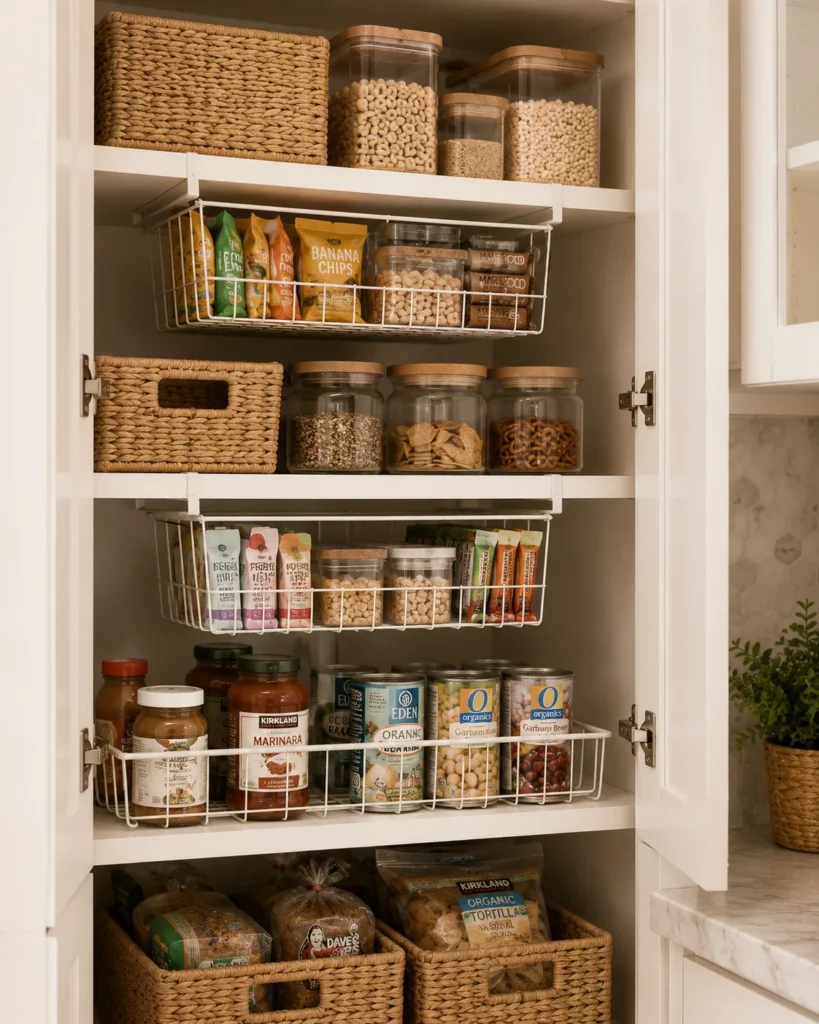
11. Add Under-Shelf Baskets
Under-shelf baskets make use of the space beneath an existing cabinet or pantry shelf.
They are useful for lightweight items such as napkins, tea towels, snack packets, and food-storage bags. Most slide onto the shelf above, creating a small additional storage compartment.
Check the shelf thickness and the clearance beneath it before purchasing a basket. The clips need to fit securely without interfering with items stored on the lower shelf.
Choose baskets that are easy to remove or access during ordinary kitchen use.
Keep the contents light and avoid loading hanging baskets with heavy jars or canned goods. The basket’s attachment and the shelf itself both need to support the stored weight.
This is a practical way to organize small supplies without buying a larger cabinet organizer.
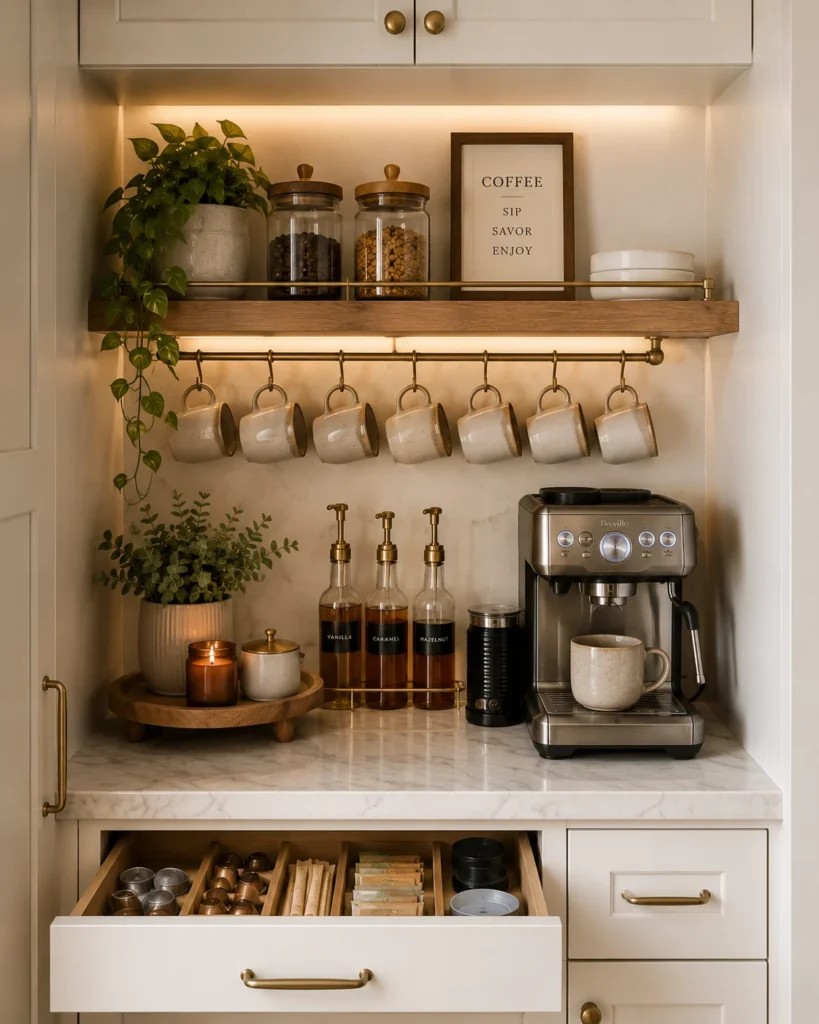
12. Create a Coffee Station
A dedicated coffee station keeps the supplies for your morning routine together rather than scattered across several cabinets and drawers.
Choose a small section of countertop or a suitable cabinet near the equipment you use. Arrange coffee, filters, mugs, and sweeteners in a tray or compact organizer.
If you use a coffee maker or electric kettle, select a location with appropriate access to an outlet and enough space to operate the appliance.
Store less frequently used supplies nearby rather than filling the counter with everything at once. A drawer or small basket can hold extra filters, tea bags, and accessories.
Keep the arrangement easy to wipe clean, especially around appliances that produce moisture or occasional spills.
The best coffee station is functional first and decorative second. A coordinated tray and a few useful containers are often enough to make the area feel organized.
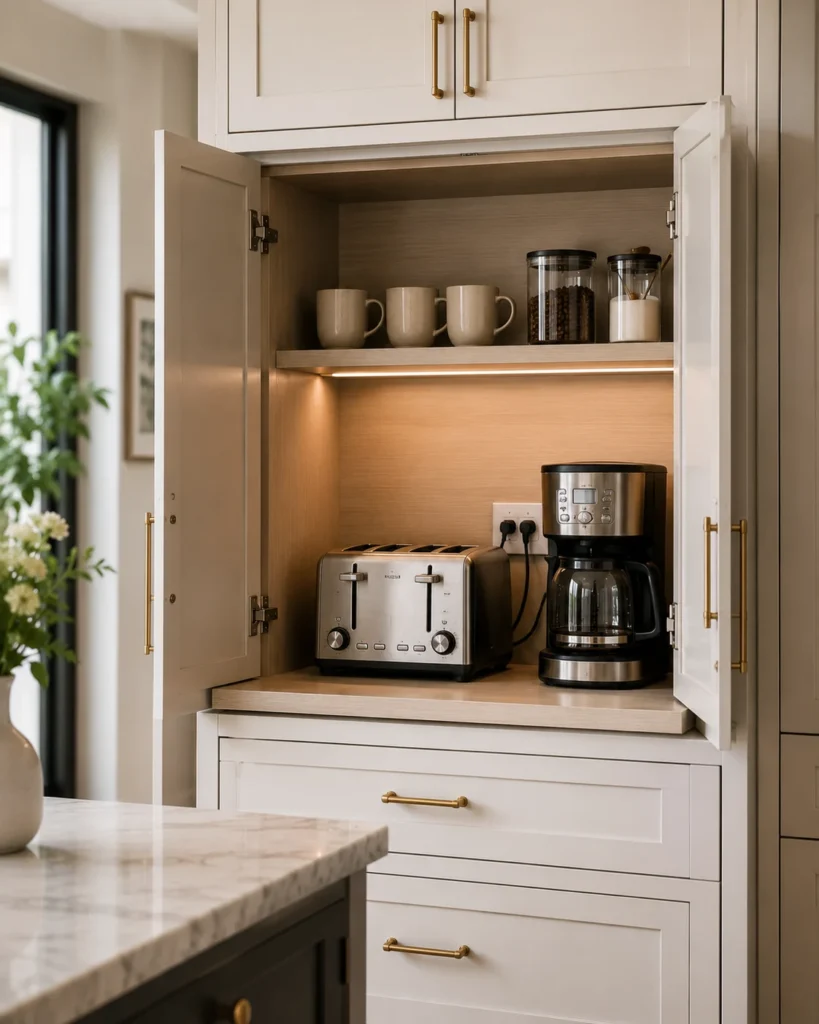
13. Store Appliances in Appliance Garages
Small appliances can consume a surprising amount of countertop space, particularly when several are used regularly.
An appliance garage provides a dedicated storage area for equipment such as a blender, toaster, or stand mixer. Depending on the kitchen, this might be an enclosed countertop cabinet or an accessible section of existing cabinetry.
Choose the location according to the appliance’s dimensions and how often you use it. Frequently used equipment should be easy to retrieve without awkward lifting.
Consider the type of door and how much clearance it needs. Roll-up, lift-up, and hinged designs all affect access differently.
An appliance garage is a storage solution, not automatically a safe place to operate equipment. Many appliances must be pulled out into an open, appropriately ventilated position before use.
Avoid creating an enclosure that hides clutter but makes everyday cooking less convenient.
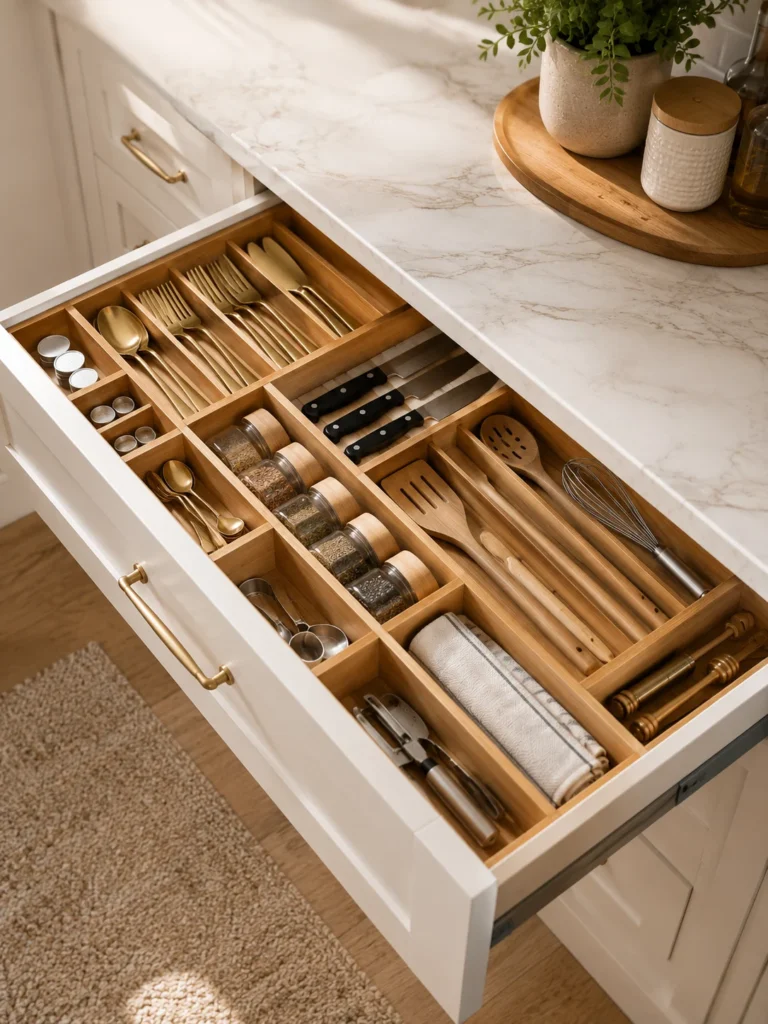
14. Use Drawer Dividers
Drawer dividers can transform a crowded utensil drawer into a set of practical compartments.
Begin by removing everything and grouping utensils according to how they’re used. Keep cooking tools together, separate measuring equipment, and identify gadgets that rarely leave the drawer.
Choose adjustable dividers or trays that fit the drawer’s interior dimensions. Bamboo, plastic, and metal options provide different appearances and cleaning requirements.
Place frequently used utensils toward the front and less common tools toward the back.
Avoid filling every compartment completely. A little spare room makes it easier to remove utensils and return them after washing.
For especially narrow drawers, a few larger sections may be more practical than numerous tiny compartments.
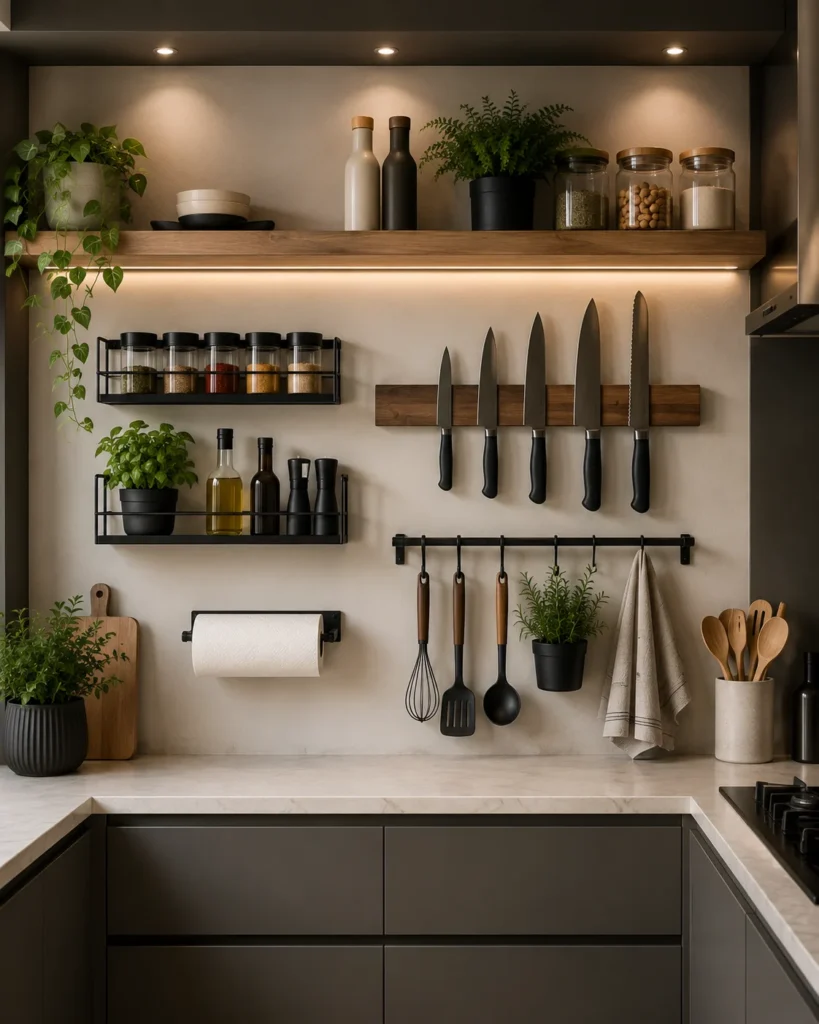
15. Add Magnetic Storage
Magnetic organizers can turn suitable vertical surfaces into storage for knives, spices, or selected utensils.
A magnetic spice rack on the side of a compatible refrigerator may free cabinet space, while a securely installed magnetic knife strip can provide an alternative to a countertop knife block.
Choose the organizer according to the surface and intended contents. Not all refrigerator finishes are magnetic, and a product suitable for lightweight spice containers may not support kitchen knives.
Consider the location carefully. Knives should be mounted securely, away from children’s reach and places where someone might accidentally brush against exposed blades.
Keep magnetic accessories away from hot cooking surfaces and positions where steam, grease, or moisture could affect their condition.
Magnetic storage is most useful when it moves frequently used items into a safe, convenient location rather than simply putting more objects on display.
16. Use Matching Storage Baskets
Storage baskets make it easier to contain the small packets, accessories, and household supplies that tend to spread across kitchen shelves.
Group items by purpose, such as snacks, baking supplies, lunch essentials, or spare towels. Choose baskets that fit comfortably inside the available cabinets or open shelving.
Matching materials or colors can give visible storage a more coordinated appearance, but identical baskets aren’t necessary if different sizes serve different needs.
Use easy-to-clean bins in areas exposed to spills. Natural woven baskets may be better suited to dry, sheltered shelving.
Add labels when several people use the kitchen or when the contents aren’t visible.
For more ideas about using baskets as attractive everyday storage, see 12 Wicker Basket Kitchen Ideas for Beautiful Everyday Storage.
Avoid buying baskets before deciding what belongs inside them. Organize the contents first, then select containers that actually fit.
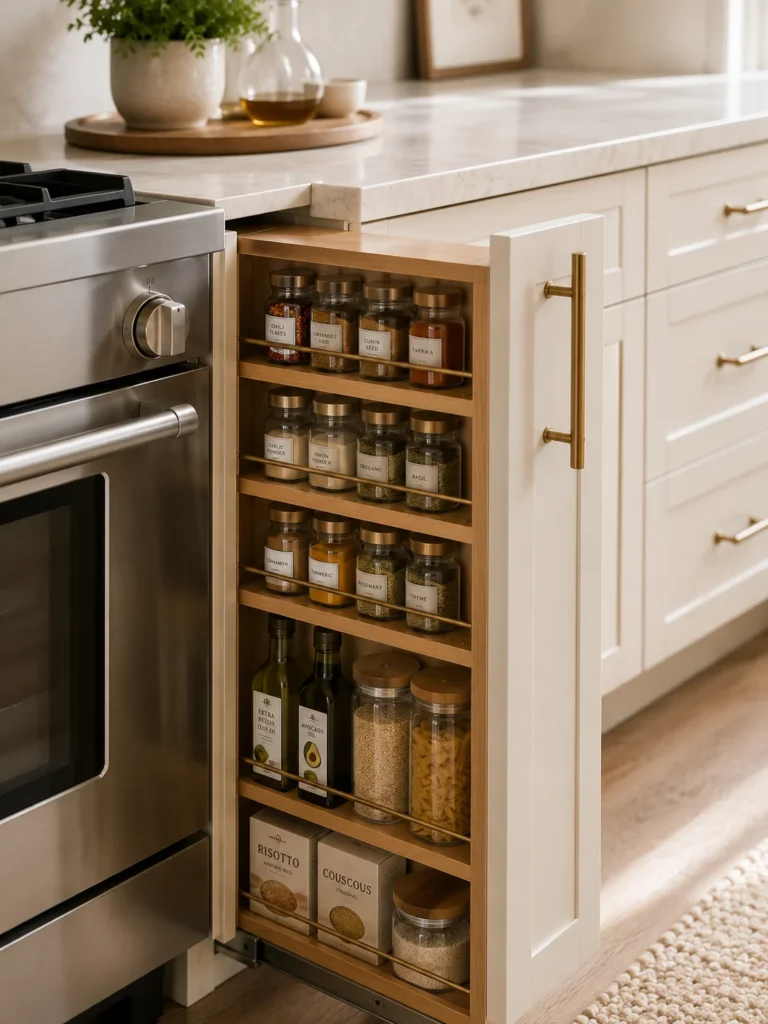
17. Turn Awkward Gaps Into Storage
Narrow spaces between cabinets or beside appliances can sometimes accommodate a slim storage organizer.
A pull-out pantry unit or compact rolling shelf may hold small jars, pantry packets, and other lightweight supplies.
Measure the gap at several points rather than assuming the opening is perfectly even. Account for handles, baseboards, and nearby doors that may interfere with movement.
Choose an organizer that can be pulled out smoothly without rubbing against finished surfaces.
Not every gap should be filled. Refrigerators and other appliances may require clearances for ventilation, servicing, and proper operation.
Use these organizers only where the available space is genuinely suitable. A small gap that must remain open for airflow is not wasted storage space.
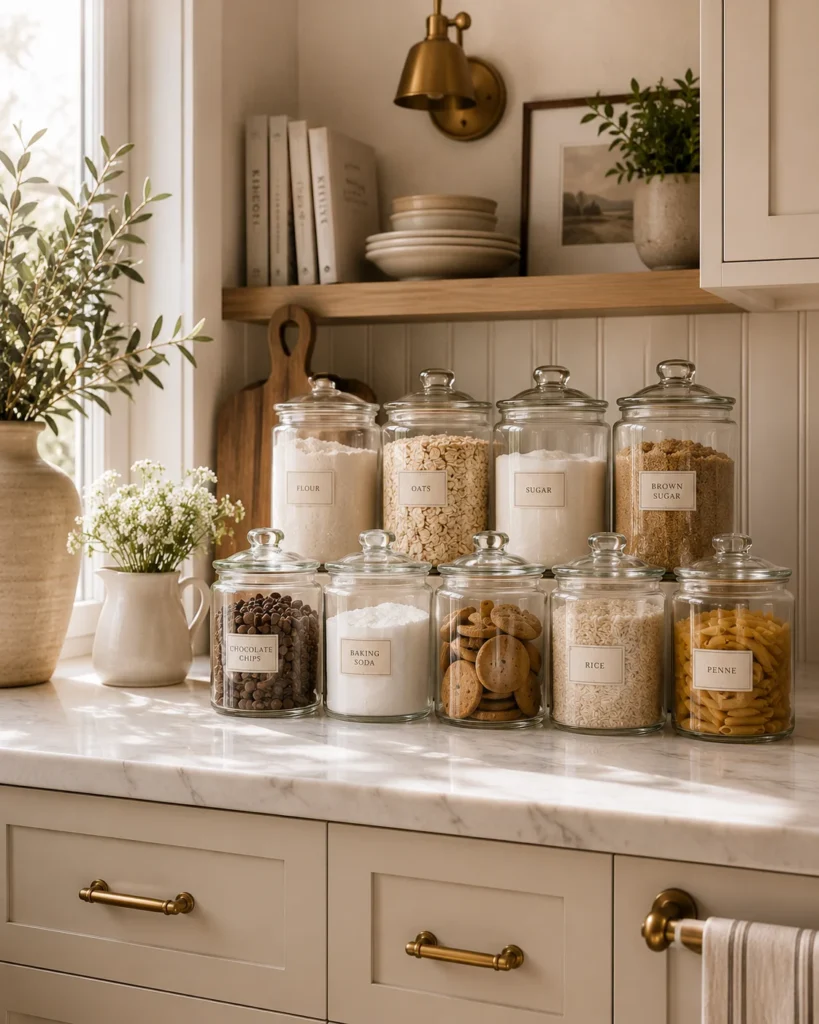
18. Use Glass Jars for Everyday Ingredients
Glass jars can make frequently used dry ingredients easier to identify while creating an attractive arrangement on open shelves.
Choose food-safe jars with lids suited to the ingredients you’re storing. Wide openings are useful for scooping flour, oats, rice, and other pantry staples.
Arrange the jars according to how often you use them. Everyday ingredients belong within comfortable reach, while occasional baking supplies can occupy less prominent positions.
Label the contents clearly and retain relevant packaging information, including dates and allergen details.
Glass containers can become heavy when filled, so keep larger jars on stable, easily accessible shelves rather than high overhead storage.
Unlike the broader pantry-container approach in idea two, this idea focuses on attractive glass storage for ingredients you use regularly.
A small collection of useful jars often looks more intentional than transferring every ingredient into matching glassware.
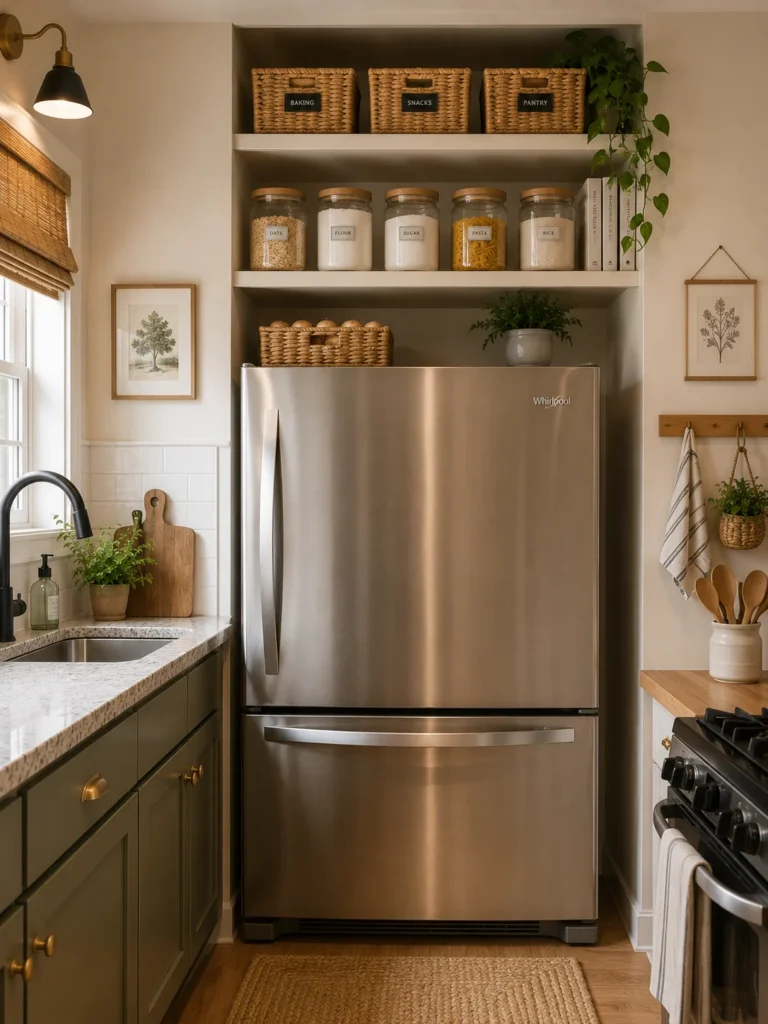
19. Add Open Shelving Above the Refrigerator
The area above the refrigerator may offer extra storage when the kitchen has limited cabinet space.
A properly supported shelf can hold lightweight, infrequently used supplies such as spare paper products, empty serving baskets, or occasional kitchen accessories.
Before planning the shelf, check the refrigerator manufacturer’s clearance and ventilation requirements. Some appliances need open space above or around the unit.
Consider accessibility as well. High shelving is generally unsuitable for heavy cookware, fragile objects, or items needed every day.
Choose a shelf depth that doesn’t make access awkward or interfere with refrigerator doors and surrounding cabinets.
If the space is appropriate, coordinated lightweight baskets can help keep the storage visually organized.
Avoid treating every empty area above an appliance as available shelving space. Appliance function and safe access take priority.
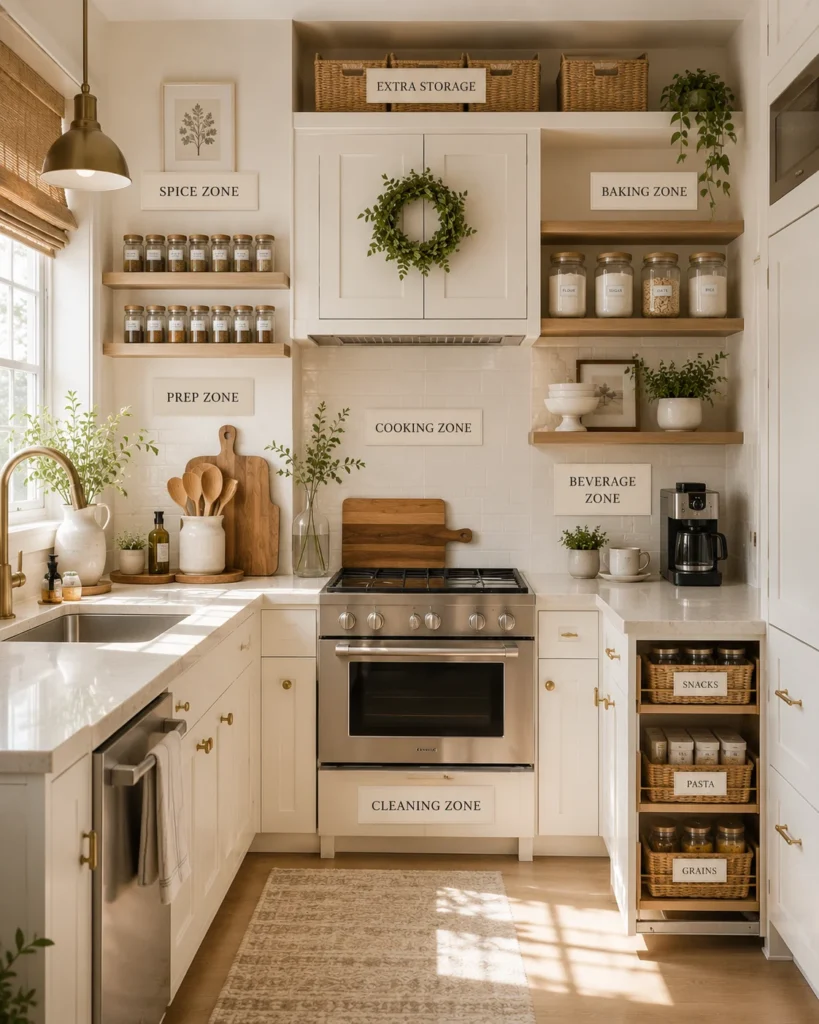
20. Create Zones for Everything
Kitchen storage works best when items are organized around the tasks you perform rather than placed wherever an empty shelf happens to be.
Create practical zones for cooking, baking, food preparation, breakfast, cleaning, and food storage. Keep related supplies close together when the layout allows.
For example, measuring cups and mixing bowls can share a baking area, while food-storage containers may belong near the refrigerator or preparation counter.
Start with one cabinet or drawer at a time. Remove unnecessary items, group the remaining contents, and decide which organizers would make them easier to access.
Use baskets, drawer dividers, and shelf risers only where they improve the arrangement.
Review the layout as your cooking habits change. A storage system should adapt to your household rather than force everyone to follow an inconvenient arrangement.
How to Choose the Best Storage Solutions for a Small Kitchen
Before buying organizers, identify the areas causing the most frustration.
If your lower cabinets are deep and difficult to access, pull-out shelves may be more useful than extra baskets. If drawers are overcrowded, dividers can help separate utensils. If the countertop is the main problem, consider whether appliances or pantry supplies could move into existing storage.
Measure the relevant spaces carefully, including cabinet openings, hinges, shelves, and appliance clearances.
Choose organizers that fit the items you actually own. A product that looks impressive in a photograph may be unsuitable for your cookware, dishes, or cabinet layout.
For related layout inspiration, explore 13 Small Island Kitchen Ideas That Make the Most of Limited Space.
Small Kitchen Storage Ideas for Renters
Renters can improve kitchen storage without making extensive permanent changes.
Freestanding shelf risers, drawer dividers, under-shelf baskets, pantry containers, and suitable rolling carts are good starting points.
Removable organizers can also make cabinet doors and shelves more useful, provided the products are compatible with the surfaces and don’t damage the cabinetry.
Avoid drilling into walls or cabinets without checking your lease and obtaining permission where required.
If permanent shelving isn’t an option, concentrate on making existing cabinets more efficient before introducing additional furniture.
Common Small Kitchen Storage Mistakes
One common mistake is buying matching organizers before measuring cabinets or sorting their contents. This often produces containers that look coordinated but don’t fit the available space.
Another is storing heavy items overhead. Even a sturdy shelf may be inconvenient when large cookware or filled glass jars must be lifted down regularly.
Overcrowding open shelves can also make a small kitchen feel busier. Leave enough space to remove dishes and clean the surrounding surfaces.
Finally, avoid adding storage that interferes with cooking. A hanging pot rack, rolling cart, or wall shelf should improve access without creating new obstacles.
Kitchen Storage Safety and Installation
Follow the manufacturer’s installation instructions and load ratings for shelves, racks, pull-out organizers, and wall-mounted accessories. Use fixings appropriate for the wall or cabinet construction, and seek qualified installation help where needed.
Keep storage away from burners, hot appliances, and other heat sources unless the product is specifically suitable for that location. Maintain required appliance ventilation and service clearances.
Do not operate heat-producing appliances inside enclosed storage cabinets unless the appliance and enclosure are expressly designed for that use.
Store heavy cookware and filled glass containers on stable, accessible shelves. Secure tall furniture and freestanding storage units against tipping when appropriate, particularly in homes with children.
Keep sharp knives safely mounted or stored, and separate cleaning chemicals from food and food-preparation supplies.
Use food-safe containers for ingredients, maintain original allergen and date information, and follow appropriate food-storage practices.
Finally, keep doors, walkways, and kitchen work areas clear. Additional storage should never make the room harder to move through or use safely.
Keeping a Small Kitchen Organized Over Time
Once you’ve improved the layout, simple habits can help prevent clutter from returning.
Return frequently used items to their designated zones, check pantry supplies before shopping, and periodically remove tools or containers that no longer serve a purpose.
Resist filling every newly available shelf immediately. Some spare space makes it easier to put groceries away and accommodate changes in your routine.
A small kitchen doesn’t need endless storage products to work well. Thoughtfully chosen organizers, accessible cabinets, and a logical arrangement of everyday essentials can make limited space easier to manage while keeping the room comfortable for cooking.
