
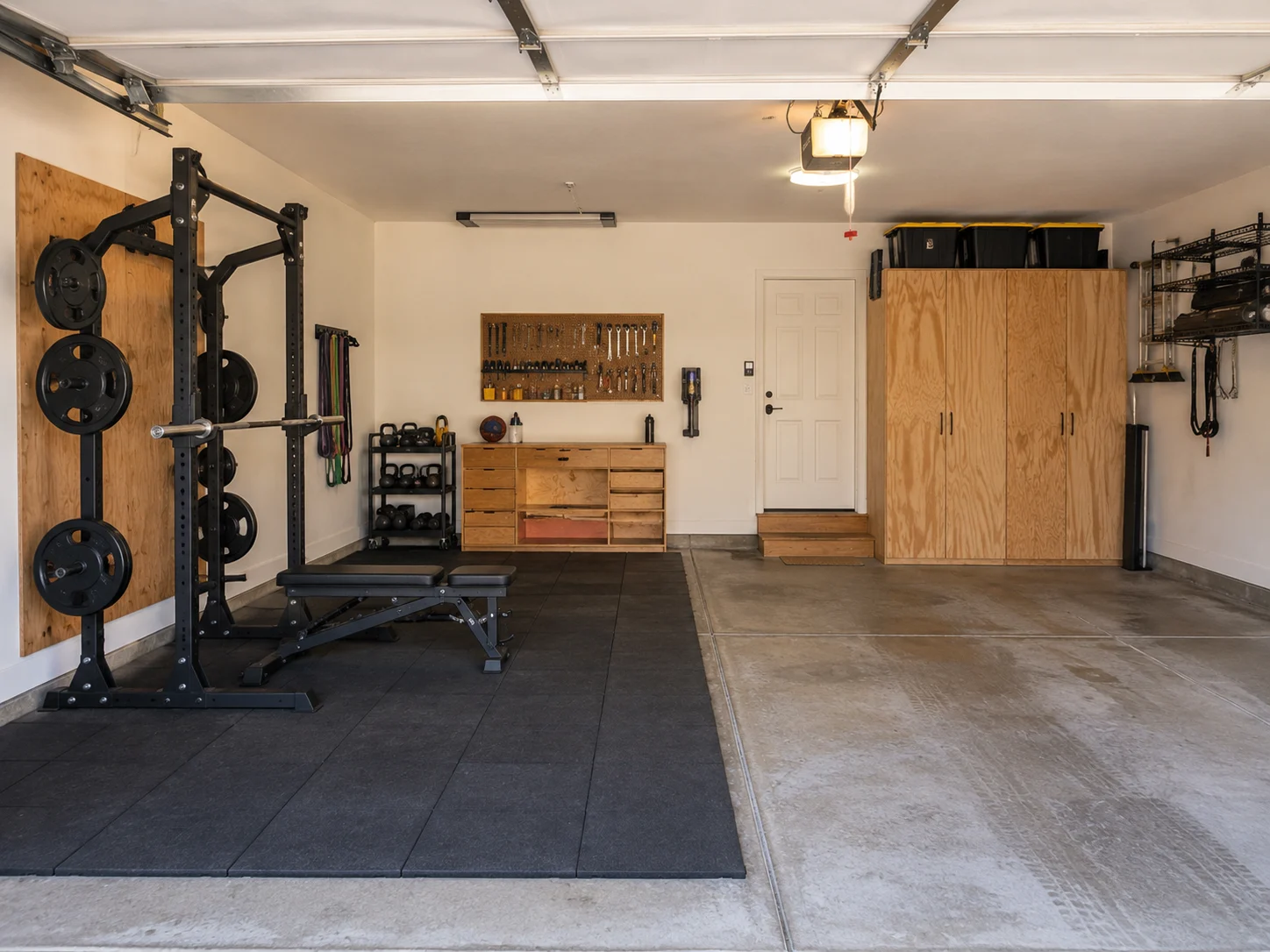
17 Garage Gym Ideas That Turn an Ordinary Garage Into a Functional Home Gym
A garage gym doesn’t need expensive machines, dramatic black walls, or enough equipment to fill a commercial fitness studio. Even a modest one-car garage can become a practical workout space when the layout is planned around the exercises you actually do.
The biggest challenge is making everything fit without sacrificing safety or movement. Weight racks need room for loading and lifting. Cardio machines require adequate clearance. Flooring must suit the equipment, and storage shouldn’t interfere with garage doors, electrical panels, or walking routes.
A good garage gym also needs comfortable lighting, ventilation, and temperature control. These details may not be as exciting as a new weight bench, but they can make a significant difference to how often you use the space.
Whether you’re converting an entire two-car garage or setting aside one corner for exercise, these 17 garage gym ideas offer practical ways to organize equipment, improve comfort, and create a functional workout area without unnecessary clutter.
1. Create a Simple One-Car Garage Gym
A one-car garage can accommodate a useful home gym without becoming crowded with equipment.
Start by deciding which exercises matter most. If your routine focuses on dumbbells, kettlebells, and bodyweight movements, a compact adjustable bench and a small weight collection may provide everything you need.
Position equipment along one wall and preserve an open area in the center. Where the room allows, a clear space around 6 by 8 feet can provide a starting point for stretching, lunges, and floor exercises. The actual clearance needed depends on your movements and equipment.
Choose flooring appropriate for the workouts you plan to perform. A simple exercise mat may suit mobility work, while strength training with heavy weights may require more substantial flooring.
Use a narrow rack or suitable wall storage for accessories. Avoid spreading weights, bands, and mats across the floor.
Check garage-door tracks, overhead equipment, and ceiling clearance before buying anything tall.
If the garage also stores household supplies, keep those items in a separate zone so they don’t interfere with training.
Image Prompt: Photorealistic vertical 1000×1500 editorial image of a realistic modest American one-car garage converted into a compact functional home gym, adjustable dumbbells on sturdy low rack, adjustable workout bench, appropriately installed rubber gym flooring, open central exercise space, simple wall hooks for light accessories, standard residential garage door and visible tracks with safe clearances, realistic 8-foot ceiling, bright even overhead lighting, clean practical non-luxury setting, no people, readable text, logos or watermark.

2. Dedicate One Bay of a Two-Car Garage to Training
You don’t need to convert an entire two-car garage to create a comfortable workout space.
One bay can remain dedicated to parking or household storage while the other becomes a defined exercise area.
Use rubber flooring to visually separate the gym from the remaining concrete. Keep the gym equipment within that boundary instead of allowing benches and weights to spread toward the parked vehicle.
Place a compact rack or weight station against the outer wall, leaving adequate clearance for exercise.
If you use a barbell, remember that a typical Olympic bar is approximately 7.2 feet long. You’ll also need additional room at both ends for loading plates.
Position storage so the parked car’s doors can open without striking equipment.
Wall-mounted organizers can hold resistance bands, collars, and other lightweight accessories, while properly rated storage should be used for heavy plates.
The most practical layout is one that allows both activities to happen without constantly rearranging the garage.
Image Prompt: Photorealistic vertical 1000×1500 editorial image of a modest American two-car garage with one clearly defined gym bay featuring black rubber flooring, compact squat rack, weight bench and secure plate storage, adjacent bay retaining practical parking space with a generic ordinary sedan, safe separation between vehicle and gym equipment, realistic 8-foot ceiling, garage door tracks unobstructed, even overhead lighting, attainable residential proportions, no people, readable text, logos or watermark.

3. Turn a Full Two-Car Garage Into a Flexible Home Gym
A full two-car garage offers enough space for several types of exercise, but filling every corner with equipment can make it less functional.
Divide the room into three main areas: strength training, cardio, and open-floor movement.
Position larger strength equipment along one side. A treadmill or stationary bike can occupy another section, while the center remains available for stretching, kettlebells, and bodyweight exercises.
Install suitable flooring in each zone rather than assuming one material will meet every requirement.
Keep the largest machines away from the garage-door operating path. Check the height and movement of overhead tracks, door panels, and openers.
Wall storage can help consolidate accessories without creating additional floor obstacles.
If you’re permanently converting the entire garage, consider improving lighting, insulation, ventilation, and electrical capacity before investing in more equipment.
The aim is to create a flexible room that accommodates different workouts comfortably, not to recreate a crowded commercial gym.
Image Prompt: Photorealistic vertical 1000×1500 editorial image of a realistic ordinary American two-car garage converted into a functional home gym with clearly separated strength area containing squat rack and bench, compact stationary bike along opposite wall, open central stretching area, appropriate rubber flooring, secured wall storage, standard garage door tracks with safe overhead clearances, realistic residential 8-foot ceiling, bright even ceiling lighting, practical non-luxury materials, no people, readable text, logos or watermark.
4. Build the Layout Around a Squat Rack or Power Rack
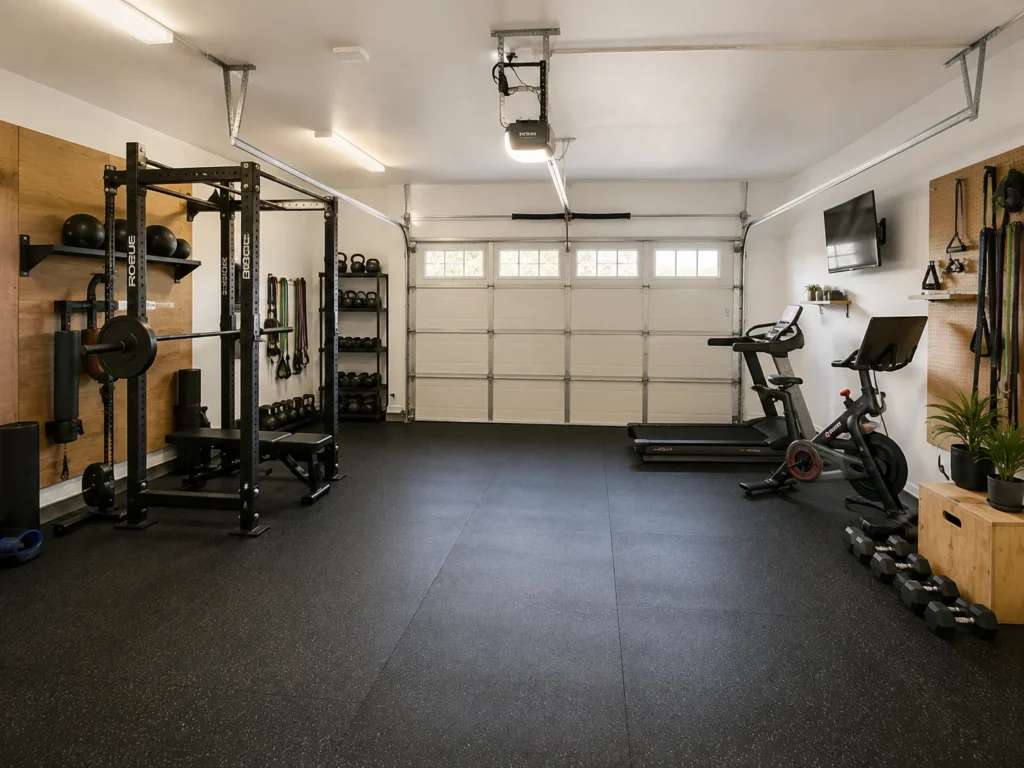
If barbell training is central to your workouts, plan the entire gym around the squat rack.
A power rack requires more space than its basic footprint suggests. You need room for the rack, barbell, weight plates, bench, and safe movement around the equipment.
Many residential racks are approximately 4 feet wide and 4–6 feet deep, but dimensions vary considerably. Always use the manufacturer’s actual measurements.
Check the ceiling height before purchasing. Pull-ups, overhead presses, and other exercises may require more clearance than the rack itself.
Garage-door tracks and openers can also interfere with tall equipment, even when the rack appears to fit with the door closed.
A folding wall-mounted rack may suit a shared garage, but it must be compatible with the wall structure and installed according to the manufacturer’s specifications.
Choose suitable safety bars or spotter arms and use the rack as instructed.
A properly planned rack area is more useful than an oversized setup that leaves no room for loading plates or moving safely.
Image Prompt: Photorealistic vertical 1000×1500 editorial image of a modest American garage gym focused on one sturdy correctly installed power rack with barbell, safety bars, adjustable bench, securely stored weight plates and thick suitable rubber flooring, generous barbell loading clearance on both sides, overhead garage-door track safely away from rack, realistic 8-foot ceiling with verified equipment clearance, neutral gray walls, bright even lighting, no people, readable text, logos or watermark.
5. Create a Dumbbell-Focused Strength Wall
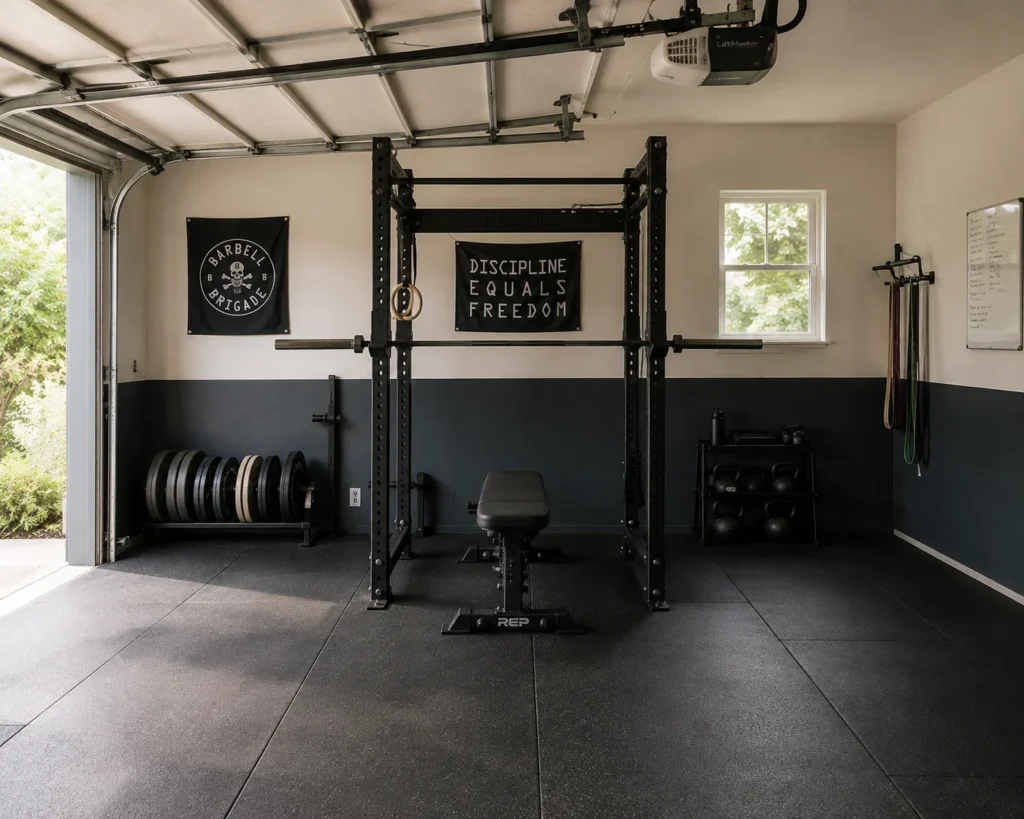
A dumbbell-focused setup can provide a wide range of strength exercises while occupying less space than a full barbell station.
Arrange adjustable dumbbells or a limited selection of fixed weights along one wall. Position an adjustable bench nearby and leave enough floor space for standing and seated exercises.
If you use fixed dumbbells, choose a sturdy rack designed for the weight and quantity you own.
Keep heavier dumbbells on lower levels and avoid placing equipment on unsuitable decorative shelving.
A securely mounted mirror may be useful for checking positioning during certain exercises. It doesn’t need to cover the entire wall.
Use a small pegboard or drawer for resistance bands, lifting straps, and other accessories.
For a narrow garage, adjustable dumbbells can be particularly helpful because they replace several pairs of individual weights.
This arrangement works well for general strength training without requiring a complicated room layout.
Image Prompt: Photorealistic vertical 1000×1500 editorial image of a realistic modest American garage gym with compact dumbbell strength wall, sturdy low rack holding neatly arranged dumbbells, adjustable black workout bench, one securely mounted mirror positioned away from impact zone, narrow pegboard holding light accessories, black rubber floor tiles, medium-gray walls, realistic 8-foot ceiling, even overhead lighting and open exercise clearance, no people, readable text, logos or watermark.
6. Move Storage Onto the Walls
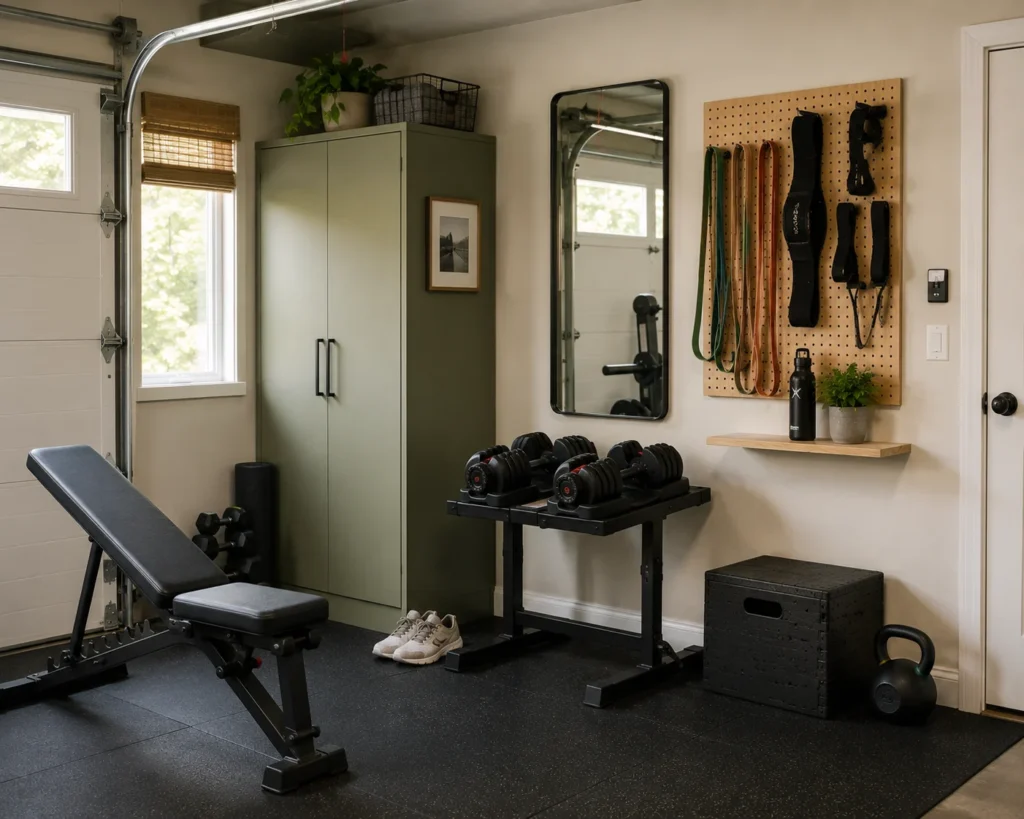
Wall storage can make a garage gym feel more organized while preserving valuable floor space.
Start with lightweight items such as resistance bands, jump ropes, lifting straps, and exercise mats.
A securely installed pegboard or hook rail can keep these accessories visible and easy to retrieve.
Heavier equipment requires specialized storage. Weight plates, barbells, and kettlebells should be placed on racks or mounts specifically rated for their loads.
Position frequently used accessories at comfortable heights. Avoid creating a system that requires a step stool every time you need a resistance band.
For vertical barbell storage, check that there is sufficient overhead clearance to remove and replace the bars safely.
Keep storage away from electrical panels, outlets, doors, and emergency access routes.
A simple arrangement of sturdy shelves, rated mounts, and a few accessory hooks can be more effective than a large collection of decorative organizers.
Image Prompt: Photorealistic vertical 1000×1500 editorial image of a modest American garage gym featuring an organized storage wall with structurally secured purpose-rated plate and barbell holders, pegboard for lightweight resistance bands and jump ropes, vertical exercise mat storage, sturdy low shelving, rubber flooring, clear open workout area, electrical panel unobstructed, realistic 8-foot ceiling, bright practical lighting, no people, readable text, logos or watermark.

7. Install Flooring That Matches How You Train
Garage gym flooring should be selected for the exercises and equipment it needs to support.
For stretching and yoga, a suitable exercise mat may be enough. For strength training, rubber tiles or rolls can provide a more durable surface.
Interlocking tiles are often convenient for smaller spaces because they can be installed in sections. Rubber rolls may create fewer seams in larger workout areas.
Heavy lifting can require thicker impact-resistant flooring or a dedicated lifting platform, depending on the loads and equipment.
Before installing anything, inspect the concrete for moisture problems. Covering damp concrete without addressing the cause can trap moisture beneath the flooring.
Also consider the garage slab’s slope. Many garage floors slope toward the door or a drain, and placing rubber tiles over the concrete doesn’t make the surface level.
Equipment that requires a level base should be installed according to its manufacturer’s instructions.
Choose flooring based on performance, stability, maintenance, and compatibility with the space rather than appearance alone.
Image Prompt: Photorealistic vertical 1000×1500 editorial image of an ordinary American garage gym showing professionally neat black interlocking rubber floor tiles covering a defined strength-training zone, compact weight bench and securely stored dumbbells, adjacent exposed clean concrete demonstrating distinct flooring zones, standard residential garage structure, realistic 8-foot ceiling, bright overhead lighting, dry clean floor with no standing moisture, no people, readable text, logos or watermark.

8. Give Cardio Equipment Its Own Corner
Cardio equipment works best when it has a clearly defined location with sufficient space for safe use.
Choose one machine that suits your routine rather than filling the garage with several pieces that rarely get used.
A stationary bike may be practical in a compact garage, while a treadmill generally requires more room and careful clearance planning.
Always follow the manufacturer’s specified space requirements, particularly behind and around a treadmill.
Consider ceiling height as well. The treadmill deck raises the user above the floor, and movement during exercise requires additional clearance.
Position cardio equipment where it can be accessed without stepping over weights or moving benches.
Keep power cords away from walking routes and avoid relying on unsuitable extension cords as a permanent electrical solution.
A small fan may improve comfort, provided it remains stable and doesn’t obstruct the machine.
Image Prompt: Photorealistic vertical 1000×1500 editorial image of a modest American garage gym with a compact stationary exercise bike in its own clearly defined cardio corner, suitable rubber flooring, small safely positioned fan, nearby secure accessory shelf, open access around equipment, ordinary garage walls and standard garage door, realistic 8-foot ceiling, bright even lighting, no loose electrical cords, no people, readable text, logos or watermark.

9. Use Folding and Adjustable Equipment in a Shared Garage
A garage that serves several purposes benefits from equipment that can be stored compactly.
An adjustable bench can support multiple exercises without requiring several separate benches.
Adjustable dumbbells can replace a long rack of fixed weights, while a properly installed folding rack may free up floor space when not in use.
Choose equipment that is genuinely easy to adjust or store. If every workout requires a lengthy setup process, the room may become frustrating to use.
Give each item a designated storage location.
For example, the bench might stand in an approved storage position against one wall, while dumbbells sit on a compact rack.
Keep parking, bicycles, and household supplies in their own defined zones.
A folding gym setup should make the garage more convenient, not create a situation where heavy equipment must be moved through narrow walkways before every workout.
Image Prompt: Photorealistic vertical 1000×1500 editorial image of a modest shared-use American garage with a structurally secured folding squat rack in properly stowed position against one wall, compact adjustable dumbbell stand, adjustable bench stored according to manufacturer instructions, black rubber workout zone, neatly organized household storage on separate wall, open central floor, realistic 8-foot ceiling, standard garage door, bright overhead lighting, no people, readable text, logos or watermark.
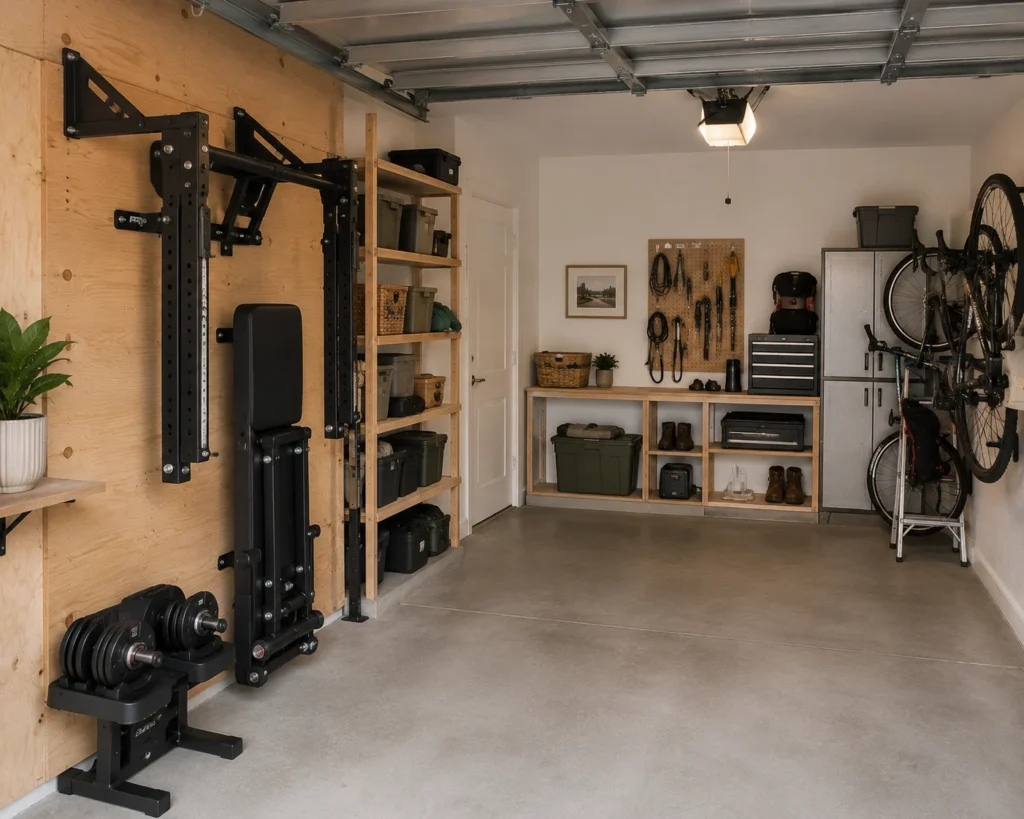
10. Make a Dark Garage Feel Like an Intentional Moody Home Gym
A moody garage gym can look polished without painting every surface black.
Choose charcoal or deep gray for one main wall, then keep the remaining walls or ceiling lighter to preserve brightness.
Black exercise equipment and rubber flooring will naturally coordinate with the darker palette.
Introduce a little warm wood through shelves or a compact storage cabinet to soften the industrial appearance.
Lighting is particularly important. Dark walls absorb more light, so use evenly distributed overhead fixtures rather than relying on a single central bulb.
A properly installed mirror can reflect light and make the room feel more open, but it shouldn’t replace adequate illumination.
Choose washable, durable finishes where appropriate. Chalk, dust, and equipment marks may be especially visible against dark paint.
This approach works best when the room feels intentional and practical rather than dramatically dark.
Image Prompt: Photorealistic vertical 1000×1500 editorial image of a realistic modest American moody garage gym with one charcoal accent wall, remaining walls light warm gray, black power rack and bench, rubber flooring, compact medium-walnut storage cabinet, one securely mounted mirror, bright evenly distributed ceiling lights, realistic 8-foot ceiling, visible ordinary garage construction, clear training space, no people, readable text, logos or watermark.
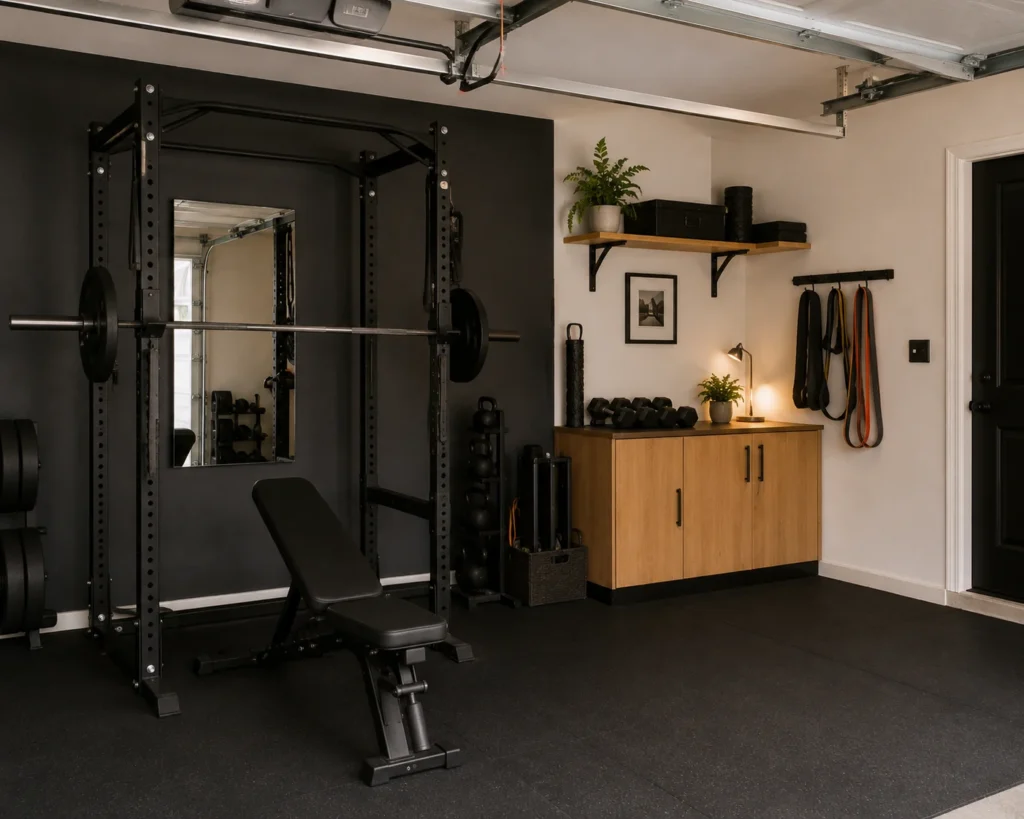
11. Add Mirrors Without Turning the Garage Into a Fitness Studio
A mirror can be useful in a garage gym, but you don’t need an entire mirrored wall.
One appropriately positioned panel can provide visual feedback for certain movements while making the space feel brighter.
Place the mirror where it won’t be struck by barbells, plates, dumbbells, or other equipment.
Think about the full range of movement during exercise, not just where the equipment sits when stored.
A smaller mirror or a simple grid of securely installed panels may be more affordable than a large custom mirror.
Mounting is especially important because large mirrors can be heavy. Use suitable materials and fixings for the wall construction and mirror weight.
Consider lighting reflections as well. A mirror directly opposite a bright overhead fixture may produce distracting glare.
For a compact gym, one well-placed mirror often provides enough function without adding unnecessary visual complexity.
Image Prompt: Photorealistic vertical 1000×1500 editorial image of a modest American garage gym with one large securely mounted rectangular wall mirror positioned safely beside an open mobility area and away from weight impact zones, adjustable dumbbell stand on opposite wall, neutral gray paint, black rubber flooring, realistic 8-foot ceiling, bright glare-controlled overhead lighting, practical residential proportions, no people, readable text, logos or watermark.
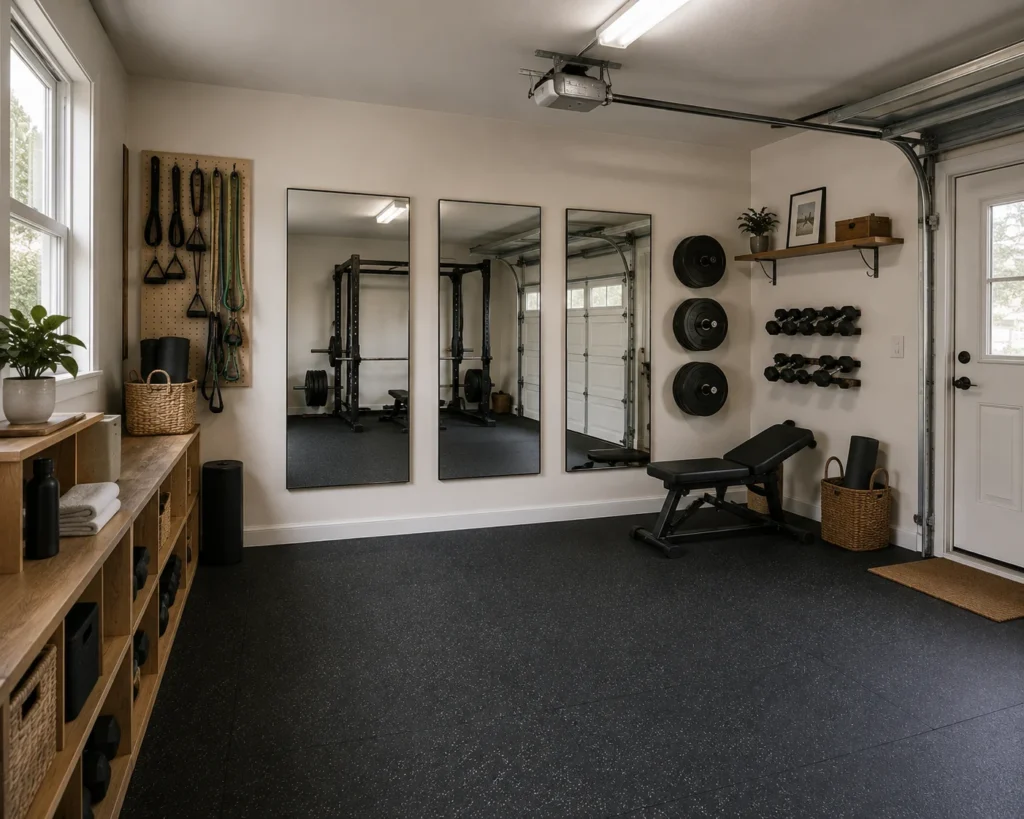
12. Keep a Clear Mobility and Stretching Zone
An open floor area may be one of the most valuable features in a garage gym.
Reserve enough space for stretching, mobility exercises, and bodyweight movements without needing to rearrange heavy equipment.
A standard exercise mat can help define the area, but remember to allow additional room for arms and legs to extend.
Position the stretching zone away from sharp rack corners, unstable equipment, and weight storage.
Keep foam rollers, yoga blocks, resistance bands, and mats in a nearby basket or wall organizer.
The storage should be close enough to use conveniently without occupying the exercise area.
If the garage is warm, a suitably positioned fan can make floor exercises more comfortable.
Resist the temptation to fill every remaining corner with another machine. Open floor space makes the gym more adaptable and easier to use.
Image Prompt: Photorealistic vertical 1000×1500 editorial image of a modest American garage gym with generous clear mobility area, one flat exercise mat on suitable rubber flooring, foam roller and yoga blocks neatly stored in a low basket beside wall, strength equipment positioned safely farther away, light neutral walls, realistic 8-foot ceiling, bright overhead lighting, uncluttered practical residential setting, no people, readable text, logos or watermark.
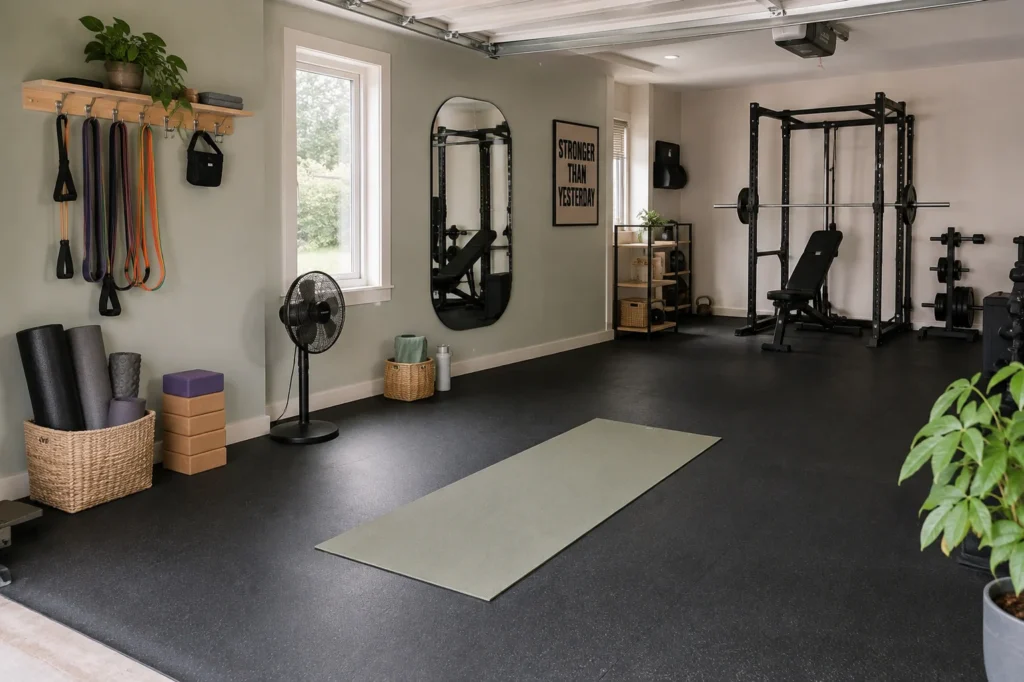
13. Upgrade the Lighting for Early-Morning and Evening Workouts
Many garages have basic lighting intended for parking and storage rather than exercise.
A functional gym needs enough illumination to see equipment, floor surfaces, and moving parts clearly.
Use several evenly distributed ceiling fixtures where appropriate instead of relying on one very bright bulb in the center.
Position lights to reduce shadows around the weight rack, bench, cardio machine, and stretching area.
Neutral-white lighting can create a practical workout environment, although personal preference and the existing room finishes also matter.
Avoid placing fixtures where they interfere with garage-door movement or tall equipment.
Supplemental lighting may be useful, but cords should never cross exercise routes.
If additional circuits or permanent electrical changes are required, use a qualified professional and follow applicable requirements.
Good lighting makes the room easier to use and maintain, regardless of the decorating style.
Image Prompt: Photorealistic vertical 1000×1500 editorial image of a modest American garage gym with multiple professionally installed evenly spaced flush or low-profile ceiling LED fixtures providing bright neutral-white illumination across dumbbell bench, rack and open exercise floor, light-gray walls, black rubber flooring, realistic 8-foot ceiling, garage-door tracks and opener safely clear of fixtures, no loose wires, no people, readable text, logos or watermark.
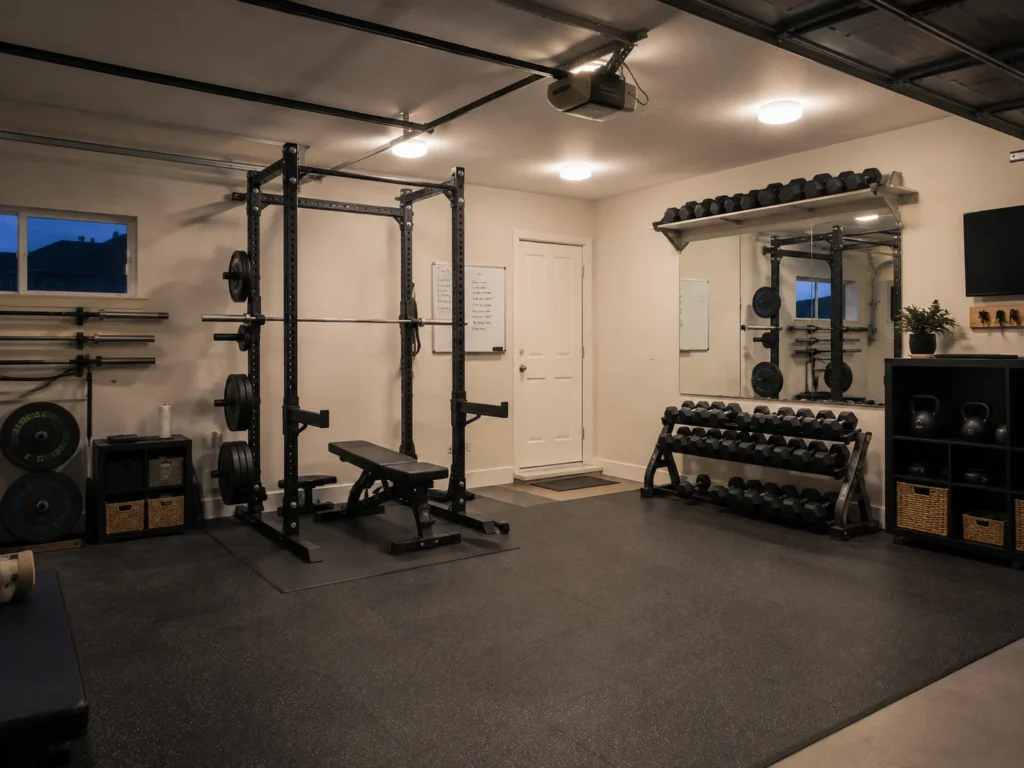
14. Plan for Heat, Cold, Ventilation, and Humidity
Temperature and air quality can determine whether a garage gym is comfortable throughout the year.
In warm weather, a suitable fan may improve air circulation. Position it where it won’t obstruct movement or create a tripping hazard.
In colder climates, insulation and appropriate heating may be more important.
The correct approach depends on the garage’s construction, climate, and local building requirements.
Address moisture problems before installing flooring or expensive equipment. Damp conditions can contribute to corrosion and deterioration.
Wipe down benches, barbells, and other equipment after workouts, and follow the manufacturer’s maintenance recommendations.
Opening the garage door may provide ventilation in suitable conditions, but weather, security, insects, and outdoor air quality can make that impractical.
Avoid exercising in a garage while a vehicle engine, generator, or other fuel-burning equipment is operating. Carbon monoxide and other exhaust pollutants can create serious hazards.
Permanent heating, cooling, ventilation, or electrical improvements should be properly assessed and installed.
Image Prompt: Photorealistic vertical 1000×1500 editorial image of a realistic modest American garage gym with compact wall-mounted ventilation equipment professionally installed, safely positioned freestanding fan, dry clean rubber flooring, neatly stored weights, insulated-looking but ordinary residential walls, standard garage door, realistic 8-foot ceiling, bright natural and overhead lighting, no vehicles running, no heaters near combustible materials, no people, readable text, logos or watermark.
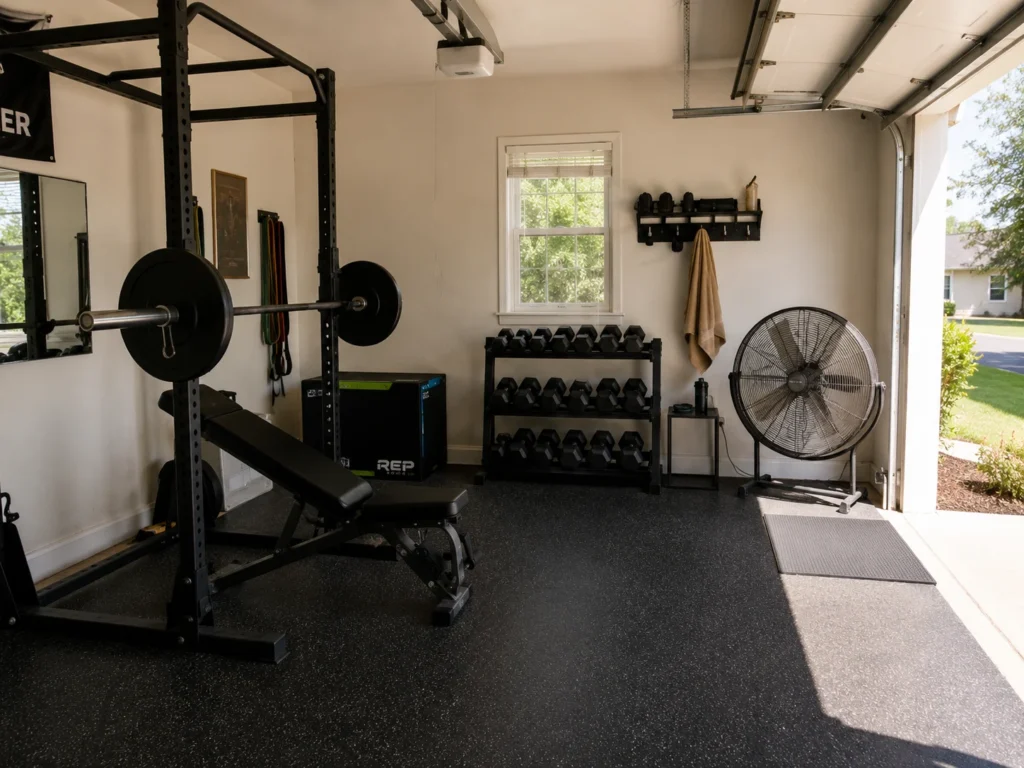
15. Add a Compact Wellness Cabinet
A small cabinet can keep recovery and cleaning supplies organized without requiring a dedicated wellness room.
Choose a sturdy stock cabinet or utility cupboard that fits along an unused wall.
Use it to store clean towels, resistance bands, massage balls, wipes, and lightweight accessories.
Keep frequently used items within easy reach and place less frequently needed supplies on higher shelves.
A small ventilated laundry basket beside the cabinet can hold used towels until they’re washed.
Choose a cabinet finish that coordinates with the gym. Warm wood can soften a gray-and-black space, while a neutral painted cabinet can blend into the wall.
Avoid turning the cabinet into an oversized refreshment station with unnecessary appliances.
A simple storage unit can make the garage gym feel more organized and comfortable while keeping everyday supplies off the bench and floor.
Image Prompt: Photorealistic vertical 1000×1500 editorial image of a modest American garage gym with compact medium-walnut stock utility cabinet against warm-gray wall, cabinet partly open showing neatly folded clean towels, resistance bands and foam-rolling accessories, small ventilated laundry basket beside cabinet, nearby rubber exercise flooring and workout bench, realistic 8-foot ceiling, even overhead lighting, no people, readable text, logos or watermark.
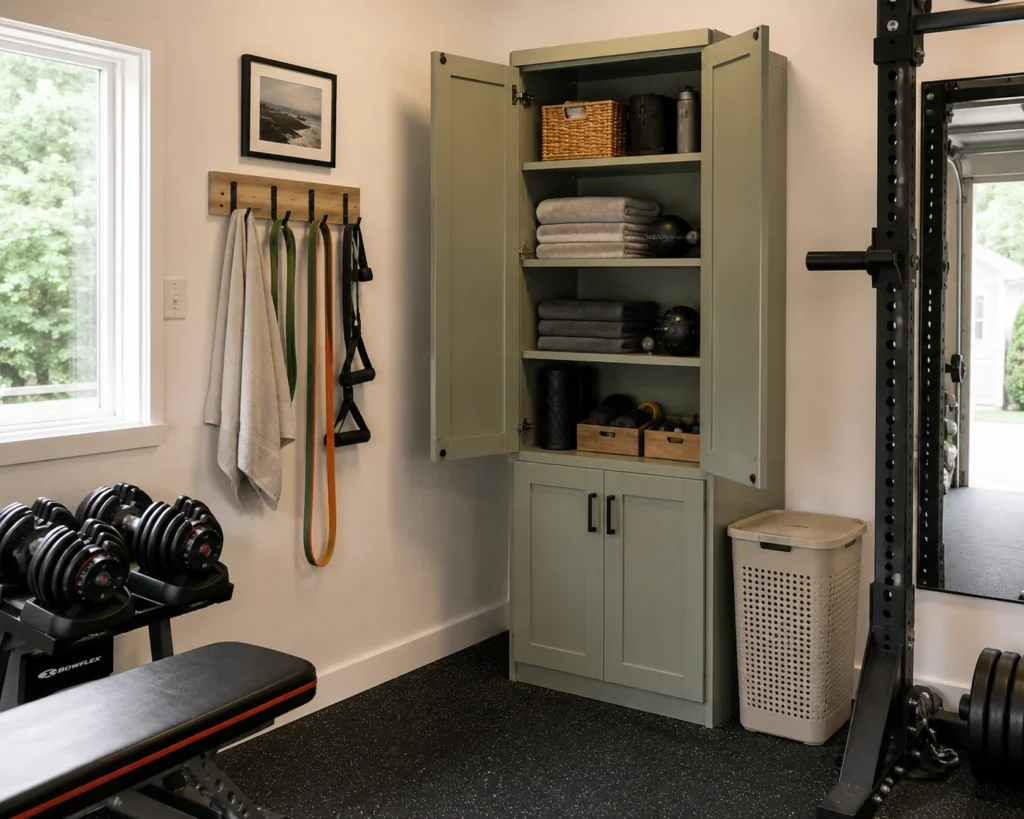
16. Add a Sauna or Recovery Corner Only If the Garage Can Support It
A sauna can be an appealing addition to a home gym, but it requires considerably more planning than a bench or storage cabinet.
Start by determining whether the garage has enough room for the sauna and the required surrounding clearances.
The installation must not block the garage door, exits, electrical panels, or workout circulation.
Different sauna types have different electrical, ventilation, temperature, and moisture requirements.
Review the manufacturer’s specifications and applicable local building and electrical requirements before purchasing.
If the garage already has humidity or condensation problems, address those issues first.
A sauna should not be connected through improvised extension cords or installed without suitable electrical and structural planning.
For many ordinary garages, a simpler recovery corner may be the better choice.
A sturdy bench, stretching mat, foam roller, clean towels, and fan can create a useful space without requiring a major renovation.
Image Prompt: Photorealistic vertical 1000×1500 editorial image of a realistic modest American garage gym featuring a compact practical recovery corner rather than luxury spa, sturdy wooden bench, neatly rolled exercise mat, foam roller, towel shelf and safely positioned fan, black rubber flooring, light warm-gray walls, strength equipment visible farther away, realistic 8-foot ceiling, bright even lighting, clear access to garage door and electrical panel, no people, readable text, logos or watermark.
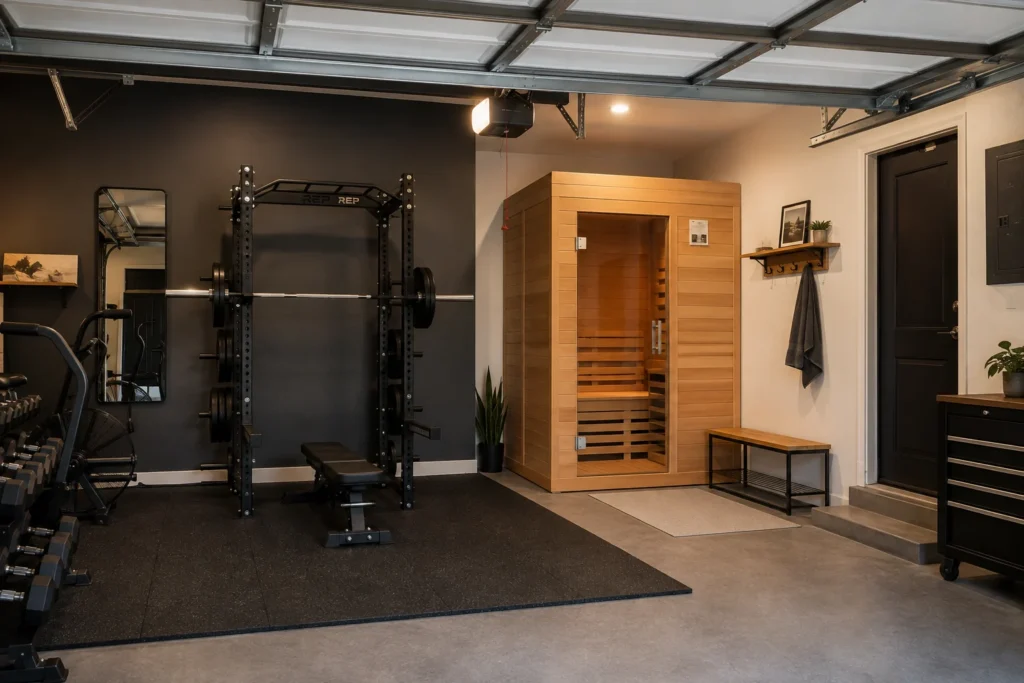
17. Finish the Garage Gym With Practical Everyday Organization
A garage gym is only as functional as its everyday storage system.
Give each piece of equipment a designated place based on how often you use it.
Frequently used dumbbells should remain near the training area. Resistance bands can hang on suitable hooks, while weight plates belong on properly rated racks.
Store exercise mats vertically or in a suitable container to keep them off the floor.
Use a small washable tray or shelf for workout shoes and a ventilated basket for used towels.
If the garage also stores household supplies, organize those items separately from the gym.
Keep cleaning products securely stored, especially if children can access the garage.
Avoid positioning heavy overhead storage above benches, racks, or areas where people exercise.
Leave some unused floor and wall space. That flexibility makes it easier to clean, move equipment, and adjust the layout as your routine changes.
Image Prompt: Photorealistic vertical 1000×1500 editorial image of a realistic modest American garage gym showing completed everyday organization, secure dumbbell and weight plate racks, resistance bands on sturdy hooks, vertical mat storage, low shoe tray, ventilated towel basket, compact cleaning cabinet, neatly separated household storage, clear rubber-floored workout area, standard garage door and realistic 8-foot ceiling, bright even lighting, no people, readable text, logos or watermark.

How to Plan a Garage Gym Layout
Before buying equipment, measure the usable floor area and ceiling height.
Account for the garage door in both its open and closed positions, including tracks, springs, and the opener. Check the locations of electrical panels, outlets, windows, and other fixed features.
Then make a list of the exercises you perform regularly.
For strength training, prioritize safe weight storage, a suitable bench or rack, and enough room for the full range of movement.
For cardio, allow the clearances required by the equipment manufacturer.
For stretching and mobility, preserve an open floor area where you can extend your arms and legs comfortably.
Mark the proposed equipment footprints on the floor with painter’s tape before making large purchases.
This simple step can reveal clearance problems that aren’t obvious when looking at product photos.
Garage Gym Flooring Options
| Flooring type | Best suited for | Main consideration | |—|—|—| | Exercise mat | Stretching, yoga, floor exercises | Not intended for heavy weight impacts | | Interlocking rubber tiles | Small to medium workout zones | Check thickness, stability, and seam fit | | Rubber rolls | Larger exercise areas | Requires careful installation and moisture assessment | | Heavy-duty gym tiles | More demanding strength areas | Select for actual equipment and impact loads | | Dedicated lifting platform | Certain barbell lifting setups | Requires suitable design, stability, and clearances |
The right flooring depends on the exercises, weights, existing concrete, and equipment requirements.
Do not assume that rubber flooring will correct a sloped slab or protect against every type of impact.
Budget-Friendly Garage Gym Priorities
A functional garage gym can be built gradually.
Start with the equipment you will use most often. For many general fitness routines, adjustable dumbbells, a suitable bench, a mat, and a small amount of storage may be enough.
Add appropriate flooring and lighting before purchasing larger machines.
If you train primarily with barbells, prioritize a suitable rack, safety equipment, and secure plate storage.
Avoid buying several inexpensive machines simply because they fit the available budget. Equipment that occupies floor space without supporting your routine can make the gym less useful.
Secondhand equipment may offer value, but inspect its condition carefully and verify that all necessary components, safety features, and instructions are available.
Spend money first on stability, appropriate installation, and equipment that suits your training.
Garage Gym Safety and Maintenance
Inspect the garage before converting it into a workout area.
Check for water intrusion, uneven surfaces, damaged concrete, electrical hazards, and inadequate ventilation.
Keep garage-door tracks, springs, and moving components unobstructed. Do not attach exercise equipment to garage-door hardware or other structures that are not designed to support it.
Install racks, shelves, and heavy storage according to the manufacturer’s specifications. Use appropriate structural mounting and professional assistance when required.
Maintain safe clearances around cardio equipment, weight racks, and exercise areas.
Keep exits, electrical panels, and walking routes accessible. Store household chemicals, fuel, and other hazardous materials securely and away from the training area.
Never operate a vehicle engine or fuel-burning appliance in an attached garage while using it as a gym.
Inspect weights, benches, racks, flooring, and electrical equipment regularly. Clean sweat from equipment and address corrosion or damage promptly.
For permanent conversions, check applicable local building, electrical, ventilation, and fire-safety requirements before making changes.
Final Thoughts
A successful garage gym isn’t defined by how many machines it contains or how dramatic it looks in photographs.
It’s a space that supports your workouts comfortably and safely.
Start with the exercises you enjoy, choose equipment that fits, and protect enough floor space to move freely.
Appropriate flooring, secure storage, good lighting, and comfortable ventilation will often improve the gym more than additional decorative features.
Whether you use one wall of a single-car garage or convert an entire two-car space, a thoughtful layout can turn an ordinary garage into a home gym that remains practical long after the initial makeover.
