

19 Corner Fireplace Ideas With Stone Mantels for a Cozy Living Room
The best corner fireplace ideas solve more than the fireplace itself. A corner unit creates an angled focal point, which means the stone, mantel, hearth, furniture, TV, and nearby walls all have to work together. If one piece is out of scale, the fireplace can feel either too small for the room or oddly dominant.
A useful rule is to design the wall, mantel, hearth, and furniture layout as one composition.
The stone should give the angled wall enough visual weight, but not so much that a standard-height room feels crowded. The mantel needs to extend far enough to anchor the firebox without becoming a bulky shelf. The hearth should feel connected to the fireplace while leaving enough floor space to move comfortably. Furniture should acknowledge the corner without forcing every seat to stare directly into it.
The good news is that many corner fireplaces don’t need a complete rebuild. A better mantel, lighter stone, a simplified hearth, more thoughtful furniture placement, or restrained mantel styling can change the entire room.
Here are 19 ways to make a corner fireplace feel intentional, cozy, and easier to live with.
19 Corner Fireplace Ideas With Stone Mantels for a Cozy Living Room
1. Pair Warm Gray Stacked Stone With a Thick Oak Mantel
A thick oak mantel over warm gray stacked stone gives an angled fireplace enough visual weight to hold its own without making the corner feel dark. Wrap the fireplace face in medium-scale ledgestone, then use a natural-oak beam that extends visibly beyond the firebox on both sides.
Keep the hearth low and relatively shallow. A simple rectangular stone slab works better in a modest living room than an oversized raised platform projecting deep into the seating area.
Place the sofa parallel to the room’s main wall rather than aiming it directly at the fireplace. Add one compact accent chair angled toward the fire so the fireplace remains part of the conversation zone.
This works because the stone creates architectural presence while the oak softens its hard texture.
For mantel styling, use one dominant framed artwork and one small grouping of a vase and candle, leaving the rest of the beam exposed.
Full-height stacked stone isn’t necessary here. Stopping the stone at a proportionate upper wall or mantel zone can keep an eight-foot ceiling from feeling overloaded.
Any mantel clearances and stone installation around an operating fireplace need to follow the fireplace manufacturer’s requirements and applicable local codes.

2. Use Pale Limestone in a Small Living Room
A small living room benefits from a corner fireplace that has texture without excessive visual weight. Pale limestone or limestone-look stone can give the angled wall enough definition while reflecting more light than dark stacked stone.
Use creamy stone around the firebox and continue it upward only as far as the room can comfortably support. Add a medium-thick oak mantel with a simple square profile rather than a heavily distressed beam.
A low flush or near-flush hearth helps preserve floor space. In a 12-by-14-foot room, every extra few inches projecting from the corner affects how naturally a chair or coffee table can sit nearby.
For furniture, place a compact sofa on the main wall and float one small chair opposite it, turning the chair slightly toward the fireplace.
This arrangement lets the fireplace participate in the room without becoming the only focal direction.
A pale stone fireplace also works well with warm beige upholstery, olive accents, and brass or black lighting.
Keep mantel decor minimal: one mirror or artwork plus one smaller object. A highly textured stone wall already creates plenty of visual movement.

3. Give a Rustic Fieldstone Fireplace a Reclaimed-Look Mantel
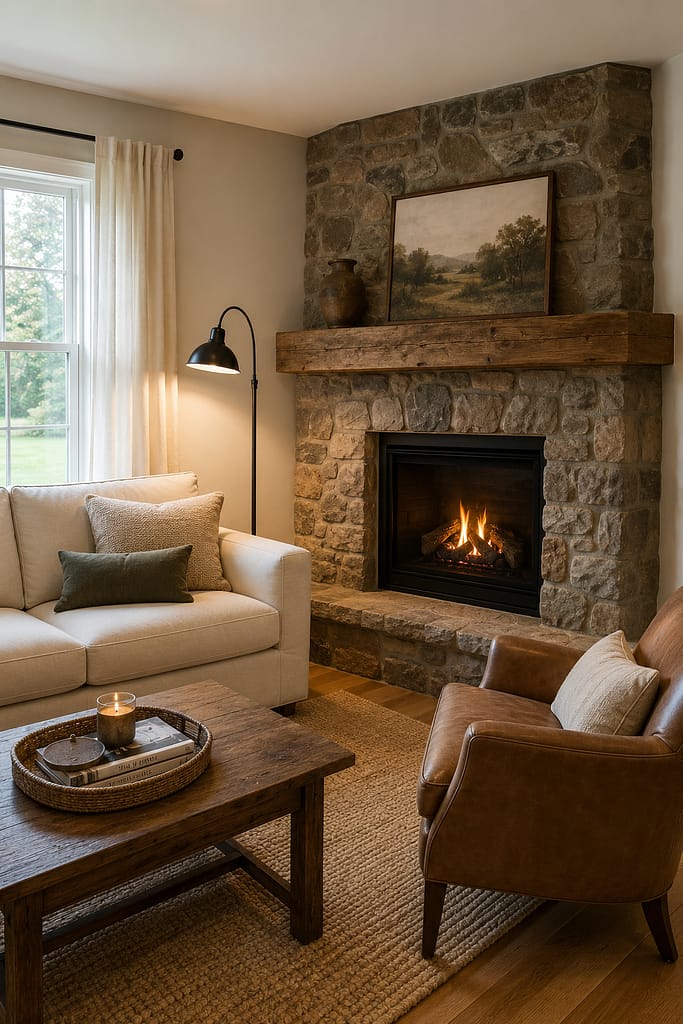
A rustic corner stone fireplace works best when the stone looks varied but the rest of the room remains controlled. Use irregular fieldstone in warm gray, taupe, and muted brown, then anchor it with a reclaimed-look timber mantel.
The beam should be substantial enough to stand up to the rougher stone, but it doesn’t need to look as though it came from a giant lodge. In a normal residential living room, moderate thickness looks more believable.
Pair the fireplace with linen upholstery, a natural woven rug, and medium-brown wood furniture. A black iron floor lamp or small aged-metal accent can reinforce the rustic direction without turning the room into a theme.
Position the sofa slightly off-axis from the fireplace and use one chair closer to the corner. This makes conversation more comfortable than arranging every seat in a semicircle around the fire.
A low stone hearth can continue the rough material without taking over the floor.
For styling, one pottery vessel and one framed landscape are enough. Rough fieldstone already supplies strong texture, so a crowded mantel can make the corner feel visually noisy.
4. Try a Light Farmhouse Fireplace With Whitewashed Stone
A farmhouse corner fireplace doesn’t need distressed signs or layers of rustic decor. Light stone, warm white walls, a simple wood mantel, and black accents are usually enough.
Use whitewashed or pale beige stacked stone around the angled fireplace and pair it with a medium-oak mantel. A simple black firebox surround adds definition and keeps the light materials from blending together.
For the hearth, use a shallow stone slab that follows the fireplace footprint without creating an oversized platform.
Arrange the furniture so the sofa remains aligned with the main room architecture. One black-framed or wood-framed chair can turn toward the corner to visually connect the seating area.
This approach works because the fireplace feels farmhouse-inspired through material contrast rather than themed accessories.
Keep the mantel especially simple: one large neutral artwork, one small vase, and visible empty space.
If the room is small, avoid extending whitewashed stone from floor to ceiling unless the ceiling and wall proportions support it. Even light stone can become visually heavy when it covers too much of a narrow angled wall.

5. Use a Traditional Painted Mantel Over Warm Stone
A traditional corner fireplace can feel more substantial when the mantel visually frames the stone rather than sitting like a narrow shelf above the firebox.
Use warm beige limestone or ledgestone around the opening, then add a painted warm-white mantel with simple side trim and a modest shelf. The trim should follow the fireplace angle cleanly rather than pretending the wall is flat.
A low rectangular hearth in the same stone keeps the base grounded.
Pair the fireplace with tailored furniture: a neutral sofa, two smaller chairs, and a classic rug with muted blue or rust. The furniture doesn’t have to be perfectly symmetrical, but it should feel balanced from the main seating position.
One framed painting above the mantel and a small pair of candlesticks can work better than a row of accessories.
Traditional styling is especially useful if an existing builder-grade corner fireplace feels too visually small. Expanding the mantel’s apparent width can help the whole corner feel more architecturally finished.
Avoid an excessively deep mantel shelf on a narrow angled wall; it can project awkwardly into the room.

6. Make a Small Gas-Log Fireplace Feel More Substantial
A compact gas-log unit can look undersized in a corner if the surround stops too close to the firebox. The solution isn’t necessarily a larger fireplace; it’s giving the wall around it enough architectural presence.
Use light gray ledgestone extending beyond the gas insert, then add a medium-width oak mantel that visually anchors the full fireplace composition.
A low stone hearth or flush stone floor zone can give the unit a stronger base without occupying too much room.
This is especially effective in a smaller suburban living room where a large masonry-style fireplace would overwhelm the space.
Keep furniture compact. A loveseat on the main wall and two small chairs angled inward can acknowledge the corner while preserving conversation.
A gas fireplace also allows the upper wall to remain relatively simple. One large piece of art above the mantel is usually enough.
Installation, venting, gas connections, mantel clearances, and surrounding materials need to follow the appliance manufacturer’s instructions. Gas work and structural modifications are not casual DIY tasks and may require qualified professionals.

7. Add a Raised Hearth to a Larger Rustic Corner Fireplace
A raised hearth can make a rustic corner fireplace feel grounded, but it needs enough surrounding floor space. In a medium-size living room, use a low raised stone hearth that projects just far enough to look intentional.
Pair it with irregular warm-gray stone and a medium-brown wood mantel. The raised base gives the fireplace a stronger horizontal line and can visually balance the diagonal angle.
Place the sofa parallel to the main wall, then float one chair near the hearth but outside the circulation path. A second chair can face inward from the opposite side.
This layout allows the fireplace to sit naturally within a conversation zone rather than forcing the sofa directly toward the corner.
For mantel decor, use one larger mirror or artwork and one asymmetric cluster of greenery and candleholders.
A raised hearth is less forgiving in a tight room. If it projects too far, it can become a tripping obstacle and steal useful furniture space. Before enlarging an existing hearth, evaluate how people actually walk between the sofa, coffee table, and fireplace.
Hearth construction and clearances must follow applicable fireplace requirements.

8. Keep the Hearth Nearly Flush in a Tight Room
If your living room is small, keep the hearth low before adding more stone or decor. A nearly flush hearth helps the fireplace feel finished without taking valuable floor space.
Use pale gray or warm-beige stone around the corner firebox, then continue a thin slab onto the floor directly in front. Pair it with a slim oak mantel instead of a thick rustic beam.
This creates a cleaner small living room corner fireplace that doesn’t visually or physically dominate the room.
Furniture can sit more naturally because the coffee table and chairs don’t have to work around a deep projecting hearth. Use a compact sofa along the main wall and one swivel or lightweight accent chair that can turn toward either the fireplace or the conversation area.
A simple floor lamp on the opposite side helps balance the corner visually after dark.
Keep the mantel styling to one horizontal artwork or mirror and one small object.
The restrained approach is particularly effective for eight-foot ceilings, where full-height heavy stone and deep mantels can quickly make the fireplace corner feel compressed.

9. Put the TV on the Adjacent Wall Instead of Over the Fireplace
A corner fireplace already creates an angled focal point, so putting the TV directly above it can sometimes exaggerate that angle and force an uncomfortable viewing height.
Instead, treat the adjacent straight wall as the media wall. Use a light limestone corner fireplace with an oak mantel and keep the television on a low media unit beside it.
The sofa can then face more toward the TV while still seeing the fireplace peripherally. One accent chair can turn toward the fire, and another can face the sofa.
This works especially well in a family living room because the two focal points share the same general zone without being stacked vertically.
Keep the fireplace mantel simple so it doesn’t compete with the TV: one framed artwork and one small vessel are enough.
Use a low hearth to preserve circulation around the corner.
The TV wall and fireplace should share at least one finish—black metal, oak, or warm neutral paint—so they don’t look like separate decorating projects.
This is often more comfortable than mounting a television high above a fireplace simply because the space exists.

10. Add Built-In Shelving on Only One Adjacent Wall
Built-ins can help a corner fireplace feel integrated, but symmetry is difficult because the fireplace itself is angled. Rather than forcing cabinetry on both sides, use one modest built-in or bookcase on the longer adjacent wall.
Pair a warm-gray stone fireplace with a medium-oak mantel, then paint the shelving warm white or the same color as the wall. This lets the fireplace remain the heavier architectural element.
Use the shelves for a controlled mix of books, one or two ceramic objects, and closed lower storage. Avoid filling every shelf.
A sofa parallel to the opposite main wall keeps the room grounded, while one chair near the bookcase can angle toward both the fireplace and sofa.
This asymmetric arrangement works because it respects the corner geometry instead of pretending the fireplace is centered on a flat wall.
A TV can go within the built-in only if the viewing angle makes sense from the sofa.
Built-ins beside a corner fireplace need careful proportion. Oversized cabinetry can make the angled wall feel crowded, particularly in a standard-height room.

11. Leave the Upper Fireplace Wall Plaster for a Softer Look
Not every stone corner fireplace needs stone running to the ceiling. In a standard living room, limiting stone to the firebox and lower wall can create a lighter, more adaptable result.
Use warm beige ledgestone or limestone around the fireplace, then transition to smooth warm-white plaster or drywall above a slim oak mantel.
The visual break lets the mantel become a clear horizontal anchor and gives artwork more breathing room.
This treatment is particularly helpful in rooms where full-height stone would compete with nearby windows or built-ins.
Arrange a small sofa and two chairs around a rug centered more on the conversation area than the fireplace itself. The fireplace stays visible, but the room doesn’t orbit completely around the corner.
A wall sconce on the adjacent wall or recessed light aimed toward the stone can help texture read after dark.
Keep the mantel to one dominant piece of art and a small supporting vase group.
This is also a relatively flexible update if the existing stone stops below the ceiling and you want the corner to look intentional rather than unfinished.

12. Pair Dark Charcoal Stone With a Walnut Mantel
Dark stone can look sophisticated on a corner fireplace when the surrounding room has enough light and the mantel introduces warmth.
Use charcoal ledgestone or dark gray natural-looking stone around the angled firebox, then add a walnut mantel with visible warm grain. The wood prevents the fireplace from reading as one large dark mass.
Keep the hearth low and use medium rather than oversized stone pieces so the fireplace remains residential in scale.
This palette works particularly well with soft gray or cream upholstery, medium oak floors, and black lighting.
Place the sofa on the main wall and use one tan leather chair angled toward the fireplace. A floor lamp beside the opposite end of the sofa can visually balance the darker corner.
Keep mantel decor especially quiet: one pale artwork or mirror and one low ceramic vessel.
Dark stone needs light. In a room with small windows and dim artificial lighting, a full wall of charcoal stone can make the corner feel much heavier than expected.
Warm recessed or directional lighting aimed at the stone can help its texture remain visible at night.

13. Use Cream Stone and a White Mantel for a Softer Traditional Room
For a traditional room that needs more lightness, pair cream or light-beige stone with a painted white mantel.
Use the stone closely around the firebox and hearth, then frame it with a classic but restrained wood mantel. The mantel should extend far enough to make the corner look substantial without becoming oversized.
Brass lighting, warm wood flooring, and pale blue or beige upholstery work well with this palette.
A tailored sofa can remain on the main wall, while two compact chairs face inward rather than directly at the angled fireplace.
This arrangement keeps the fireplace visible as an architectural feature while preserving conversation.
For the mantel, hang one framed landscape and place one small brass candlestick group off to one side.
The contrast between the creamy stone and painted mantel is subtle, so texture matters. A stone with natural variation or slightly irregular edges usually reads better than perfectly flat beige material.
If the existing corner fireplace feels dated because of a very ornate mantel, simplifying the trim profile can modernize it without changing the traditional character entirely.

14. Interpret a Wood Corner Fireplace With Vertical Paneling
A wood corner fireplace doesn’t have to mean placing combustible material directly around the firebox. Instead, use an approved noncombustible surround at the opening and bring wood into the upper wall or adjacent angled chimney breast where appropriate.
For example, pair a simple pale stone firebox surround with vertical oak paneling above the mantel. Use a slim matching oak mantel so the whole corner reads as one warm architectural feature.
This works particularly well in a modern-rustic living room where you want less stone but still need the angled wall to feel deliberate.
Keep the hearth nearly flush and use a neutral sofa with one black-framed chair for contrast.
A TV is often better on the adjacent wall because the wood paneling deserves to remain visually clean.
Use minimal mantel styling—perhaps one low sculptural object and one framed piece leaning or hung above where clearances allow.
Combustible materials, paneling, mantel depth, and clearances around a working fireplace must comply with manufacturer instructions and local codes. Don’t improvise wood placement near the firebox.

15. Style the Mantel Asymmetrically on an Angled Fireplace
An angled fireplace wall already introduces directional movement, so perfectly mirrored mantel decor can sometimes feel stiff. A looser asymmetrical arrangement usually suits the geometry better.
Use a warm-gray stone fireplace with a medium-oak mantel. Hang one dominant artwork slightly off center, then build a small cluster of a tall vase and two short candleholders on the opposite side.
Leave a large area of the mantel empty.
This follows a useful corner fireplace styling rule: one dominant piece + one supporting cluster + visible empty space.
The approach is especially effective when the adjacent wall already contains a window, built-in, or television, because it avoids adding yet another strict line of symmetry.
Keep the hearth low and furniture conversational. A sofa on the main wall with one chair turned toward the fireplace is usually enough.
Avoid lining the mantel with small objects. Corner fireplace walls already contain stone joints, angles, firebox lines, and mantel edges. Too much small decor can make the entire corner look busier than a straight fireplace wall would.

16. Create a Cottage Fireplace With Irregular Light Stone
A cottage-style corner fireplace can feel softer than a rugged rustic version by using lighter irregular stone, a medium-thickness painted or oak mantel, and warm textiles.
Choose pale fieldstone or irregular limestone with cream, tan, and light gray variation. Pair it with a simple light-oak mantel rather than a distressed beam.
A shallow hearth in the same material gives the corner a finished base.
Use a compact slipcovered sofa and one small floral or striped accent chair. A woven rug and linen curtains add softness without competing with the stone.
This is a good setup for a smaller cottage or ranch home where a dark fireplace would feel too dominant.
Keep the mantel styling relaxed: one small landscape artwork, one pottery vase, and maybe a short stack of books.
Lighting matters. A nearby table lamp or wall sconce helps the irregular stone remain visible after dark.
The stone pattern should remain relatively small in scale. Huge irregular boulders can quickly push an ordinary cottage living room toward an exaggerated lodge look.

17. Create a Modern Rustic Fireplace With Slimmer Stone and Mantel Lines
Modern rustic works well on an angled fireplace when you reduce the bulk of both the stone and the wood.
Use narrow-format gray-beige ledgestone around the firebox and continue it to a proportionate height. Add a slim natural-oak mantel rather than a thick timber beam.
A flush hearth keeps the lower line clean.
Use a low-profile sofa, one leather chair, and one fabric chair arranged around a simple rug. The furniture can face inward while still keeping the fireplace visible at the corner.
Black metal lighting and a dark-framed artwork provide contrast.
This approach works because the materials remain rustic—stone, oak, leather—but their forms are cleaner.
A large television can go on the adjacent wall if it is important to the room. That usually gives better viewing than forcing it above the mantel.
Keep decor restrained and avoid covering the mantel with reclaimed objects, baskets, and signs. The combination of stone texture and wood grain already provides enough visual warmth.

18. Mix Brick and Stone for a Traditional Fireplace Update
If an older corner fireplace already has brick you don’t want to remove, adding stone selectively can create a more layered traditional look.
Keep brick around the firebox or hearth, then introduce light stone on the upper surround or side sections. A medium-brown stained wood mantel can visually tie the materials together.
The key is limiting the number of finishes. Use one brick tone, one stone family, and one wood finish rather than adding painted trim, tile, and multiple metals on top.
This treatment works especially well in an older ranch or traditional home where completely replacing the fireplace would feel disconnected from the architecture.
Place a neutral sofa on the main wall and two small chairs inward around the coffee table. The angled fireplace remains visible but doesn’t dictate the entire seating arrangement.
One framed artwork above the mantel and one brass or pottery accent is enough.
If the existing brick or masonry needs structural repair, cosmetic stone additions won’t solve that problem. Fireplace modifications should preserve safe clearances and follow appropriate construction requirements.

19. Use Full-Height Stone With a Restrained Mantel in a Room That Can Handle It
Full-height stone can be beautiful on a corner fireplace when the room has enough visual breathing room. It works best in a medium-size living room with a standard-to-slightly-higher ceiling rather than a tiny space where the stone would dominate everything.
Use pale or medium warm-gray stacked stone from hearth to ceiling, then interrupt the vertical surface with a simple natural-oak mantel.
The mantel should be substantial enough to register against the stone but not so thick that it divides the wall into two heavy sections.
Keep the hearth low and rectangular. Let the stone itself be the main visual feature.
Arrange the sofa parallel to the room’s longest wall and float two chairs opposite it, turning the chair nearest the fireplace slightly toward the corner. This keeps conversation central.
Use recessed or directional lighting to bring out stone texture after dark.
The mantel needs very little styling: one large simple artwork or mirror and one small supporting object.
If the room has an eight-foot ceiling and narrow proportions, consider stopping the stone lower instead. Full-height coverage is most successful when there is enough wall and floor area around it to breathe.

How to Make a Corner Fireplace Feel Like Part of the Living Room
The strongest corner fireplace ideas usually follow a simple framework: right-size stone + substantial mantel + practical hearth + furniture that acknowledges the angle + restrained styling.
Start by looking at the fireplace from the main seating position. A corner firebox may feel undersized because the mantel is too narrow, not because the fireplace itself needs to become larger. Likewise, adding floor-to-ceiling stone may solve a visual problem in one room and overwhelm another with lower ceilings.
Pay close attention to the hearth. A shallow or flush hearth can work far better in a tight room than a large raised platform that interrupts circulation.
Furniture doesn’t need to point directly at the fireplace. A sofa can stay parallel to the main wall while one or two chairs turn slightly toward the corner. That usually supports both conversation and the focal point more naturally.
For mantel decor, use one dominant piece, one supporting cluster, and visible empty space. The angled wall already has plenty of architectural movement.
TV position, stone color, mantel depth, lighting, clearances, and room size all matter. Gas work, venting, mantel clearances, and structural fireplace alterations should follow manufacturer requirements, local codes, and qualified professional guidance where appropriate.
A corner fireplace works best when it stops feeling like an obstacle and starts reading as one deliberate part of the room.